

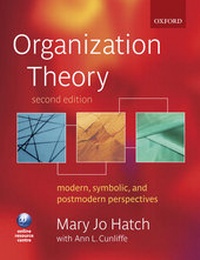
Organization Theory
Modern, Symbolic, and Postmodern Perspectives
2nd Edition
Published on 2. February 2006
Book
Paperback/Softback
400 pages
978-0-19-926021-8 (ISBN)
Description
Organization Theory offers a clear and comprehensive introduction to the study of organizations and organizing processes. It encourages an even-handed appreciation of the different perspectives contributing to our knowledge of organizations and challenges readers to broaden their intellectual reach. Organization Theory is in three parts: BL Part I introduces the multi-perspective approach. BL Part II presents many ways in which organizations can be analyzed - as entities within an environment, as social structures, technologies, cultures and physical structures, and as the products of power and political processes. BL Part III explores applications of organization theory to the practical matters of organizational design and change, and introduces the latest perspectives on the horizons of organization theory, including complex adaptive systems, organizational identity theory, critical realism, network theory, aesthetics, and organizational learning. Online Resource Centre For lecturers: PowerPoint slides, exam questions, teachig suggestions, a discussion forum, case studies and exercises with instructor's notes. For Students: annotated web links, and discussion questions.
Reviews / Votes
Organization Theory is unique among textbooks in organization and management. It is theoretically acurate, giving a comprehensive and up-to-date view of this dynamic, diverse and quickly developing field. In addition, the book is written in such a way that it encourages a reflexive stance towards both academic theory and organizational practices. We have used the book extensively in our undergraduate education, and it has proved to enrich students' understanding of this important field of theory and practice. Rolf Lind, Stolkholm University School of Business I very much welcome this second edition of Organization theory. As a textbook it is not only comprehensive and instructive but also original and evocative - it makes a significant contribution to the study of organizations. In particular the book demonstrates convincingly the advantages of taking a multiperspectival approach to organization theory. Taking the student through the complex literatures of modern, symbolic, and postmodern analysis it offers the reader a repetoire of new ways of understanding complex organisations. In my view it is a must for students of organization. John Hassard, Manchester University The instant success of Mary Jo Hatch's Organization Theory when it was first published in 1997 demonstrated that this text was badly needed... But even the best textbooks age, and therefore it is a great relief to see that Mary Jo Hatch continues to update her book. This is a livig text, which reports the most recent developments in organizational theory and practice, and both teachers and students can continue to use it with full confidence. Barbara Czarniawaska, Goteborg University Mary Jo Hatch;s textbook was brilliant the first time it was published. Now, revised jointly with Ann Cunliffe, it is even better. Hatch and cunliffe do not merely summarize major perspectives and trends in organization theory for the reader, They provide an organizing framework for making sense of it perplexing density, while, at the same time, being sensitive to the forced synthesis any integrative summarizing may entail. This is a marvellous textbook. Haridimos Tsoukas, Athens Laboratory of Business Administration (ALBA) and Warwick University Textbooks are supposed to icover the ground so that the student is introduced to a field or to an area. ncovering is much harder; uncovering involves the bringing in of innovative and marginalized knowledge to a field through exposure to perspectives that refresh and challenge it. Students who read this book should open their minds; by contrast, many textbooks in organization theory erect strict boundaries and manage foreclosures on contexts, politics and public issues. Theycover things. Hatch and Conliffe cover - but they also uncover. Stewart Clegg, University of Technology, SydneyMore details
Edition
2nd Revised edition
Language
English
Place of publication
Oxford
United Kingdom
Target group
College/higher education
This text is appropriate for second and third-year undergraduates and Master's level students on business, management and public administration courses as well as Ph.D students in the field of organization studies and organizational communication.
Edition type
Revised edition
Illustrations
Numerous tables and line drawings
Dimensions
Height: 246 mm
Width: 189 mm
Thickness: 22 mm
Weight
767 gr
ISBN-13
978-0-19-926021-8 (9780199260218)
Copyright in bibliographic data and cover images is held by Nielsen Book Services Limited or by the publishers or by their respective licensors: all rights reserved.
Schweitzer Classification
Other editions
New editions
Book
11/2012
3rd Edition
Oxford University Press
€63.13
Article is exhausted; no reprint
Previous edition

Mary Jo Hatch
Organization Theory
Book
05/1997
Oxford University Press
€37.13
Article exhausted; check for reprint
Content
I: WHAT IS ORGANIZATION THEORY?; 1. Why Study Organization Theory?; 2. A Brief History of Organization Theory; II: CORE CONCEPTS AND THEORIES; 3. Organization and Environment; 4. Organizational Social Structure; 5. Technology; 6. Organizational Culture; 7. The Physical Structure of Organizations; 8. Organizational Power, Control and Conflict; III: PRACTICAL ISSUES AND NEW DIRECTIONS IN ORGANIZATION THEORY; 9. Theory in Practice; 10. New Directions in Organization Theory