

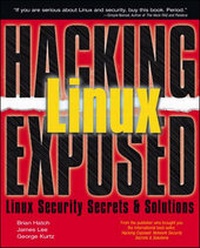
Hacking Linux Exposed
Published on 16. April 2001
Book
Paperback/Softback
566 pages
978-0-07-212773-7 (ISBN)
Description
Tighten holes and maintain security on your Linux system! From one of the authors of the international best-seller, Hacking Exposed: Network Security Secrets & Solutions, comes a must-have security handbook for anyone running Linux. This cutting-edge volume shows you how to think like a Linux hacker in order to beat the Linux hacker. You'll get detailed information on Linux-specific hacks, both internal and external, and how to stop them.
More details
Language
English
Place of publication
United States
Publishing group
McGraw-Hill Education - Europe
Target group
College/higher education
Professional and scholarly
Dimensions
Height: 231 mm
Width: 185 mm
Thickness: 34 mm
Weight
1233 gr
ISBN-13
978-0-07-212773-7 (9780072127737)
Copyright in bibliographic data and cover images is held by Nielsen Book Services Limited or by the publishers or by their respective licensors: all rights reserved.
Schweitzer Classification
Other editions
New editions
Brian Hatch | James Lee | George Kurtz
Hacking Exposed Linux
Book
12/2002
2nd Edition
McGraw-Hill Professional
€33.41
Article exhausted; check for reprint
Persons
Brian Hatch is a UNIX/Linux security consultant, administrator, and expert hacker with Onsight, Inc. He has taught various courses at Northwestern University and is the co-maintainer of Stunnel, a widely used secure SSL wrapper. He is the lead author of the first edition of Hacking Exposed Linux.
James Lee is a Perl hacker, Linux administrator, security consultant, and open source advocate. James is the founder and CEO of Onsight Inc., a consulting firm specializing in Perl training and web development. James is also a co-author of the first edition of Hacking Exposed Linux.
George Kurtz is co-founder and CEO of CrowdStrike, a cutting-edge big data security technology company focused on helping enterprises and governments protect their most sensitive intellectual property and national security information. George Kurtz is also an internationally recognized security expert, author, entrepreneur, and speaker. He has almost twenty years of experience in the security space and has helped hundreds of large organizations and government agencies around the world tackle the most demanding security problems. His entrepreneurial background and ability to commercialize nascent technologies has enabled him to drive innovation throughout his career by identifying market trends and correlating them with customer feedback, resulting in rapid growth for the businesses he has run. In 2011 George relinquished his role as McAfees Worldwide Chief Technology Officer to his co-author and raised $26M in venture capital to create CrowdStrike. During his tenure as McAfees CTO, Kurtz was responsible for driving the integrated security architectures and platforms across the entire McAfee portfolio. Kurtz also helped drive the acquisition strategy that allowed McAfee to grow from $1b in revenue in 2007 to over $2.5b in 2011. In one of the largest tech M&A deals in 2011, Intel (INTC) acquired McAfee for nearly $8b. Prior to joining McAfee, Kurtz was Chief Executive Officer and co-founder of Foundstone, Inc., which was acquired by McAfee in October 2004. You can follow George on Twitter @george_kurtz or his blog at http://www.securitybattlefield.com.
James Lee is a Perl hacker, Linux administrator, security consultant, and open source advocate. James is the founder and CEO of Onsight Inc., a consulting firm specializing in Perl training and web development. James is also a co-author of the first edition of Hacking Exposed Linux.
George Kurtz is co-founder and CEO of CrowdStrike, a cutting-edge big data security technology company focused on helping enterprises and governments protect their most sensitive intellectual property and national security information. George Kurtz is also an internationally recognized security expert, author, entrepreneur, and speaker. He has almost twenty years of experience in the security space and has helped hundreds of large organizations and government agencies around the world tackle the most demanding security problems. His entrepreneurial background and ability to commercialize nascent technologies has enabled him to drive innovation throughout his career by identifying market trends and correlating them with customer feedback, resulting in rapid growth for the businesses he has run. In 2011 George relinquished his role as McAfees Worldwide Chief Technology Officer to his co-author and raised $26M in venture capital to create CrowdStrike. During his tenure as McAfees CTO, Kurtz was responsible for driving the integrated security architectures and platforms across the entire McAfee portfolio. Kurtz also helped drive the acquisition strategy that allowed McAfee to grow from $1b in revenue in 2007 to over $2.5b in 2011. In one of the largest tech M&A deals in 2011, Intel (INTC) acquired McAfee for nearly $8b. Prior to joining McAfee, Kurtz was Chief Executive Officer and co-founder of Foundstone, Inc., which was acquired by McAfee in October 2004. You can follow George on Twitter @george_kurtz or his blog at http://www.securitybattlefield.com.
Content
Part I: Locking Into Linux. Chapter 1: Linux Security Overview. Chapter 2: Proactive Measures and Recovering from a Break-In. Chapter 3: Mapping Your Machine and Network. Part II: Getting in from the Outside. Chapter 4: Social Engineering, Trojans, and Other Hacker Trickery. Chapter 5: Physical Attacks. Chapter 6: Attacking Over the Network. Chapter 7: Abusing the Network Itself. Part III: Local User Attacks. Chapter 8: Elevating User Privileges. Chapter 9: Password Cracking. Chapter 10: How Hackers Maintain Access. Part IV: Server Issues. Chapter 11: Mail and FTP Security. Chapter 12: Web Servers and Dynamic Content. Chapter 13: Access Control and Firewalls. Part V: Appendices. Appendix A: Keeping Your Programs Current. Appendix B: Turning Off Unneeded Services. Appendix C: Online Resources. Appendix D: Case Studies.