

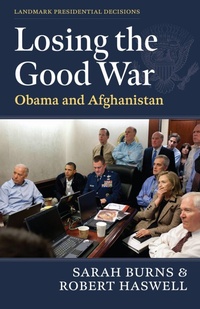
Losing the Good War
Description
A clear-eyed look at how political pressures and military influences led President Obama to significantly increase US involvement in the War in Afghanistan, even as the prospects for success seemed increasingly dim.
Barack Obama entered the White House in 2009 with a mandate to end the wars and occupations begun under George W. Bush. The American public and foreign policy–makers alike were ready to withdraw from these unpopular and unwieldy conflicts. While Obama fulfilled his campaign promises with the “bad war” in Iraq, the “good war” in Afghanistan followed a very different path.
Unlike his predecessor, Obama chose to prioritize South Asia as the focus of the United States military. Following a strategic review, Obama and his military advisors decided to replicate the Iraqi troop surge in Afghanistan, embarking on a labor-intensive counterinsurgency campaign. Unlike the Iraqi surge, however, Obama placed an eighteen-month limit on the increased troop deployment promising a withdrawal in the summer of 2011. Despite a revised strategy that emphasized training the Afghan forces, the Afghan units struggled to perform in a leadership role, remaining dependent on American airpower. These problems were compounded by the civilian side of the government that suffered from corruption and appeared illegitimate to much of the Afghan population.
After Obama withdrew troops, the Taliban began their resurgence in 2014. Around the same time the Islamic State emerged on the scene in Iraq and Syria, requiring new counterterrorism efforts that drained resources from Afghanistan and shifted the US focus back to the Middle East, leaving Afghanistan more vulnerable to local and international extremists. Peace talks with the Taliban broke down, and the war dragged on—becoming an unwinnable quagmire.
As part of the Landmark Presidential Decisions series, Losing the Good War analyzes how Obama’s campaign promises translated into policy, particularly the decision-making around the surge. Sarah Burns and Robert Haswell shine a light on this mishandled episode in US foreign policy.
More details
Persons
Sarah Burns is associate professor of political science at Rochester Institute of Technology. She is the author of The Politics of War Powers: The Theory and History of Presidential Unilateralism (Kansas, 2019).
Robert Haswell is a PhD candidate at Carleton University. He is researching the subject of counterinsurgency within American foreign policy during the Vietnam War and the War in Afghanistan.
Content
List of Abbreviations
Introduction: Obama and the Bush Wars
1. The Handover
2. The Strategy Review and the Year of White House Drama
3. A Small (Tape) Measure of Success
4. The View from NATO
5. The Rise of IS and the “End” of the Afghanistan War
Epilogue: Biden Goes to Kabul
Acknowledgments
Notes
Index