

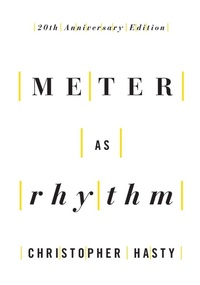
Meter as Rhythm
20th Anniversary Edition
Published on 22. June 2020
Book
Paperback/Softback
400 pages
978-0-19-088691-2 (ISBN)
Description
Drawing on insights from the modern "process" philosophy of Bergson, William James, and A. N. Whitehead, Christopher Hasty's Meter as Rhythm releases meter from its mechanistic connotations and recognizes it as a concrete, visceral agent of musical expression. Hasty reinterprets oppositions of law and freedom, structure and process, determinacy and indeterminacy to form a theory that engages diverse repertories and aesthetic issues. The revised 20th anniversary edition facilitates the work's current contexts of application, from new subfields in ethnomusicology and music cognition to non-music fields like literary studies, physics, and biology.
Reviews / Votes
[A] significant contribution to the study of the temporal aspects of music. * Choice * As a seminal text on the theory of temporality, Christopher Hasty's Meter As Rhythm remains relevant to music scholarship today. In fact I would argue it ismore relevant today than ever. Rhythm has become one of the most important subjects of study today, in music theory, popular music, and world music alike. * Nancy Yunhwa Rao, Professor of Music, Department of Music, Mason Gross School of the Arts, Rutgers University * Christopher Hasty'sMeter as Rhythmis a foundational text in contemporary music theory. Hasty's accomplishment - still unparalleled in any other existing study of meter, historical or contemporary - was to encourage a complete revision of our core beliefs concerning this musical phenomenon along the lines of process philosophy. With acute sensitivity to the history of ideas surrounding temporality and to the minutiae of music's phenomenal unfolding, Hasty's book offers a distinctive theory of meter. It is a document to which all subsequent theories of musical temporality must respond. * Roger Mathew Grant, Associate Professor of Music, Wesleyan University *More details
Language
English
Place of publication
New York
United States
Target group
College/higher education
Illustrations
121 line illus.
Dimensions
Height: 254 mm
Width: 178 mm
Thickness: 21 mm
Weight
739 gr
ISBN-13
978-0-19-088691-2 (9780190886912)
Copyright in bibliographic data and cover images is held by Nielsen Book Services Limited or by the publishers or by their respective licensors: all rights reserved.
Schweitzer Classification
Other editions
Additional editions
E-Book
04/2020
OUP eBook
€24.49
Available for download
E-Book
04/2020
OUP eBook
€24.49
Available for download
Person
Christopher Hasty's scholarly work engages problems in the theory and analysis of music from the 16th to the 20th centuries from the standpoint of process and experience. His book Meter as Rhythm (1997) won the Wallace Berry Award from the Society for Music Theory for the Outstanding Music Theory Book of the Year. His current research interests include process philosophy, poetic prosody, and ecological and post-cognitivist psychology.
Content
PART I
METER AND RHYTHM COMPOSED ONE
General Characterization of the Opposition Periodicity and the Denial of Taste
Rhythmic Experience
Period versus Pattern; Metrical Accent versus Rhythmic Accent TWO
Two Eighteenth-Century Views THREE
Evaluations of Rhythm and Meter FOUR
Distinctions of Rhythm and Meter in Three Influential American Studies FIVE
Discontinuity of Number and Continuity of Tonal "Motion" PART II
A THEORY OF METER AS PROCESS SIX
Preliminary Definitions:
Begining, End, and Duration
"Now"
Durational Determinacy SEVEN
Meter as Projection:
"Projection Defined"
Projection and Prediction EIGHT
Precedents for a Theory of Projection NINE
Some Traditional Questions of Meter Approached from the Perspective of Projective Process:
Accent
Division
Hierarchy
Anacrusis
Pulse and Beat
Metrical Types - Equal/Unequal TEN
Metrical Particularity:
Particularity and Reproduction
Two Examples ELEVEN
Obstacles to a View of Meter as Process:
Meter as Habit
"Large Scale Meter as Container (Hypermeter) TWELVE
The Limits of Meter:
The Durational "Extent" of Projection
The Efficacy of Meter
Some Small Examples THIRTEEN
Overlapping, End as Aim, Projective Types:
Overlapping
End as Aim
Projective Types FOURTEEN
Problems of Meter in Early-Seventeenth-Century and Twentieth-Century Music:
Monteverdi, "Oime, se tanto amate" (First Phase)
Shutz, "Adjuro vos, filiae Jerusalem"
Webern, Quartet, op. 22
Babbitt, Du SIXTEEN
The Spatialization of Time and the Eternal "Now Moment"
METER AND RHYTHM COMPOSED ONE
General Characterization of the Opposition Periodicity and the Denial of Taste
Rhythmic Experience
Period versus Pattern; Metrical Accent versus Rhythmic Accent TWO
Two Eighteenth-Century Views THREE
Evaluations of Rhythm and Meter FOUR
Distinctions of Rhythm and Meter in Three Influential American Studies FIVE
Discontinuity of Number and Continuity of Tonal "Motion" PART II
A THEORY OF METER AS PROCESS SIX
Preliminary Definitions:
Begining, End, and Duration
"Now"
Durational Determinacy SEVEN
Meter as Projection:
"Projection Defined"
Projection and Prediction EIGHT
Precedents for a Theory of Projection NINE
Some Traditional Questions of Meter Approached from the Perspective of Projective Process:
Accent
Division
Hierarchy
Anacrusis
Pulse and Beat
Metrical Types - Equal/Unequal TEN
Metrical Particularity:
Particularity and Reproduction
Two Examples ELEVEN
Obstacles to a View of Meter as Process:
Meter as Habit
"Large Scale Meter as Container (Hypermeter) TWELVE
The Limits of Meter:
The Durational "Extent" of Projection
The Efficacy of Meter
Some Small Examples THIRTEEN
Overlapping, End as Aim, Projective Types:
Overlapping
End as Aim
Projective Types FOURTEEN
Problems of Meter in Early-Seventeenth-Century and Twentieth-Century Music:
Monteverdi, "Oime, se tanto amate" (First Phase)
Shutz, "Adjuro vos, filiae Jerusalem"
Webern, Quartet, op. 22
Babbitt, Du SIXTEEN
The Spatialization of Time and the Eternal "Now Moment"