

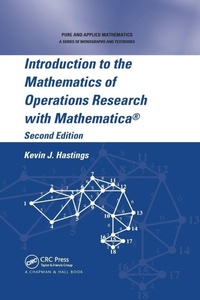
Introduction to the Mathematics of Operations Research with Mathematica (R)
2nd Edition
Published on 19. September 2019
Book
Paperback/Softback
588 pages
978-0-367-39078-5 (ISBN)
Description
The breadth of information about operations research and the overwhelming size of previous sources on the subject make it a difficult topic for non-specialists to grasp. Fortunately, Introduction to the Mathematics of Operations Research with Mathematica (R), Second Edition delivers a concise analysis that benefits professionals in operations research and related fields in statistics, management, applied mathematics, and finance.
The second edition retains the character of the earlier version, while incorporating developments in the sphere of operations research, technology, and mathematics pedagogy. Covering the topics crucial to applied mathematics, it examines graph theory, linear programming, stochastic processes, and dynamic programming. This self-contained text includes an accompanying electronic version and a package of useful commands. The electronic version is in the form of Mathematica notebooks, enabling you to devise, edit, and execute/reexecute commands, increasing your level of comprehension and problem-solving.
Mathematica sharpens the impact of this book by allowing you to conveniently carry out graph algorithms, experiment with large powers of adjacency matrices in order to check the path counting theorem and Markov chains, construct feasible regions of linear programming problems, and use the "dictionary" method to solve these problems. You can also create simulators for Markov chains, Poisson processes, and Brownian motions in Mathematica, increasing your understanding of the defining conditions of these processes. Among many other benefits, Mathematica also promotes recursive solutions for problems related to first passage times and absorption probabilities.
The second edition retains the character of the earlier version, while incorporating developments in the sphere of operations research, technology, and mathematics pedagogy. Covering the topics crucial to applied mathematics, it examines graph theory, linear programming, stochastic processes, and dynamic programming. This self-contained text includes an accompanying electronic version and a package of useful commands. The electronic version is in the form of Mathematica notebooks, enabling you to devise, edit, and execute/reexecute commands, increasing your level of comprehension and problem-solving.
Mathematica sharpens the impact of this book by allowing you to conveniently carry out graph algorithms, experiment with large powers of adjacency matrices in order to check the path counting theorem and Markov chains, construct feasible regions of linear programming problems, and use the "dictionary" method to solve these problems. You can also create simulators for Markov chains, Poisson processes, and Brownian motions in Mathematica, increasing your understanding of the defining conditions of these processes. Among many other benefits, Mathematica also promotes recursive solutions for problems related to first passage times and absorption probabilities.
More details
Edition
2nd edition
Language
English
Place of publication
Oxford
United Kingdom
Publishing group
Taylor & Francis Ltd
Target group
Professional and scholarly
Academic and Professional Practice & Development
Product notice
Paperback (trade)
Unsewn / adhesive bound
Dimensions
Height: 229 mm
Width: 150 mm
Thickness: 33 mm
Weight
839 gr
ISBN-13
978-0-367-39078-5 (9780367390785)
Copyright in bibliographic data and cover images is held by Nielsen Book Services Limited or by the publishers or by their respective licensors: all rights reserved.
Schweitzer Classification
Other editions
Additional editions
E-Book
10/2018
2nd Edition
Chapman & Hall/CRC
€72.49
Available for download
E-Book
10/2018
2nd Edition
Chapman & Hall/CRC
€72.49
Available for download
Book
05/2006
2nd Edition
Taylor & Francis
€267.66
Shipment within 15-20 days
Person
Hastings, Kevin J.
Content
Graph Theory and Network Analysis. Linear Programming. Further Topics in Linear Programming. Markov Chains. Continuous Time Processes. Dynamic Programming.