

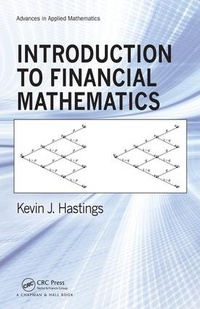
Introduction to Financial Mathematics
1st Edition
Published on 23. October 2015
Book
Hardback
422 pages
978-1-4987-2390-9 (ISBN)
Description
Introduction to Financial Mathematics is ideal for an introductory undergraduate course. Unlike most textbooks aimed at more advanced courses, the text motivates students through a discussion of personal finances and portfolio management. The author then goes on to cover valuation of financial derivatives in discrete time, using all of closed form, recursive, and simulation methods.
The text covers nearly all of the syllabus topics of the Financial Mathematics Actuarial examination, providing students with the foundation they require for future studies and throughout their careers. It begins by covering standard material on the mathematics of interest, including compound interest, present value, annuities, loans, several versions of the rate of return on an investment, and interest in continuous time.
The text explains how to value bonds at their issue dates, at coupon times, between coupon times, and in cases where the bonds are terminated early. Next, it supplies a rapid-fire overview of the main ideas and techniques of discrete probability, including sample spaces and probability measures, random variables and distributions, expectation, conditional probability, and independence.
The author introduces the basic terminology of stocks and stock trading. He also explains how to derive the rate of return on a portfolio and how to use the idea of risk aversion to model the investor tradeoff between risk and return. The text also discusses the estimation of parameters of asset models from real data.
The text closes with a detailed discussion of how to value financial derivatives using anti-arbitrage assumptions. The one-step and multi-step cases are covered, and exotic options such as barrier options are also introduced, to which simulation methods are applied.
Many of the examples in the book involve numerical solution of complicated non-linear equations; others ask students to produce algorithms which beg to be implemented as programs. For maximum flexibility, the author has produced the text without adhering to any particular computational platform.
A digital version of this text is also available in the form of Mathematica notebooks that contain additional content.
The text covers nearly all of the syllabus topics of the Financial Mathematics Actuarial examination, providing students with the foundation they require for future studies and throughout their careers. It begins by covering standard material on the mathematics of interest, including compound interest, present value, annuities, loans, several versions of the rate of return on an investment, and interest in continuous time.
The text explains how to value bonds at their issue dates, at coupon times, between coupon times, and in cases where the bonds are terminated early. Next, it supplies a rapid-fire overview of the main ideas and techniques of discrete probability, including sample spaces and probability measures, random variables and distributions, expectation, conditional probability, and independence.
The author introduces the basic terminology of stocks and stock trading. He also explains how to derive the rate of return on a portfolio and how to use the idea of risk aversion to model the investor tradeoff between risk and return. The text also discusses the estimation of parameters of asset models from real data.
The text closes with a detailed discussion of how to value financial derivatives using anti-arbitrage assumptions. The one-step and multi-step cases are covered, and exotic options such as barrier options are also introduced, to which simulation methods are applied.
Many of the examples in the book involve numerical solution of complicated non-linear equations; others ask students to produce algorithms which beg to be implemented as programs. For maximum flexibility, the author has produced the text without adhering to any particular computational platform.
A digital version of this text is also available in the form of Mathematica notebooks that contain additional content.
Reviews / Votes
Hastings (mathematics, Knox College) perceived a need for an introductory text to financial mathematics, and the result is an excellent book that superbly fits that niche. This clearly written work serves as a bridge to more advanced texts, such as the second edition of Capinski and Zastawniak's Mathematics for Finance: An Introduction to Financial Engineering (CH, Jun'11, 48-5740). In addition to its clear explanations, this volume emphasizes real problem solving with examples and exercises that challenge students to apply knowledge of basic concepts to new situations. Another unique aspect is the application of discrete probability to finance; the author provides an overview and illustrates problems in which the rates of interest are random variables, instead of traditional problems that consider only known constants. Topics covered include the mathematics of interest, valuation of bonds, discrete probability for finance, portfolio selection, and derivatives. Though the problems in this book can be solved with an advanced calculator, the author suggests using a computational platform, such as Mathematica. There is an electronic version of this text, which can be obtained as a Mathematica notebook. This book is highly recommended for undergraduates and those preparing for actuarial credentialing and exams.--S. J. Chapman Jr., Purdue University NorthWest
More details
Series
Language
English
Place of publication
Boca Raton
United States
Publishing group
Taylor & Francis Inc
Target group
College/higher education
Postgraduate
Illustrations
1 s/w Tabelle, 83 s/w Abbildungen
1 Tables, black and white; 83 Illustrations, black and white
Dimensions
Height: 234 mm
Width: 156 mm
Weight
725 gr
ISBN-13
978-1-4987-2390-9 (9781498723909)
Copyright in bibliographic data and cover images is held by Nielsen Book Services Limited or by the publishers or by their respective licensors: all rights reserved.
Schweitzer Classification
Other editions
New editions
Kevin J. Hastings
Introduction to Financial Mathematics
Book
11/2024
2nd Edition
Chapman & Hall/CRC
€122.50
Shipment within 10-20 days
Additional editions
Kevin J. Hastings
Introduction to Financial Mathematics
Book
10/2024
1st Edition
Chapman & Hall/CRC
€90.55
Article exhausted; check different version
Person
Kevin Hastings is Professor of Mathematics; Rothwell C. Stephens Distinguished Service Chair at Knox College. He holds a Ph.D. from Northwestern University. His interests include applications to real-world problems affected by random inputs or disturbances. He is the author or three other books for CRC Press:
Introduction to Probability with Mathematica, 2nd ed., Chapman & Hall/CRC Press, 2009.
Introduction to the Mathematics of Operations Research with Mathematica, 2nd edition, Taylor & Francis/Marcel Dekker, 2006.
Introduction to Probability with Mathematica. CRC Press/Chapman & Hall, November, 2000. Also issued electronically.
Introduction to Probability with Mathematica, 2nd ed., Chapman & Hall/CRC Press, 2009.
Introduction to the Mathematics of Operations Research with Mathematica, 2nd edition, Taylor & Francis/Marcel Dekker, 2006.
Introduction to Probability with Mathematica. CRC Press/Chapman & Hall, November, 2000. Also issued electronically.
Content
Theory of Interest. Bonds. Discrete Probability for Finance. Portfolio Theory. Valuation of Derivatives. Appendix: Answers to Selected Exercises. Bibliography. Index.