

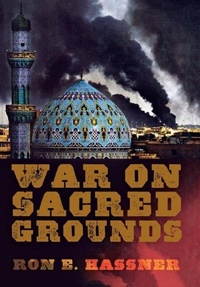
War on Sacred Grounds
Published on 15. September 2009
Book
Hardback
248 pages
978-0-8014-4806-5 (ISBN)
Description
Sacred sites offer believers the possibility of communing with the divine and achieving deeper insight into their faith. Yet their spiritual and cultural importance can lead to competition as religious groups seek to exclude rivals from practicing potentially sacrilegious rituals in the hallowed space and wish to assert their own claims. Holy places thus create the potential for military, theological, or political clashes, not only between competing religious groups but also between religious groups and secular actors.
In War on Sacred Grounds, Ron E. Hassner investigates the causes and properties of conflicts over sites that are both venerated and contested; he also proposes potential means for managing these disputes. Hassner illustrates a complex and poorly understood political dilemma with accounts of the failures to reach settlement at Temple Mount/Haram el-Sharif, leading to the clashes of 2000, and the competing claims of Hindus and Muslims at Ayodhya, which resulted in the destruction of the mosque there in 1992. He also addresses more successful compromises in Jerusalem in 1967 and Mecca in 1979. Sacred sites, he contends, are particularly prone to conflict because they provide valuable resources for both religious and political actors yet cannot be divided.
The management of conflicts over sacred sites requires cooperation, Hassner suggests, between political leaders interested in promoting conflict resolution and religious leaders who can shape the meaning and value that sacred places hold for believers. Because a reconfiguration of sacred space requires a confluence of political will, religious authority, and a window of opportunity, it is relatively rare. Drawing on the study of religion and the study of politics in equal measure, Hassner's account offers insight into the often-violent dynamics that come into play at the places where religion and politics collide.
In War on Sacred Grounds, Ron E. Hassner investigates the causes and properties of conflicts over sites that are both venerated and contested; he also proposes potential means for managing these disputes. Hassner illustrates a complex and poorly understood political dilemma with accounts of the failures to reach settlement at Temple Mount/Haram el-Sharif, leading to the clashes of 2000, and the competing claims of Hindus and Muslims at Ayodhya, which resulted in the destruction of the mosque there in 1992. He also addresses more successful compromises in Jerusalem in 1967 and Mecca in 1979. Sacred sites, he contends, are particularly prone to conflict because they provide valuable resources for both religious and political actors yet cannot be divided.
The management of conflicts over sacred sites requires cooperation, Hassner suggests, between political leaders interested in promoting conflict resolution and religious leaders who can shape the meaning and value that sacred places hold for believers. Because a reconfiguration of sacred space requires a confluence of political will, religious authority, and a window of opportunity, it is relatively rare. Drawing on the study of religion and the study of politics in equal measure, Hassner's account offers insight into the often-violent dynamics that come into play at the places where religion and politics collide.
Reviews / Votes
An important and engaging work. Hassner approaches the topic of sacred turf with refreshing new insights and perspectives.... He explores from a political science perspective why sacred places are contested and then examines why the 'indivisibility' of sacred sites makes them more problematic to solve than common territorial disputes.... The primary focus of the book then turns to the theory and practice of successful sharing of scared space as a result of direct involvement and input of religious leaders-something Hassner sees as missing from most negotiations-who in turn must work with their religious constituencies and with the political elite in reconfiguring sacred space.... We can only hope that political leaders in control of sacred spaces will read Hassner's book and that more religious leaders will then be included in peace negotiations so that they can creatively shape and reshape 'the meaning, value, and parameters of sacred space.- Chad F. Emmett (Middle East Journal) Ron Hassner's War on Sacred Grounds is a tour de force. It is, quite simply, the best book on religion and war I have read. It is not merely meticulously researched, theoretically interesting, and methodologically sophisticated, it is also extremely well written.... Hassner develops a framework for studying religious sites based on a site's 'vulnerability' and its 'centrality.' This enables him to estimate the importance of sites in the eyes of worshippers and evaluate the likelihood of conflict erupting over it. He draws on insights from both political science and the sociology of religion... in a careful and sober manner, and in a way that does neither discipline injustice.
- Havard Mokleiv Nygard (Journal of Peace Research) Sacred sites, as Hassner shows, have particular characteristics that may differentiate them from other strategic locations in times of conflict.... War on Sacred Grounds is an illuminating work that takes religious beliefs seriously while placing them within the context of strategic political action. It provides comparative politics with theoretical insights on a highly salient issue, supported by a rich and nuanced treatment of historical examples.
- Natan B. Sachs (Comparative Political Studies) This book would be a useful addition to courses on conflict resolution, religious violence, and the Israeli-Palestinian conflict (from which many examples are drawn). I also recommend it more generally as a thought-provoking book that is well written and informative.
(International Journal of Middle East Studies) This well-written, carefully researched study will be of special interest to students of religion and politics and is strongly recommended for all academic libraries. Summing Up: Highly recommended.
(CHOICE) The book contains a wealth of information about historically and spiritually significant shrines all over the world. The author goes into considerable detail in describing the course of conflicts among different religious groups; he asks pointed questions and gives appropriate answers. Anyone with an interest in holy places, especially Jews and Muslims, will find the book useful and interesting.
(The American Journal of Islamic Social Sciences)
More details
Language
English
Place of publication
Ithaca
United States
Product notice
Paper over boards
Illustrations
13 halftones - 13 Halftones, black and white
Dimensions
Height: 242 mm
Width: 165 mm
Thickness: 23 mm
Weight
486 gr
ISBN-13
978-0-8014-4806-5 (9780801448065)
Copyright in bibliographic data and cover images is held by Nielsen Book Services Limited or by the publishers or by their respective licensors: all rights reserved.
Schweitzer Classification
Other editions
Additional editions
Ron E. Hassner
War on Sacred Grounds
E-Book
12/2010
Cornell University Press
€9.49
Available for download
Person
Ron E. Hassner is Associate Professor of Political Science at the University of California, Berkeley. Visit his website at https://sites.google.com/view/ronhassner/about-me.
Content
Prologue: "A Terrifying and Fascinating Mystery"
1. On Sacred GroundsPART ONE: UNDERSTANDING CONFLICTS OVER SACRED SPACES
2. What Is Sacred Space?
3. The Indivisibility Problem
4. Conflict over Sacred Places
5. Mismanaging Conflicts over Sacred PlacesPART TWO: MANAGING CONFLICTS OVER SACRED SPACES
6. The Foundations and Limits of Religious Authority
7. Successful Conflict Management: Jerusalem, 1967
8. Successful Conflict Management: Mecca, 1979
9. Lessons from Conflicts over Sacred SpacesAcknowledgements
Notes
Index
1. On Sacred GroundsPART ONE: UNDERSTANDING CONFLICTS OVER SACRED SPACES
2. What Is Sacred Space?
3. The Indivisibility Problem
4. Conflict over Sacred Places
5. Mismanaging Conflicts over Sacred PlacesPART TWO: MANAGING CONFLICTS OVER SACRED SPACES
6. The Foundations and Limits of Religious Authority
7. Successful Conflict Management: Jerusalem, 1967
8. Successful Conflict Management: Mecca, 1979
9. Lessons from Conflicts over Sacred SpacesAcknowledgements
Notes
Index