

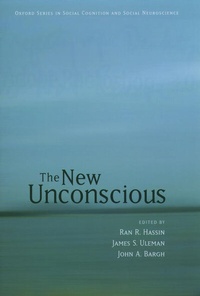
The New Unconscious
Published on 21. October 2004
Book
Hardback
604 pages
978-0-19-514995-1 (ISBN)
Description
Over the past two decades, a new picture of the cognitive unconscious has emerged from a variety of disciplines that are broadly part of cognitive science. According to this picture, unconscious processes seem to be capable of doing many things that were thought to require intention, deliberation, and conscious awareness. Moreover, they accomplish these things without the conflict and drama of the psychoanalytic unconscious. These processes range from complex information processing, through goal pursuit and emotions, to cognitive control and self-regulation. This collection of 20 original chapters by leading researchers examines the cognitive unconscious from social, cognitive, and neuroscientific viewpoints, presenting some of the most important developments at the heart of this new picture of the unconscious. The volume, the first book in the new Social Cognition and Social Neuroscience series, will be an important resource on the cognitive unconscious for researchers in cognitive psychology and neuroscience.
Reviews / Votes
The New Unconscious is...a fascinating read. It contains a mine of information that will not only interest philosophers of mind and psychology, but also prove relevant to explorations in naturalized epistemology and ethics. David Livingstone Smith, Mind JournalMore details
Language
English
Place of publication
New York
United States
Target group
Professional and scholarly
Researchers and students in neuroscience, cognitive science, and cognitive and social psychology
Illustrations
num. fig.
numerous figures
Dimensions
Height: 234 mm
Width: 156 mm
ISBN-13
978-0-19-514995-1 (9780195149951)
Copyright in bibliographic data and cover images is held by Nielsen Book Services Limited or by the publishers or by their respective licensors: all rights reserved.
Schweitzer Classification
Other editions
Additional editions
James S. Uleman John A. Bargh Ran R. Hassin
New Unconscious
E-Book
11/2004
1st Edition
Oxford University Press, UK
€83.29
Available for download
Ran R. Hassin | James S. Uleman | John A. Bargh
New Unconscious
E-Book
10/2004
1st Edition
Oxford University Press
€39.59
Available for download
Persons
Edited by Ran R. Hassin, Department of Psychology, The Hebrew University, Jerusalem, Israel, James S. Uleman, Department of Psychology, New York University, USA, and John A. Bargh, Department of Psychology, Yale University, USA
Content
Introduction: Becoming aware of the new unconscious; PART 1: FUNDAMENTAL QUESTIONS; 1. Who is the controller of controlled processes?; 2. Bypassing the will: towards demystifying the nonconsious control of social behaviour; PART 2: BASIC MECHANISMS; 3. The interaction of emotion and cognition: the relation between the human amygdala and cognitive awareness; 4. The power of the subliminal: on subliminal persuasion and other potential applications; 5. Nonintentional similarity processing; 6. The mechanics of imagination: automaticity and control in counterfactual thinking; 7. Compensatory automaticity: unconscious volition is not an oxymoron; 8. Non conscious control and implicit working memory; PART 3: INTENTION AND THEORY OF MIND; 9. Folk theory of mind: conceptual foundations of human social cognition; 10. The development of the intention concept: from the observable world to the unobservable mind; 11. Theory of mind: conscious attribution and spontaneous trait inference; PART 4: PERCEIVING AND ENGAGING OTHERS; 12. The glimpsed world: unintended communication and unintended perception; 13. Beyond the perception-behaviour link: the ubiquitous utility and motivational moderators of nonconscious mimicry; 14. Implicit impressions; 15. Attitudes as accessibility bias: dissociating automatic and controlled processes; 16. The unconscious relational self; PART 5: SELF REGULATION; 17. The control of the unwanted; 18. Motivational sources of unintended thought; 19. Going beyond the motivational given: self-control and situational control over behaviour