

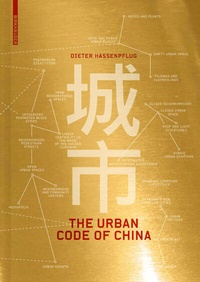
The Urban Code of China
1st Edition
Published on 23. September 2010
Book
Hardback
176 pages
978-3-0346-0572-4 (ISBN)
Description
When reading the Chinese city, which this book sets out to do, it is not the well-known cities such as Beijing, Shanghai, and Xi an that are in the focus of attention, but rather the essentially Chinese of the Chinese city, those characteristics or attributes that are more or less shared by all Chinese cities. The spotlight is on their spatial grammar, their syntax, in short: their code. Only by deciphering their common traits a view to the underlying structure of Chinese cities is opened, and we can begin to reasonably evaluate and classify the diversity of impressions. Deciphering the code of the Chinese city also enables the author to read new Chinese towns designed by Western architects. Thus, readers are provided with valuable insight on China s booming urbanization and urban development.
More details
Language
English
Place of publication
Basel/Berlin/Boston
Switzerland
Target group
Professional and scholarly
US School Grade: College Graduate Student
Edition type
New edition
Illustrations
1 s/w Abbildung, 101 farbige Abbildungen, 3 s/w Tabellen, 3 farbige Tabellen
1 b/w and 101 col. ill., 3 b/w and 3 col. tbl.
Dimensions
Height: 24 cm
Width: 17 cm
Weight
456 gr
ISBN-13
978-3-0346-0572-4 (9783034605724)
Schweitzer Classification
Other editions
Additional editions
E-Book
12/2012
1st Edition
Birkhäuser
€37.95
Available for download
Person
Content
Contents Acknowledgments Introduction 1 How to read a city? 2 Transformations of empty urban space Pajamas and clotheslines Open and public urban places Rocks and plants 3 Swinging lines and dancing dots 4 Closed urban space Closed neighborhoods Introverted neighborhood courtyards Roof and light sculptures Branding compound lifestyles Orient meets Occident -- hybrid urban quarters 5 Open urban space Linear centrality or the magic of the Golden Corridor Open neighborhood spaces Integrated perimeter block strips Neighborhood pedestrian streets Neighborhood and community centers The sutlers of urban growth Mediapolis Postmodern eclecticism in urban planning and design 6 Urban fictions Shanghai s new satellite cities A piece of good old Germany : Anting New Town European travesties of the Chinese city Taiwushi New Town (Thames Town) Luodian New Town (the Nordic city) Holland Village in Shenyang: an urban parody View from the Eiffel Tower towards Angkor Wat 7 The compact city Great street -- vertical block Shenzhen s urban villages The big city River jumping Hyper-growth 8 The Chinese city as a semiotic system Summary Annotations Bibliography Illustration credits