

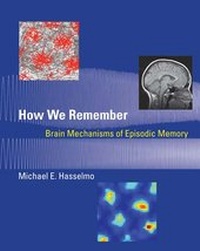
How We Remember
Brain Mechanisms of Episodic Memory
Published on 28. October 2011
Book
Hardback
384 pages
978-0-262-01635-3 (ISBN)
Description
Episodic memory proves essential for daily function, allowing us to remember where we
parked the car, what time we walked the dog, or what a friend said earlier. In How We
Remember, Michael Hasselmo draws on recent developments in neuroscience to present a new
model describing the brain mechanisms for encoding and remembering such events as spatiotemporal
trajectories. He reviews physiological breakthroughs on the regions implicated in episodic memory,
including the discovery of grid cells, the cellular mechanisms of persistent spiking and resonant
frequency, and the topographic coding of space and time. These discoveries inspire a theory for
understanding the encoding and retrieval of episodic memory not just as discrete snapshots but as a
dynamic replay of spatiotemporal trajectories, allowing us to "retrace our steps" to recover a
memory. In the main text of the book, he presents the model in narrative form, accessible to
scholars and advanced undergraduates in many fields. In the appendix, he presents the material in a
more quantitative style, providing mathematical descriptions appropriate for advanced undergraduates
and graduate students in neuroscience or engineering.
parked the car, what time we walked the dog, or what a friend said earlier. In How We
Remember, Michael Hasselmo draws on recent developments in neuroscience to present a new
model describing the brain mechanisms for encoding and remembering such events as spatiotemporal
trajectories. He reviews physiological breakthroughs on the regions implicated in episodic memory,
including the discovery of grid cells, the cellular mechanisms of persistent spiking and resonant
frequency, and the topographic coding of space and time. These discoveries inspire a theory for
understanding the encoding and retrieval of episodic memory not just as discrete snapshots but as a
dynamic replay of spatiotemporal trajectories, allowing us to "retrace our steps" to recover a
memory. In the main text of the book, he presents the model in narrative form, accessible to
scholars and advanced undergraduates in many fields. In the appendix, he presents the material in a
more quantitative style, providing mathematical descriptions appropriate for advanced undergraduates
and graduate students in neuroscience or engineering.
More details
Language
English
Place of publication
Cambridge, Mass.
United States
Publishing group
MIT Press Ltd
Target group
College/higher education
Interest Age: From 18 years
Illustrations
111 s/w Abbildungen, 8 farbige Bildtafeln
111 b&w illus., 8 color plates
Dimensions
Height: 229 mm
Width: 178 mm
Thickness: 0 mm
Weight
907 gr
ISBN-13
978-0-262-01635-3 (9780262016353)
Copyright in bibliographic data and cover images is held by Nielsen Book Services Limited or by the publishers or by their respective licensors: all rights reserved.
Schweitzer Classification
Other editions
Additional editions
Book
08/2013
MIT Press
€108.30
Article exhausted; check different version
Person
Michael Hasselmo is Professor of Psychology and Director of the Computational Neurophysiology Laboratory at Boston University, where he is also a faculty member in the Center for Memory and Brain and the Program in Neuroscience and principal investigator on grants from the National Institute of Mental Health and the Office of Naval Research