

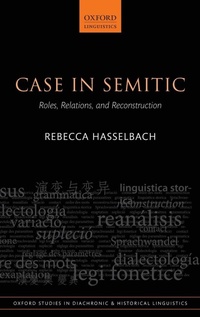
Case in Semitic
Roles, Relations, and Reconstruction
Published on 2. May 2013
Book
Hardback
370 pages
978-0-19-967180-9 (ISBN)
Description
This book sets out a new reconstruction for the Semitic case system. It is based on a detailed analysis of the expression of grammatical roles and relations in the attested Semitic languages and, for the first time, brings typological methods to bear in the study of these features in Semitic languages and their reconstruction for proto-Semitic. Professor Hasselbach supports her argument with detailed analyses of a wide range of data and presents it in a way that will be accessible to both Semitists and typologists.
The volume is divided into seven chapters: the first discusses basic methodologies used in Semitic linguistics and the limitations thereof. The second presents the evidence for morphological case-marking in the individual Semitic languages, the conventional reconstruction of Proto-Semitic, and the evidence which conflicts with it. The third introduces typological concepts and methods and their deployment in Semitic. Chapter 4 considers the case alignment of early Semitic. Chapter 5 presents a detailed study of marking structures and patterns and considers what these reveal about the nature of the original case system. Chapter 6 looks at the functions of case markers, considers the light they cast on the nominal system, and shows that the reconstruction of early Semitic as ergative is implausible. In the final chapter the author argues that early Semitic had a different nominal system from that of the later Semitic languages. She shows that the course of its development has parallels in other Afroasiatic languages, including Berber and Cushitic. Her book sheds important new light on the history of the Semitic languages and on the early development of the Afro-Asiatic language family as a whole.
The volume is divided into seven chapters: the first discusses basic methodologies used in Semitic linguistics and the limitations thereof. The second presents the evidence for morphological case-marking in the individual Semitic languages, the conventional reconstruction of Proto-Semitic, and the evidence which conflicts with it. The third introduces typological concepts and methods and their deployment in Semitic. Chapter 4 considers the case alignment of early Semitic. Chapter 5 presents a detailed study of marking structures and patterns and considers what these reveal about the nature of the original case system. Chapter 6 looks at the functions of case markers, considers the light they cast on the nominal system, and shows that the reconstruction of early Semitic as ergative is implausible. In the final chapter the author argues that early Semitic had a different nominal system from that of the later Semitic languages. She shows that the course of its development has parallels in other Afroasiatic languages, including Berber and Cushitic. Her book sheds important new light on the history of the Semitic languages and on the early development of the Afro-Asiatic language family as a whole.
More details
Series
Language
English
Place of publication
Oxford
United Kingdom
Target group
College/higher education
Professional and scholarly
Dimensions
Height: 240 mm
Width: 161 mm
Thickness: 24 mm
Weight
719 gr
ISBN-13
978-0-19-967180-9 (9780199671809)
Copyright in bibliographic data and cover images is held by Nielsen Book Services Limited or by the publishers or by their respective licensors: all rights reserved.
Schweitzer Classification
Other editions
Additional editions

Kasia M. Jaszczolt | Louis De Saussure
Time: Language, Cognition & Reality
Roles, Relations, and Reconstruction
E-Book
05/2013
1st Edition
OUP eBook
€77.49
Available for download
Person
Rebecca Hasselbach has been Assistant Professor of Comparative Semitics, University of Chicago, since 2005, before which she was Preceptor for Semitic Philology at Harvard. Her publications include Sargonic Akkadian: A Historical and Comparative Study of the Syllabic Texts (Wiesbaden: Harrassowitz, 2005).
Content
Abbreviations ; 1. Introduction ; 2. The Semitic case system: basic evidence and traditional reconstruction ; 3. Linguistic Typology ; 4. Grammatical roles and the alignment of Semitic ; 5. Head- and dependent-marking in Semitic ; 6. The function of case markers in Semitic ; 7. Conclusions ; Bibliography ; Indexes of names and subjects