

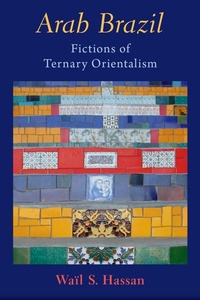
Arab Brazil
Fictions of Ternary Orientalism
Published on 19. June 2024
Book
Hardback
344 pages
978-0-19-768876-2 (ISBN)
Description
Arab-Brazilian relations have been largely invisible to area studies and Comparative Literature scholarship. Arab Brazil is the first book of its kind to highlight the representation of Arab and Muslim immigrants in Brazilian literature and popular culture since the early twentieth century, revealing anxieties and contradictions in the country's ideologies of national identity.
Author Wail S. Hassan analyzes these representations in a century of Brazilian novels, short stories, and telenovelas. He shows how the Arab East works paradoxically as a site of otherness (different language, culture, and religion) and solidarity (cultural, historical, demographic, and geopolitical ties). Hassan explores the differences between colonial Orientalism's binary structure of Self/Other, East/West, and colonizer/colonized, on the one hand; and on the other hand Brazilian Orientalism's ternary structure, which defines the country's identity in relation to both North and East.
Author Wail S. Hassan analyzes these representations in a century of Brazilian novels, short stories, and telenovelas. He shows how the Arab East works paradoxically as a site of otherness (different language, culture, and religion) and solidarity (cultural, historical, demographic, and geopolitical ties). Hassan explores the differences between colonial Orientalism's binary structure of Self/Other, East/West, and colonizer/colonized, on the one hand; and on the other hand Brazilian Orientalism's ternary structure, which defines the country's identity in relation to both North and East.
Reviews / Votes
Arab Brazil is a theoretically sophisticated and elegantly written assessment of what Brazilian and Arab-Brazilian writings and television tell us about how Brazilian culture understands the Arab world and how the presence of Brazilians of Arab origin highlights the limits of the Brazilian ideal of mistura. On the one hand, Hassan's study astutely explains Brazilian Orientalism as one that is ternary, in the sense that it is not based on binary opposition, but on a triangulation in which Europe and North America remain at the apex. On the other hand, this book demonstrates that many of the manifestations of Brazilian Arabness, whether mathematics textbooks, novels, or television series, due to their stereotyping and Islamophobia, point to the fact that mistura is still only aspirational. * Christina Civantos, University of Miami * Wail Hassan argues that Arab Brazilians feel effects of a ternary Orientalism, which adds the Global South to the standard Brazil-Europe post-colonial sphere. While deep ancient roots of Arabic culture and language in Iberia gave Arab immigrants to Brazil a special status, promoted by novelist Jorge Amado, other authors repeated images of European Orientalism to exoticize them, thereby disrupting a national self-definition based on mixture and assimilation. Hassan brilliantly follows their fictional portrayal from early Arab Brazilian novelists to prominent works by major novelists including Raduan Nassar, Milton Hatoum, Nelida Pinon, and Alberto Mussa. Arab Brazil brings the wide range of Arab immigrants into the center of Brazilian literary and social history. * Kenneth David Jackson, Yale University * It is hard to overstate the value and significance of Wail Hassan's fine new book. By bringing a rigorous comparative perspective to the critical study of the enduring and salient presence of Islam and Arabic culture in the literary and popular cultural production of a majority Catholic country spanning the last one hundred years, Hassan crucially addresses a long-standing scholarly gap in literary studies. But Arab Brazil goes considerably beyond filling a scholarly gap. It succeeds in moving both Luso-Brazilian and postcolonial literary and cultural studies in a provocative new direction by incisively exploring the fundamentally different form that "Orientalism" assumes in Brazil. Hassan's book will prove of inestimable value not only to scholars of Luso-Brazilian literary cultural studies but postcolonial studies more generally. * Luis Madureira, University of Wisconsin-Madison *More details
Language
English
Place of publication
New York
United States
Target group
College/higher education
Product notice
sewn/stitched
Cloth over boards
Dimensions
Height: 221 mm
Width: 150 mm
Thickness: 30 mm
Weight
635 gr
ISBN-13
978-0-19-768876-2 (9780197688762)
Copyright in bibliographic data and cover images is held by Nielsen Book Services Limited or by the publishers or by their respective licensors: all rights reserved.
Schweitzer Classification
Other editions
Additional editions
E-Book
03/2024
OUP eBook
€57.99
Available for download
E-Book
03/2024
OUP eBook
€57.99
Available for download
Person
Wail S. S. Hassan is Professor of Comparative Literature at the University of Illinois Urbana-Champaign. Among other books, he is the author of Immigrant Narratives: Orientalism and Cultural Translation in Arab American and Arab British Literature, editor of The Oxford Handbook of Arab Novelistic Traditions, and Portuguese-to-Arabic translator of Alberto Mussa's Lughz al-qaf. Hassan is a past president of the American Comparative Literature Association.
Content
Note on Translation and Transliteration
Acknowledgments
Introduction: Mistura and Ternary Orientalism
1. Oriental Wisdom: Malba Tahan and Humberto de Campos
2. Merchants to Landowners: Cecilio Carneiro and Perminio Asfora
3. Arab Bahia: Jorge Amado
4. Parable of Integration: Raduan Nassar
5. Amazonian Orient: Milton Hatoum
6. Feline Mermaid: Ana Miranda
7. Islam on Primetime TV: O Clone
8. Shahrazad in the Tropics: Nelida Pinon
9. Brazilian Mu'allaqa: Alberto Mussa
10. Al-Andalus Re-Imagined: Gilberto Abrao and Joao Almino
11. Syrian Refugees: Orfaos da terra
Conclusion: It's All in the Kibbeh
Works Cited
Index
Acknowledgments
Introduction: Mistura and Ternary Orientalism
1. Oriental Wisdom: Malba Tahan and Humberto de Campos
2. Merchants to Landowners: Cecilio Carneiro and Perminio Asfora
3. Arab Bahia: Jorge Amado
4. Parable of Integration: Raduan Nassar
5. Amazonian Orient: Milton Hatoum
6. Feline Mermaid: Ana Miranda
7. Islam on Primetime TV: O Clone
8. Shahrazad in the Tropics: Nelida Pinon
9. Brazilian Mu'allaqa: Alberto Mussa
10. Al-Andalus Re-Imagined: Gilberto Abrao and Joao Almino
11. Syrian Refugees: Orfaos da terra
Conclusion: It's All in the Kibbeh
Works Cited
Index