

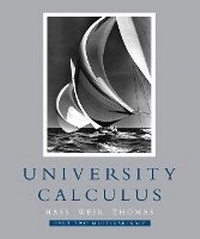
University Calculus, Part Two (Multivariable, Chap 8-14)
Published on 17. April 2008
Book
Paperback/Softback
528 pages
978-0-321-45421-8 (ISBN)
Description
Calculus hasn't changed, but your students have. Many of today's students have seen calculus before at the high school level. However, professors report nationwide that students come into their calculus courses with weak backgrounds in algebra and trigonometry, two areas of knowledge vital to the mastery of calculus. University Calculus, Part Two responds to the needs of today's students by developing their conceptual understanding while maintaining a rigor appropriate to the calculus course.
University Calculus, Part Two is suitable for the multivariable calculus course. The Alternate Edition is the perfect alternative for instructors who want the same quality and quantity of exercises as Thomas' Calculus, Media Upgrade, Eleventh Edition but prefer a faster-paced presentation.
University Calculus is now available with an enhanced MyMathLab (TM) course-the ultimate homework, tutorial and study solution for today's students. The enhanced MyMathLab (TM) course includes a rich and flexible set of course materials and features innovative Java (TM) Applets, Group Projects, and new MathXL (R) exercises. This text is also available with WebAssign (R) and WeBWorK (R).
University Calculus, Part Two is suitable for the multivariable calculus course. The Alternate Edition is the perfect alternative for instructors who want the same quality and quantity of exercises as Thomas' Calculus, Media Upgrade, Eleventh Edition but prefer a faster-paced presentation.
University Calculus is now available with an enhanced MyMathLab (TM) course-the ultimate homework, tutorial and study solution for today's students. The enhanced MyMathLab (TM) course includes a rich and flexible set of course materials and features innovative Java (TM) Applets, Group Projects, and new MathXL (R) exercises. This text is also available with WebAssign (R) and WeBWorK (R).
More details
Language
English
Place of publication
United States
Publishing group
Pearson Education (US)
Target group
Professional and scholarly
College/higher education
Dimensions
Height: 225 mm
Width: 255 mm
Thickness: 19 mm
Weight
1021 gr
ISBN-13
978-0-321-45421-8 (9780321454218)
Copyright in bibliographic data and cover images is held by Nielsen Book Services Limited or by the publishers or by their respective licensors: all rights reserved.
Schweitzer Classification
Other editions
New editions
Joel R. Hass | Maurice D. Weir | George B. Thomas
University Calculus
Early Transcendentals, Multivariable
Book
08/2011
2nd Edition
Pearson
€100.27
Article exhausted; check for reprint
Persons
Joel Hass received his PhD from the University of California-Berkeley. He is currently a professor of mathematics at the University of California-Davis. He has coauthored six widely used calculus texts as well as two calculus study guides. He is currently on the editorial board of Geometriae Dedicata and Media-Enhanced Mathematics. He has been a member of the Institute for Advanced Study at Princeton University and of the Mathematical Sciences Research Institute, and he was a Sloan Research Fellow. Hass's current areas of research include the geometry of proteins, three dimensional manifolds, applied math, and computational complexity. In his free time, Hass enjoys kayaking.
Maurice D. Weir holds a DA and MS from Carnegie-Mellon University and received his BS at Whitman College. He is a Professor Emeritus of the Department of Applied Mathematics at the Naval Postgraduate School in Monterey, California. Weir enjoys teaching Mathematical Modeling and Differential Equations. His current areas of research include modeling and simulation as well as mathematics education. Weir has been awarded the Outstanding Civilian Service Medal, the Superior Civilian Service Award, and the Schieffelin Award for Excellence in Teaching. He has coauthored eight books, including the University Calculus series and the twelfth edition of Thomas' Calculus.
George B. Thomas, Jr. (late) of the Massachusetts Institute of Technology, was a professor of mathematics for thirty-eight years; he served as the executive officer of the department for ten years and as graduate registration officer for five years. Thomas held a spot on the board of governors of the Mathematical Association of America and on the executive committee of the mathematics division of the American Society for Engineering Education. His book, Calculus and Analytic Geometry, was first published in 1951 and has since gone through multiple revisions. The text is now in its twelfth edition and continues to guide students through their calculus courses. He also co-authored monographs on mathematics, including the text Probability and Statistics.
Maurice D. Weir holds a DA and MS from Carnegie-Mellon University and received his BS at Whitman College. He is a Professor Emeritus of the Department of Applied Mathematics at the Naval Postgraduate School in Monterey, California. Weir enjoys teaching Mathematical Modeling and Differential Equations. His current areas of research include modeling and simulation as well as mathematics education. Weir has been awarded the Outstanding Civilian Service Medal, the Superior Civilian Service Award, and the Schieffelin Award for Excellence in Teaching. He has coauthored eight books, including the University Calculus series and the twelfth edition of Thomas' Calculus.
George B. Thomas, Jr. (late) of the Massachusetts Institute of Technology, was a professor of mathematics for thirty-eight years; he served as the executive officer of the department for ten years and as graduate registration officer for five years. Thomas held a spot on the board of governors of the Mathematical Association of America and on the executive committee of the mathematics division of the American Society for Engineering Education. His book, Calculus and Analytic Geometry, was first published in 1951 and has since gone through multiple revisions. The text is now in its twelfth edition and continues to guide students through their calculus courses. He also co-authored monographs on mathematics, including the text Probability and Statistics.
Content
8 Infinite Sequences and Series
8.1 Sequences 502
8.2 Infinite Series 515
8.3 The Integral Test 523
8.4 Comparison Tests 529
8.5 The Ratio and Root Tests 533
8.6 Alternating Series, Absolute and Conditional Convergence 537
8.7 Power Series 543
8.8 Taylor and Maclaurin Series 553
8.9 Convergence of Taylor Series 559
8.10 The Binomial Series 569
QUESTIONS TO GUIDE YOUR REVIEW 572
PRACTICE EXERCISES 573
ADDITIONAL AND ADVANCED EXERCISES 575
9 Polar Coordinates and Conics
9.1 Polar Coordinates 577
9.2 Graphing in Polar Coordinates 582
9.3 Areas and Lengths in Polar Coordinates 586
9.4 Conic Sections 590
9.5 Conics in Polar Coordinates 599
9.6 Conics and Parametric Equations; The Cycloid 606
QUESTIONS TO GUIDE YOUR REVIEW 610
PRACTICE EXERCISES 610
ADDITIONAL AND ADVANCED EXERCISES 612
10 Vectors and the Geometry of Space
10.1 Three-Dimensional Coordinate Systems 614
10.2 Vectors 619
10.3 The Dot Product 628
10.4 The Cross Product 636
10.5 Lines and Planes in Space 642
10.6 Cylinders and Quadric Surfaces 652
QUESTIONS TO GUIDE YOUR REVIEW 657
PRACTICE EXERCISES 658
ADDITIONAL AND ADVANCED EXERCISES 660
11 Vector-Valued Functions and Motion in Space
11.1 Vector Functions and Their Derivatives 663
11.2 Integrals of Vector Functions 672
11.3 Arc Length in Space 678
11.4 Curvature of a Curve 683
11.5 Tangential and Normal Components of Acceleration 689
11.6 Velocity and Acceleration in Polar Coordinates 694
QUESTIONS TO GUIDE YOUR REVIEW 698
PRACTICE EXERCISES 698
ADDITIONAL AND ADVANCED EXERCISES 700
12 Partial Derivatives
12.1 Functions of Several Variables 702
12.2 Limits and Continuity in Higher Dimensions 711
12.3 Partial Derivatives 719
12.4 The Chain Rule 731
12.5 Directional Derivatives and Gradient Vectors 739
12.6 Tangent Planes and Differentials 747
12.7 Extreme Values and Saddle Points 756
12.8 Lagrange Multipliers 765
12.9 Taylor's Formula for Two Variables 775
QUESTIONS TO GUIDE YOUR REVIEW 779
PRACTICE EXERCISES 780
ADDITIONAL AND ADVANCED EXERCISES 783
13 Multiple Integrals
13.1 Double and Iterated Integrals over Rectangles 785
13.2 Double Integrals over General Regions 790
13.3 Area by Double Integration 799
13.4 Double Integrals in Polar Form 802
13.5 Triple Integrals in Rectangular Coordinates 807
13.6 Moments and Centers of Mass 816
13.7 Triple Integrals in Cylindrical and Spherical Coordinates 825
13.8 Substitutions in Multiple Integrals 837
QUESTIONS TO GUIDE YOUR REVIEW 846
PRACTICE EXERCISES 846
ADDITIONAL AND ADVANCED EXERCISES 848
14 Integration in Vector Fields
14.1 Line Integrals 851
14.2 Vector Fields, Work, Circulation, and Flux 856
14.3 Path Independence, Potential Functions, and Conservative Fields 867
14.4 Green's Theorem in the Plane 877
14.5 Surfaces and Area 887
14.6 Surface Integrals and Flux 896
14.7 Stokes'Theorem 905
14.8 The Divergence Theorem and a Unified Theory 914
QUESTIONS TO GUIDE YOUR REVIEW 925
PRACTICE EXERCISES 925
ADDITIONAL AND ADVANCED EXERCISES 928
Appendices AP-1
A.1 Real Numbers and the Real Line AP-1
A.2 Mathematical Induction AP-7
A.3 Lines, Circles, and Parabolas AP-10
A.4 Trigonometry Formulas AP-19
A.5 Proofs of Limit Theorems AP-21
A.6 Commonly Occurring Limits AP-25
A.7 Theory of the Real Numbers AP-26
A.8 The Distributive Law for Vector Cross Products AP-29
A.9 The Mixed Derivative Theorem and the Increment Theorem AP-30
8.1 Sequences 502
8.2 Infinite Series 515
8.3 The Integral Test 523
8.4 Comparison Tests 529
8.5 The Ratio and Root Tests 533
8.6 Alternating Series, Absolute and Conditional Convergence 537
8.7 Power Series 543
8.8 Taylor and Maclaurin Series 553
8.9 Convergence of Taylor Series 559
8.10 The Binomial Series 569
QUESTIONS TO GUIDE YOUR REVIEW 572
PRACTICE EXERCISES 573
ADDITIONAL AND ADVANCED EXERCISES 575
9 Polar Coordinates and Conics
9.1 Polar Coordinates 577
9.2 Graphing in Polar Coordinates 582
9.3 Areas and Lengths in Polar Coordinates 586
9.4 Conic Sections 590
9.5 Conics in Polar Coordinates 599
9.6 Conics and Parametric Equations; The Cycloid 606
QUESTIONS TO GUIDE YOUR REVIEW 610
PRACTICE EXERCISES 610
ADDITIONAL AND ADVANCED EXERCISES 612
10 Vectors and the Geometry of Space
10.1 Three-Dimensional Coordinate Systems 614
10.2 Vectors 619
10.3 The Dot Product 628
10.4 The Cross Product 636
10.5 Lines and Planes in Space 642
10.6 Cylinders and Quadric Surfaces 652
QUESTIONS TO GUIDE YOUR REVIEW 657
PRACTICE EXERCISES 658
ADDITIONAL AND ADVANCED EXERCISES 660
11 Vector-Valued Functions and Motion in Space
11.1 Vector Functions and Their Derivatives 663
11.2 Integrals of Vector Functions 672
11.3 Arc Length in Space 678
11.4 Curvature of a Curve 683
11.5 Tangential and Normal Components of Acceleration 689
11.6 Velocity and Acceleration in Polar Coordinates 694
QUESTIONS TO GUIDE YOUR REVIEW 698
PRACTICE EXERCISES 698
ADDITIONAL AND ADVANCED EXERCISES 700
12 Partial Derivatives
12.1 Functions of Several Variables 702
12.2 Limits and Continuity in Higher Dimensions 711
12.3 Partial Derivatives 719
12.4 The Chain Rule 731
12.5 Directional Derivatives and Gradient Vectors 739
12.6 Tangent Planes and Differentials 747
12.7 Extreme Values and Saddle Points 756
12.8 Lagrange Multipliers 765
12.9 Taylor's Formula for Two Variables 775
QUESTIONS TO GUIDE YOUR REVIEW 779
PRACTICE EXERCISES 780
ADDITIONAL AND ADVANCED EXERCISES 783
13 Multiple Integrals
13.1 Double and Iterated Integrals over Rectangles 785
13.2 Double Integrals over General Regions 790
13.3 Area by Double Integration 799
13.4 Double Integrals in Polar Form 802
13.5 Triple Integrals in Rectangular Coordinates 807
13.6 Moments and Centers of Mass 816
13.7 Triple Integrals in Cylindrical and Spherical Coordinates 825
13.8 Substitutions in Multiple Integrals 837
QUESTIONS TO GUIDE YOUR REVIEW 846
PRACTICE EXERCISES 846
ADDITIONAL AND ADVANCED EXERCISES 848
14 Integration in Vector Fields
14.1 Line Integrals 851
14.2 Vector Fields, Work, Circulation, and Flux 856
14.3 Path Independence, Potential Functions, and Conservative Fields 867
14.4 Green's Theorem in the Plane 877
14.5 Surfaces and Area 887
14.6 Surface Integrals and Flux 896
14.7 Stokes'Theorem 905
14.8 The Divergence Theorem and a Unified Theory 914
QUESTIONS TO GUIDE YOUR REVIEW 925
PRACTICE EXERCISES 925
ADDITIONAL AND ADVANCED EXERCISES 928
Appendices AP-1
A.1 Real Numbers and the Real Line AP-1
A.2 Mathematical Induction AP-7
A.3 Lines, Circles, and Parabolas AP-10
A.4 Trigonometry Formulas AP-19
A.5 Proofs of Limit Theorems AP-21
A.6 Commonly Occurring Limits AP-25
A.7 Theory of the Real Numbers AP-26
A.8 The Distributive Law for Vector Cross Products AP-29
A.9 The Mixed Derivative Theorem and the Increment Theorem AP-30