

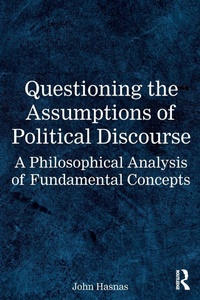
Questioning the Assumptions of Political Discourse
A Philosophical Analysis of Fundamental Concepts
1st Edition
Published on 29. June 2025
Book
Paperback/Softback
152 pages
978-1-032-86236-1 (ISBN)
Description
Much of our contemporary political discourse rests on unquestioned assumptions. This book questions these underlying assumptions and then offers new, unconventional answers.
Disputes over how to use government power assume that the use of government power is morally justified. Arguments over voting and the scope of democratic government assume that democracy is coherent form of government. Disputes over whether certain actions violate the rule of law assume that the rule of law is a genuine political value. Arguments over the scope of discrimination and affirmative action assume that there is an anti-discrimination principle that applies to all parties. And arguments over how to punish corporations assume that corporations can and should be punished.
Each chapter of the book addresses one of these assumptions, and each is designed to serve both an educational and an argumentative purpose. Each begins with the educational aspect by providing the reader with necessary background information and a description of the current state of intellectual debate on the relevant subject. The chapter then proceeds to the argumentative stage by identifying the assumption upon which this debate rests, presenting reasons to believe that it is false, and presenting an alternative resolution to the debate.
Disputes over how to use government power assume that the use of government power is morally justified. Arguments over voting and the scope of democratic government assume that democracy is coherent form of government. Disputes over whether certain actions violate the rule of law assume that the rule of law is a genuine political value. Arguments over the scope of discrimination and affirmative action assume that there is an anti-discrimination principle that applies to all parties. And arguments over how to punish corporations assume that corporations can and should be punished.
Each chapter of the book addresses one of these assumptions, and each is designed to serve both an educational and an argumentative purpose. Each begins with the educational aspect by providing the reader with necessary background information and a description of the current state of intellectual debate on the relevant subject. The chapter then proceeds to the argumentative stage by identifying the assumption upon which this debate rests, presenting reasons to believe that it is false, and presenting an alternative resolution to the debate.
More details
Language
English
Place of publication
London
United Kingdom
Publishing group
Taylor & Francis Ltd
Target group
College/higher education
Professional and scholarly
Academic, Postgraduate, Undergraduate Advanced, and Undergraduate Core
Dimensions
Height: 229 mm
Width: 152 mm
Thickness: 9 mm
Weight
245 gr
ISBN-13
978-1-032-86236-1 (9781032862361)
Copyright in bibliographic data and cover images is held by Nielsen Book Services Limited or by the publishers or by their respective licensors: all rights reserved.
Schweitzer Classification
Other editions
Additional editions
John Hasnas
Questioning the Assumptions of Political Discourse
A Philosophical Analysis of Fundamental Concepts
E-Book
06/2025
1st Edition
Routledge
€55.49
Available for download
John Hasnas
Questioning the Assumptions of Political Discourse
A Philosophical Analysis of Fundamental Concepts
E-Book
06/2025
1st Edition
Routledge
€55.49
Available for download

John Hasnas
Questioning the Assumptions of Political Discourse
A Philosophical Analysis of Fundamental Concepts
Book
06/2025
1st Edition
Routledge
€207.10
Shipment within 10-20 days
Person
John Hasnas is Professor of Ethics at the McDonough School of Business and Professor of Law (by courtesy) at Georgetown University, USA. He is also the Executive Director of the Georgetown Institute for the Study of Markets and Ethics. His recent books include Common Law Liberalism (2024) and Better Ethics for Better Behavior (2021).
Content
Introduction 1. Is the Fundamental Argument for the State Unsound? 2. Does Anyone Actually Believe in Democracy? 3. Is the Rule of Law an Important Political Value 4. Is the Popular Conception of the Rule of Law a Myth? 5. Is There an Ethical Basis for Anti-discrimination Law? 6. Should Corporations be Punished? Conclusion.