

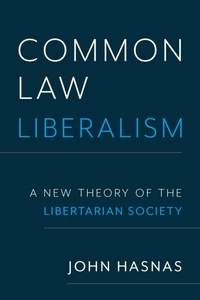
Common Law Liberalism
A New Theory of the Libertarian Society
Published on 23. December 2024
Book
Hardback
328 pages
978-0-19-778460-0 (ISBN)
Description
In conventional political philosophy, law is understood as consciously created rules that are a necessary mechanism for regulating the excesses of the free market. Although coercive in nature, law is seen as a necessary defense against anarchy. But is the situation that simple? In his examination of the purpose and functioning of the legal system, John Hasnas challenges this false dichotomy, presenting a new theory of liberalism that demonstrates that the common law can serve as an effective alternative to traditional politically created legislation.
Hasnas argues that there are options beyond the unregulated market or a market regulated by consciously created government law. Instead, he suggests, law can arise through a process of unplanned evolution in which those subject to law are bound, but not by the will of any identifiable human beings. Anglo-American common law, which evolved without a guiding human intelligence, showcases this. Over the centuries of its development, the common law process created the rules of contract, property, tort, and commercial law that define key aspects of liberal society. Common law's decentralized and continually evolving nature renders it resistant to political rent-seeking and responsive to changing economic and social conditions--allowing it to adapt to the needs of those it serves to protect, rather than to the desires of a powerful few.
Hasnas suggests that while the enforcement of law may involve coercion, law in and of itself is not destined to be a vehicle for domination. Common Law Liberalism demonstrates that the common law can provide all rules necessary to sustain a peaceful, prosperous, liberal society--without intervention by politically created legislation and the exploitation and oppression it so often engenders.
Hasnas argues that there are options beyond the unregulated market or a market regulated by consciously created government law. Instead, he suggests, law can arise through a process of unplanned evolution in which those subject to law are bound, but not by the will of any identifiable human beings. Anglo-American common law, which evolved without a guiding human intelligence, showcases this. Over the centuries of its development, the common law process created the rules of contract, property, tort, and commercial law that define key aspects of liberal society. Common law's decentralized and continually evolving nature renders it resistant to political rent-seeking and responsive to changing economic and social conditions--allowing it to adapt to the needs of those it serves to protect, rather than to the desires of a powerful few.
Hasnas suggests that while the enforcement of law may involve coercion, law in and of itself is not destined to be a vehicle for domination. Common Law Liberalism demonstrates that the common law can provide all rules necessary to sustain a peaceful, prosperous, liberal society--without intervention by politically created legislation and the exploitation and oppression it so often engenders.
Reviews / Votes
This is a real tour de force of a book. * Journal of the Commonwealth Lawyers' Association *More details
Language
English
Place of publication
New York
United States
Target group
College/higher education
Product notice
sewn/stitched
Cloth over boards
Illustrations
4 b/w illustrations
Dimensions
Height: 221 mm
Width: 145 mm
Thickness: 23 mm
Weight
498 gr
ISBN-13
978-0-19-778460-0 (9780197784600)
Copyright in bibliographic data and cover images is held by Nielsen Book Services Limited or by the publishers or by their respective licensors: all rights reserved.
Schweitzer Classification
Other editions
Additional editions
E-Book
07/2024
OUP eBook
€64.99
Available for download
E-Book
07/2024
OUP eBook
€64.99
Available for download
Person
John Hasnas is Professor of Ethics at Georgetown University's McDonough School of Business, Professor of Law (by courtesy) at Georgetown Law Center, and the Executive Director of the Georgetown Institute for the Study of Markets and Ethics. He received his BA in Philosophy from Lafayette College, his JD and PhD in Legal Philosophy from Duke University, and his LLM in Legal Education from Temple Law School.
Content
Introduction
Part I Questioning Assumptions
Chapter 1: Whither Criminal Law?
Chapter 2: Market Failure, Regulation, and Invisible Gorillas
Chapter 3: Two Theories of Environmental Regulation
Part II Applications
Chapter 4: Empirical Natural Rights
Chapter 5: Freedom of Speech and the Return of the Invisible Gorilla
Part III Anarchy
Chapter 6: The Law of Anarchy
Chapter 7: Can an Anarchist Have a Moral Duty to Obey the Law?
Chapter 8: The Obviousness of Anarchy
Part I Questioning Assumptions
Chapter 1: Whither Criminal Law?
Chapter 2: Market Failure, Regulation, and Invisible Gorillas
Chapter 3: Two Theories of Environmental Regulation
Part II Applications
Chapter 4: Empirical Natural Rights
Chapter 5: Freedom of Speech and the Return of the Invisible Gorilla
Part III Anarchy
Chapter 6: The Law of Anarchy
Chapter 7: Can an Anarchist Have a Moral Duty to Obey the Law?
Chapter 8: The Obviousness of Anarchy