

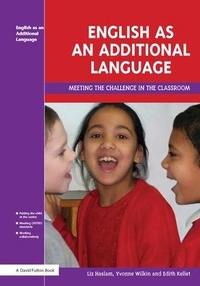
English as an Additional Language
Key Features of Practice
1st Edition
Published on 28. October 2015
Book
Hardback
116 pages
978-1-138-13310-5 (ISBN)
Description
English as an Additional Language is packed full of straightforward ideas to help teachers get a grip on good classroom practice and will help teachers:
understand language development and its impact upon pupils attainment
use the latest teaching strategies and interventions to help pupils access the curriculum and enjoy all aspects of school life
anticipate problems for later-stage pupils and be ready to support their independence
keep up-to-date withthe DfES English as an Additional Language Strategy and Race Relations Act Amendments.
understand language development and its impact upon pupils attainment
use the latest teaching strategies and interventions to help pupils access the curriculum and enjoy all aspects of school life
anticipate problems for later-stage pupils and be ready to support their independence
keep up-to-date withthe DfES English as an Additional Language Strategy and Race Relations Act Amendments.
More details
Language
English
Place of publication
London
United Kingdom
Publishing group
Taylor & Francis Ltd
Target group
Professional and scholarly
Academic and Professional Practice & Development
Dimensions
Height: 297 mm
Width: 210 mm
Weight
544 gr
ISBN-13
978-1-138-13310-5 (9781138133105)
Copyright in bibliographic data and cover images is held by Nielsen Book Services Limited or by the publishers or by their respective licensors: all rights reserved.
Schweitzer Classification
Other editions
Additional editions
Book
01/2006
1st Edition
David Fulton Publishers Ltd
€56.40
Shipment within 3-4 weeks
Persons
Elizabeth Haslam has over 20 years' experience in EAL and is an advisory teacher for Isolated Bilingual Learners in Tameside. Yvonne Wilkin is the Local Authority Consultant for Ethnic Minority Achievement. Edith Kellet is the co-ordinator for ethnic minority in Blackpool.
Content
Introduction 1 Stories about Precious and Jim 2 How pupils make progress 3 Exploring language and assessment 4 Targets and teaching strategies 5 Preparing for an EAL beginner 6 Teaching a beginner 7 Ways of moving on 8 Developing CALP (Cognitive Academic Language Proficiency)