

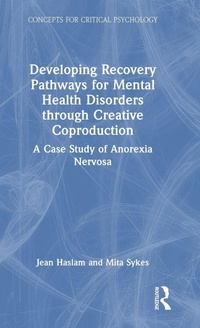
Developing Recovery Pathways for Mental Health Disorders through Creative Coproduction
A Case Study of Anorexia Nervosa
1st Edition
Published on 28. August 2025
Book
Hardback
150 pages
978-1-032-90587-7 (ISBN)
Description
This book explores the potential of Creative Coproduction as a recovery tool for severe mental disorder, using case study examples of service users with anorexia nervosa. Written by authors with expertise in both mental health provision and experience of mental health services, the book advocates a creative, coproductive approach to treating mental disorders. Creative Coproduction involves significant interaction and collaboration between health and social care professionals, sufferers, recovered patients, educational establishments, families and scientists at all levels of interaction. The book emphasises the importance of working together creatively as a diverse yet cohesive team, adding to existing knowledge through every interaction and discovering and developing alternative recovery pathways. It challenges the stigma faced by people with mental health difficulties, using Foucault's concept and theory of unreason. The book further uses the neuroscience of creativity as a lens by which to identify creative characteristics and actions, discussing ways this can be harnessed to transform recovery pathways through creative practices. Centering the voices of service users and their families alongside mental health professionals, this important book will be valuable reading for advanced undergraduate and postgraduate students in health and allied sciences, mental health and social work programmes. It will also be highly relevant for health and social care professionals including mental health nurses, allied practitioners, managers of community mental health teams and community practitioners.
More details
Series
Language
English
Place of publication
London
United Kingdom
Publishing group
Taylor & Francis Ltd
Target group
College/higher education
Professional and scholarly
Postgraduate, Professional Practice & Development, and Undergraduate Advanced
Dimensions
Height: 222 mm
Width: 145 mm
Thickness: 13 mm
Weight
343 gr
ISBN-13
978-1-032-90587-7 (9781032905877)
Copyright in bibliographic data and cover images is held by Nielsen Book Services Limited or by the publishers or by their respective licensors: all rights reserved.
Schweitzer Classification
Other editions
Additional editions
Jean Haslam | Mita Sykes
Developing Recovery Pathways for Mental Health Disorders through Creative Coproduction
A Case Study of Anorexia Nervosa
E-Book
08/2025
1st Edition
Routledge
€55.49
Available for download
Jean Haslam | Mita Sykes
Developing Recovery Pathways for Mental Health Disorders through Creative Coproduction
A Case Study of Anorexia Nervosa
E-Book
08/2025
1st Edition
Routledge
€55.49
Available for download
Jean Haslam | Mita Sykes
Developing Recovery Pathways for Mental Health Disorders through Creative Coproduction
A Case Study of Anorexia Nervosa
Book
08/2025
1st Edition
Routledge
€62.80
Shipment within 10-20 days
Persons
Jean Haslam has a Doctorate in Psychotic Creativity and a Masters in Education. She has been a user of mental health services for nearly sixty years and has expertise in Foucault, transformative coproduction, service user involvement and the Expert by Experience.
Mita Sykes is a mental health professional with longstanding personal experience of anorexia and bulimia nervosa and long-term involvement in the development of charities and educational programmes around eating disorders. She has worked with Child and Adolescent Mental Health Services (CAMHS) on a Creative Coproduction programme to bring about recovery from eating disorders for young people and was previously the manager of Bolton Patients Council with the remit to involve service users in the planning, development and future of mental health services.
Mita Sykes is a mental health professional with longstanding personal experience of anorexia and bulimia nervosa and long-term involvement in the development of charities and educational programmes around eating disorders. She has worked with Child and Adolescent Mental Health Services (CAMHS) on a Creative Coproduction programme to bring about recovery from eating disorders for young people and was previously the manager of Bolton Patients Council with the remit to involve service users in the planning, development and future of mental health services.
Content
Contents
Introduction. Creative Coproduction: A pro-active approach to the treatment of mental disorders using anorexia nervosa as an example
Chapter 1. Reversing the logic that thinness is more important than survival: Creativity and coproduction in treatment
Chapter 2. The creativity of science and its place in the co-productive treatment of mental disorders
Chapter 3. Realising and achieving Creative Coproduction in the treatment of mental disorders
Chapter 4. Reflections on personal experiences of anorexia nervosa, creativity and the recovery process
Chapter 5. The way forward. Practical steps, criteria and parameters for potential recovery from mental disorders through Creative Coproduction.
Introduction. Creative Coproduction: A pro-active approach to the treatment of mental disorders using anorexia nervosa as an example
Chapter 1. Reversing the logic that thinness is more important than survival: Creativity and coproduction in treatment
Chapter 2. The creativity of science and its place in the co-productive treatment of mental disorders
Chapter 3. Realising and achieving Creative Coproduction in the treatment of mental disorders
Chapter 4. Reflections on personal experiences of anorexia nervosa, creativity and the recovery process
Chapter 5. The way forward. Practical steps, criteria and parameters for potential recovery from mental disorders through Creative Coproduction.