

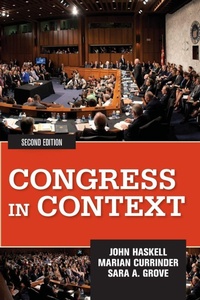
Congress in Context
2nd Edition
Published on 7. January 2014
Book
Paperback/Softback
504 pages
978-0-8133-4756-1 (ISBN)
Description
The U.S. Congress is by the far the least popular,and most misunderstood,branch of the federal government. Congress in Context de-mystifies the institution, giving students a comprehensive and practical understanding of Congress and the legislative process. This book takes a different approach to the study of Congress than other texts. Usually Congress is treated in isolation from the rest of the government. But the Framers of the Constitution explicitly intended for the branches of government to be interdependent. Congress in Context introduces readers to Congress's critical role in the context of this interdependent system. Using the metaphor of a board of directors, the authors explain the three key roles of Congress within the federal government,authorizing what government does, funding its activities, and supervising how it carries out the laws Congress passes,and shows students how Congress interacts with the rest of the government to exercise these powers.The thoroughly expanded and revised second edition features brand-new chapters on Congress and the courts and Congress and interest groups. It also includes expanded coverage of Congress's relationship with the executive branch, campaign finance, and today's major budget issues. Grounded in the latest political science literature coupled with contemporary examples, Congress in Context offers students an informed yet accessible introduction to how the legislative branch carries out its duties.
Reviews / Votes
Praise for Congress in Context "Congress in Context is thorough, well-written, and provides a unique insider's account of Congress's relationship with the broader political system. The authors combine classic congressional scholarship with contemporary policy issues to explain the nuts and bolts of how Congress functions as a policymaker within a complex system of shared powers. The structure of the text and the examples provide the groundwork for lively debates about why Congress struggles to be a productive and effective legislative body, and whether or not Congress is up to the monumental challenges it faces in the 21st century." -Alison Howard, Dominican University of California "The book's framework of 'Congress as a board of directors' gets at what the institution does in an interesting and accessible way. The authors do a very nice job of spelling out the shared nature of power in our system, and of laying out the authorizing and appropriating functions of Congress--something that is often lost in how the institution works in other books." -David Dulio, Oakland University Praise for Previous EditionsMore details
Edition
2nd edition
Language
English
Place of publication
Oxford
United States
Publishing group
Taylor & Francis Inc
Target group
College/higher education
Product notice
Paperback (UK-trade)
Dimensions
Height: 229 mm
Width: 152 mm
Thickness: 27 mm
Weight
723 gr
ISBN-13
978-0-8133-4756-1 (9780813347561)
Copyright in bibliographic data and cover images is held by Nielsen Book Services Limited or by the publishers or by their respective licensors: all rights reserved.
Schweitzer Classification
Other editions
Additional editions
John Haskell | Sara Grove | Marian Currinder
Congress in Context
Book
05/2019
2nd Edition
Routledge
€179.50
Shipment within 15-20 days
John Haskell | Sara Grove | Marian Currinder
Congress in Context
E-Book
04/2018
2nd Edition
Routledge
€72.49
Available for download
John Haskell | Sara Grove | Marian Currinder
Congress in Context
E-Book
04/2018
2nd Edition
Routledge
€72.49
Available for download
Previous edition

John Haskell
Congress in Context
Book
02/2010
1st Edition
Westview Press Inc
€62.08
Article exhausted; check for reprint
Persons
John Haskell is Assistant Director and Senior Specialist, Government and Finance Division with the Congressional Research Service. Haskell was Senior Fellow with the Government Affairs Institute at Georgetown University from 2000 to 2013 and has taught at Davidson College, University of North Carolina at Chapel Hill, Drake University, and Claremont McKenna College's Washington Program. He is the author of Fundamentally Flawed, a critique of the presidential nomination process, and Direct Democracy or Representative Government?. He was a Congressional Fellow in 1997-98, during which time he was the Budget Committee liaison for Congressman David Price. He also handled education and tax issues for the Congressman. Haskell received his Ph.D. in American politics from The University of North Carolina at Chapel Hill.Marian Currinder is a Senior Fellow with the Government Affairs Institute at Georgetown University. Before joining GAI in 2006, she was an Assistant Professor of American Politics at the College of Charleston. Marian was an American Political Science Association Congressional Fellow in 2003-04. She worked in DC as a legislative analyst and research associate before earning her M.A. and Ph.D. in American Government from the University of Florida. She has published several journal articles and book chapters on congressional politics and campaign finance, and is the author of Money in the House: Campaign Funds and Congressional Party Politics. Sara A. Grove is professor in the Department of Political Science at Shippensburg University. Prior to her arrival at Shippensburg in 1992, Dr. Grove taught at Frostburg State University, North Carolina State University, and The University of North Carolina at Chapel Hill. At Shippensburg, she teaches undergraduate and graduate courses that focus on constitutional law, political behaviour, and public policy dealing with health care and older adults. Sara took a leave of absence from her faculty position to earn her J.D. at The Dickinson School of Law of The Pennsylvania State University. She worked as a law clerk for the Governor's Office of General Counsel under Governor Tom Ridge and for The honourable J. Michael Eakin of the Pennsylvania Supreme Court. Dr. Grove received her Ph.D. in American politics from The University of North Carolina at Chapel Hill.
Content
List of illustrations List of Features Preface Acknowledgments PART 1: THE NATURE AND ORIGINS OF CONGRESS 1. Congress as the Board of Directors 2. The Two Congresses: Lawmaking and Representation 3. The House and Senate, Party Leadership and Committees 4. Congressional Elections PART 2: INSIDE CONGRESS 5. Understanding the Legislative Process 6. Authorizing the Work of Government 7. The Power of the Purse 8. Federal Budget Issues in the 21st Century 9. The Oversight Power 10. Methods of Congressional Oversight PART 3: CONGRESS AND OTHERS 11. Congress and the President: The Struggle over Directing Public Policy 12. Congress and the Courts 13. Interest Groups and Congressional Policy Making 14. Congress in the 21st century Appendix: A Century of Congress Glossary of Key Terms Index