

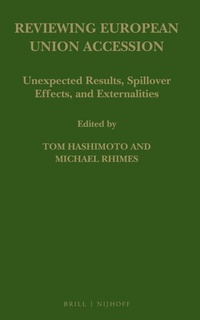
Reviewing European Union Accession
Unexpected Results, Spillover Effects, and Externalities
Published on 12. October 2017
Book
Hardback
348 pages
978-90-04-31647-8 (ISBN)
Description
The year 2017 has been an uneasy one for the EU, with so-called Brexit on the horizon and the rise of populist euroskepticism in a number of Member States. This year, with the tenth anniversary of the Romanian and Bulgarian accession to the Union, is a good year to pause and reflect over the life and future of the Union. In this work, we envision the next decade with Europe 2020 strategy and review the fruits of the 2004 accession in Central and Eastern Europe. What has the Union achieved? Which policy areas are likely to change and how? How successful, and by what measure, has the accession of the 10 Member States in 2004 been? Reviewing European Union Accession addresses a wide range of issues, deliberately without any thematic constraints, in order to explore EU enlargement from a variety of perspectives, both scientific and geographical, internal and external. In contrast to the major works in this field, we highlight the interrelated, and often unexpected, nature of the integration process - hence the subtitle, unexpected results, spillover effects and externalities.
More details
Series
Language
English
Place of publication
Netherlands
Publishing group
Brill
Target group
Professional and scholarly
Product notice
sewn/stitched
Cloth over boards
Dimensions
Height: 234 mm
Width: 155 mm
Thickness: 21 mm
Weight
662 gr
ISBN-13
978-90-04-31647-8 (9789004316478)
Copyright in bibliographic data and cover images is held by Nielsen Book Services Limited or by the publishers or by their respective licensors: all rights reserved.
Schweitzer Classification
Persons
Tom Hashimoto, LL.M., FHEA, is Director of MSc in Financial Economics program at ISM University of Management and Economics, Lecturer at Vistula University, and Teaching Fellow in Political Economy at the OSCE Academy. He is a recipient of Career Integration Fellowship from CERGE-EI, and is DPhil Candidate in Financial Geography at the University of Oxford.
Michael Rhimes, LLB (Hons) (Lond), BCL (Oxon) is Fourth referendaire to Judge Christopher Vajda, Court of Justice of the European Union, Luxembourg. He has wide interests in the law, having previously published on trade defense measures and standing under EU law.
Michael Rhimes, LLB (Hons) (Lond), BCL (Oxon) is Fourth referendaire to Judge Christopher Vajda, Court of Justice of the European Union, Luxembourg. He has wide interests in the law, having previously published on trade defense measures and standing under EU law.
Content
List of Illustrations
Notes on Contributors
Introduction: Reviewing 2014, Welcoming 2017, and Envisioning 2020
?Tom Hashimoto and Michael Rhimes
Part 1: Law - Developing Norms
1 Towards Adverse Spillover Effect? The Judicialization of the EU and the Changing Nature of Judicial Governance after Enlargement
?Mariusz Jerzy Golecki
2 Europeanization of the Hungarian Legal Order: From Convergence to Cancellation?
?Tamas Dezso Ziegler and Balazs Horvathy
3 The Use of Referendum in Central and Eastern Europe after EU Accession
?Sergiu Gherghina
4 Special Economic Zones in Poland: A Black Hole Swallowing State Budget or a Messiah for Regional Development?
?Hiroshi Kaneko
Part 2: Politics - Skepticism
5 (Dis)Trusting the European Union? On the Evolving Variety of Euroskepticism in Central and Eastern Europe
?Boyka Stefanova
6 Vaclav Klaus as a Driver of Czech Euroskepticism
?Vratislav Havlik and Ondrej Mocek
7 Poland and the Re-categorization of the Eurozone Entry: From a Legal Obligation to a Political Issue
?Anna Visvizi and Pawel Tokarski
Part 3: Society - Education and Values
8 Emerging European Geographies: The Erasmus Program and Its Effect on the East-west Divide in Time of Economic Crisis
?Amelia Hadfield and Robert Summerby-Murray
9 Slovenian Soft Power Capabilities in the European Context: Missed Opportunities of Cultural Diplomacy and Erasmus Student Exchange Program
?Ana Bojinovic Fenko and Jure Pozgan
10 The Harmonization of Laws on Same-Sex Unions in Post-Communist Post-Accession Countries
?Alar Kilp
Part 4: EU Policy - From Within to Without
11 Poland and the Common Security and Defense Policy: Potential Leader 207?
?Laura Chappell
12 Prague on a Mission: Emphasizing Democracy Promotion within EU Foreign Policy
?Marek Neuman
13 The Forgotten Chapter? Post-accession Development Policy of Central and Eastern Europe
?Simon Lightfoot and Balazs Szent-Ivanyi
14 Slovak Parliament's Involvement in the EU Agenda: Kosovo's Independence and the Policy of Non-Recognition
?Katarina Lezova
Part 5: Russia - Beyond the EU
15 The European Union and Russia during the Two Waves of Enlargement: New Political and Implementation Rationales on Old Issues
?Sandra Fernandes
16 EU-Russia Cooperation on Energy Efficiency: An Unexpected Benefit of Regional Interdependence between Russia and the CEE Member States?
?Olga Khrushcheva
17 The European Union's Influence over Media Discourse on Renewable Energy Sources in Russia
?Marianna Poberezhskaya
Index
Notes on Contributors
Introduction: Reviewing 2014, Welcoming 2017, and Envisioning 2020
?Tom Hashimoto and Michael Rhimes
Part 1: Law - Developing Norms
1 Towards Adverse Spillover Effect? The Judicialization of the EU and the Changing Nature of Judicial Governance after Enlargement
?Mariusz Jerzy Golecki
2 Europeanization of the Hungarian Legal Order: From Convergence to Cancellation?
?Tamas Dezso Ziegler and Balazs Horvathy
3 The Use of Referendum in Central and Eastern Europe after EU Accession
?Sergiu Gherghina
4 Special Economic Zones in Poland: A Black Hole Swallowing State Budget or a Messiah for Regional Development?
?Hiroshi Kaneko
Part 2: Politics - Skepticism
5 (Dis)Trusting the European Union? On the Evolving Variety of Euroskepticism in Central and Eastern Europe
?Boyka Stefanova
6 Vaclav Klaus as a Driver of Czech Euroskepticism
?Vratislav Havlik and Ondrej Mocek
7 Poland and the Re-categorization of the Eurozone Entry: From a Legal Obligation to a Political Issue
?Anna Visvizi and Pawel Tokarski
Part 3: Society - Education and Values
8 Emerging European Geographies: The Erasmus Program and Its Effect on the East-west Divide in Time of Economic Crisis
?Amelia Hadfield and Robert Summerby-Murray
9 Slovenian Soft Power Capabilities in the European Context: Missed Opportunities of Cultural Diplomacy and Erasmus Student Exchange Program
?Ana Bojinovic Fenko and Jure Pozgan
10 The Harmonization of Laws on Same-Sex Unions in Post-Communist Post-Accession Countries
?Alar Kilp
Part 4: EU Policy - From Within to Without
11 Poland and the Common Security and Defense Policy: Potential Leader 207?
?Laura Chappell
12 Prague on a Mission: Emphasizing Democracy Promotion within EU Foreign Policy
?Marek Neuman
13 The Forgotten Chapter? Post-accession Development Policy of Central and Eastern Europe
?Simon Lightfoot and Balazs Szent-Ivanyi
14 Slovak Parliament's Involvement in the EU Agenda: Kosovo's Independence and the Policy of Non-Recognition
?Katarina Lezova
Part 5: Russia - Beyond the EU
15 The European Union and Russia during the Two Waves of Enlargement: New Political and Implementation Rationales on Old Issues
?Sandra Fernandes
16 EU-Russia Cooperation on Energy Efficiency: An Unexpected Benefit of Regional Interdependence between Russia and the CEE Member States?
?Olga Khrushcheva
17 The European Union's Influence over Media Discourse on Renewable Energy Sources in Russia
?Marianna Poberezhskaya
Index