

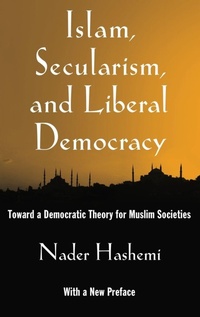
Islam, Secularism, and Liberal Democracy
Toward a Democratic Theory for Muslim Societies
Published on 2. April 2009
Book
Hardback
304 pages
978-0-19-532124-1 (ISBN)
Description
Islam's relationship to liberal-democratic politics has emerged as one of the most pressing and contentious issues in international affairs. This book analyzes the relationship between religion, secularism, and liberal democracy, both theoretically and in the context of the contemporary Muslim world. This book challenges a widely held belief among social scientists that religious politics and liberal-democratic development are structurally incompatible. While there are certainly tensions between Islam and democracy - Hashemi draws on Iran as an example - the two are not irreconcilable. He affirms the need for political secularism in order for liberal democracy to flourish, and examines how Muslim societies can develop the political secularism required for liberal democracy when the main political, cultural and intellectual resources that are available are religious. Hashemi argues that democratization and liberalization do not necessarily require a rejection or privatization of religion but do require a reinterpretation of religious ideas about the moral basis of legitimate political authority and individual rights. In fact, he shows, liberal democracy in the West often developed not in strict opposition to religious politics but in concert with it. Hashemi argues that an indigenous theory of Muslim secularism - similar to what developed in the Christian West - is possible and a necessary requirement for the advancement of liberal democracy in Muslim societies.
Reviews / Votes
A timely and insightful contribution to a debate of great consequence for the Muslim world and the West, the book represents a weighty contribution to the question of Islam and democracy. * Tauseef Ahmad Parray, The American Journal of Islamic Social Sciences. * ambitious and well-researched volume ... an informed survey of the contemporary intellectual landscape and a convenient starting point for further reflection and debate. * S Parvez Manzoor, Muslim World Book Review *More details
Language
English
Place of publication
New York
United States
Target group
College/higher education
Dimensions
Height: 240 mm
Width: 161 mm
Thickness: 21 mm
Weight
631 gr
ISBN-13
978-0-19-532124-1 (9780195321241)
Copyright in bibliographic data and cover images is held by Nielsen Book Services Limited or by the publishers or by their respective licensors: all rights reserved.
Schweitzer Classification
Other editions
Additional editions
Nader Hashemi
Islam, Secularism, and Liberal Democracy
Toward a Democratic Theory for Muslim Societies
Book
09/2012
Oxford University Press Inc
€54.30
Shipment within 15-20 days
Nader Hashemi
Islam, Secularism, and Liberal Democracy
Toward a Democratic Theory for Muslim Societies
E-Book
04/2009
1st Edition
OUP eBook
€19.99
Available for download
Nader Hashemi
Islam, Secularism, and Liberal Democracy
Toward a Democratic Theory for Muslim Societies
E-Book
04/2009
1st Edition
OUP eBook
€18.49
Available for download
Person
Nader Hashemi was formerly was an Andrew W. Mellon Postdoctoral Fellow in the Department of Political Science at Northwestern University and a Visiting Assistant Professor at the UCLA International Institute. Currently he is an Assistant Professor of Middle East and Islamic Politics at the Graduate School of International Studies at the University of Denver.
Content
Introduction
Chapter 1. Toward a Democratic Theory for Muslim Societies: The Historical Background
Chapter 2. Dueling Scriptures: The Political Theology of John Locke and the Democratization of Muslim Societies
Chapter 3. A Concise Anatomy of Secularism: Examining Its Linkages to Liberal Democracy
Chapter 4. Secularism and Its Discontents in Muslim Societies: Indigenizing the Separation between Religion and State
Conclusion
Notes
Bibliography
Index
Chapter 1. Toward a Democratic Theory for Muslim Societies: The Historical Background
Chapter 2. Dueling Scriptures: The Political Theology of John Locke and the Democratization of Muslim Societies
Chapter 3. A Concise Anatomy of Secularism: Examining Its Linkages to Liberal Democracy
Chapter 4. Secularism and Its Discontents in Muslim Societies: Indigenizing the Separation between Religion and State
Conclusion
Notes
Bibliography
Index