

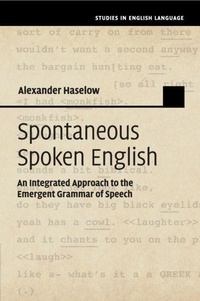
Spontaneous Spoken English
An Integrated Approach to the Emergent Grammar of Speech
Published on 2. April 2020
Book
Paperback/Softback
344 pages
978-1-108-40470-9 (ISBN)
Description
A new, thought-provoking book on the theory of grammar and language processing, based on the analysis of authentic speech produced in real time. Drawing on insights from cognitive psychology, neurology and conversation analysis, the author offers a fascinating, easy-to-follow account of why spoken English is structured the way it is. The traditional product-based approach to grammar is given up in favour of a speaker-based, dynamic perspective that integrates language-structural, neurocognitive and dialogic aspects of speech production. Based on fresh empirical research Haselow argues that grammatical knowledge rests upon two cognitive principles of linearization called 'microgrammar' and 'macrogrammar', which are shown to interact in various ways. The book discusses a broad range of speech phenomena under an integrated framework, such as the omnipresence of 'unintegrated' constituents (e.g. discourse markers), ellipses, or the allegedly 'fragmented' character of syntax, and explains the mechanisms of processing efficiency that guide syntactic planning.
Reviews / Votes
'... this book represents an illuminating interdisciplinary study that broadens the perspective of linguistic analysis by considering not only the context of an individual interaction, but also the cognitive mechanisms that give rise to the emergent grammar of spontaneous speech. Without doubt, this book can be used as a good reference book for students and researchers who are interested in interactional linguistics and cognitive linguistics.' Haiping Wu, Journal of Pragmatics 'This monograph evidently carries massive implications for research into grammar and linguistic structure since it broadens the notion of grammar and provides an alternative approach to it, enabling researchers to investigate the emergent grammar of speech from an integrated perspective, differing from the monolithic, 'fixed-code' and sentence based approach to language and grammar through which grammar has been described and analysed. The book is also of immense significance to academics in discourse studies, a field where spontaneous spoken language data have become the mainstream research objects.' Baicheng Zhang, Discourse StudiesMore details
Series
Language
English
Place of publication
Cambridge
United Kingdom
Target group
Professional and scholarly
Product notice
Paperback (trade)
Illustrations
Worked examples or Exercises; 3 Halftones, black and white; 4 Line drawings, black and white
Dimensions
Height: 229 mm
Width: 152 mm
Thickness: 19 mm
Weight
499 gr
ISBN-13
978-1-108-40470-9 (9781108404709)
Copyright in bibliographic data and cover images is held by Nielsen Book Services Limited or by the publishers or by their respective licensors: all rights reserved.
Schweitzer Classification
Other editions
Additional editions
Alexander Haselow
Spontaneous Spoken English
An Integrated Approach to the Emergent Grammar of Speech
E-Book
11/2017
Cambridge University Press
€105.99
Available for download
Alexander Haselow
Spontaneous Spoken English
An Integrated Approach to the Emergent Grammar of Speech
Book
11/2017
Cambridge University Press
€144.10
Shipment within 15-20 days
Person
Alexander Haselow is Assistant Professor of English linguistics at the University of Rostock, Germany. His current research focuses on the cognitive, dialogic and neural mechanisms underlying the production and perception of speech in real time. He is the author of Typological Changes in the Lexicon - Analytic Tendencies in English Noun Formation (2011) and co-editor of Final Particles (2015).
Content
1. Introduction; 2. Toward an interfield approach to the study of spontaneous speech; 3. A dualistic approach to grammar: Microgrammar and macrogrammar; 4. Linearization and macrogrammatical fields; 5. Macrogrammar and the linearization of structural segments; 6. Neurolinguistic evidence for the Grammatical Dualism Assumption; 7. Conclusions.