

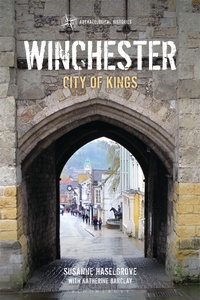
Winchester
City of Kings
Published on 7. August 2025
Book
Paperback/Softback
192 pages
978-1-350-39977-8 (ISBN)
Description
Winchester's rich heritage is brought to life in this uniquely accessible overview of the city's long and intricate physical and cultural history. Examining a wealth of archaeological evidence alongside surviving documentary sources, Susanne Haselgrove and Katherine Barclay paint a compelling picture of its waxing and waning fortunes, from prehistoric origins to early-medieval royal and ecclesiastical powerhouse, and subsequent decline to rebirth in 21st-century popular culture.
Although today Winchester is perhaps best-known globally as one of the key battlegrounds of the video-game Assassin's Creed Valhalla, its history and resonance in the contemporary world is far more complex. At its zenith the city held a prominent position on the national and international stage as a hub of learning and art, and this has endured into the modern age with the establishing of King Alfred as an icon of Britain's imperial past and the birth of environmentalism at the 'Battle of Twyford Down'.
A key part of this story is provided by the results of the ground-breaking and methodologically innovative excavations of the 1960s to 1970s, which played a critical role in the development of urban archaeology as we now know it. Across 19 sites, 3,000 volunteers brought to light the great halls of the kings and bishops, the magnificent Anglo-Saxon minsters and the homes and workshops of ordinary people. Post-excavation analyses revealed the crops and animals grown and imported into the area, how burial customs changed over time and the health of the local populations, while later excavations changed our view of medieval lepers, possibly unearthed King Alfred's body and revealed where two million First World War soldiers lived.
Although today Winchester is perhaps best-known globally as one of the key battlegrounds of the video-game Assassin's Creed Valhalla, its history and resonance in the contemporary world is far more complex. At its zenith the city held a prominent position on the national and international stage as a hub of learning and art, and this has endured into the modern age with the establishing of King Alfred as an icon of Britain's imperial past and the birth of environmentalism at the 'Battle of Twyford Down'.
A key part of this story is provided by the results of the ground-breaking and methodologically innovative excavations of the 1960s to 1970s, which played a critical role in the development of urban archaeology as we now know it. Across 19 sites, 3,000 volunteers brought to light the great halls of the kings and bishops, the magnificent Anglo-Saxon minsters and the homes and workshops of ordinary people. Post-excavation analyses revealed the crops and animals grown and imported into the area, how burial customs changed over time and the health of the local populations, while later excavations changed our view of medieval lepers, possibly unearthed King Alfred's body and revealed where two million First World War soldiers lived.
Reviews / Votes
This book is a well-written introduction to the city that uses archaeology and material remains to trace Winchester's history from prehistoric times to the present. It will appeal to a wide audience - from tourists who want an authoritative guide to Winchester and its surroundings to students of archaeology and history who want to know what the long-term excavations programs at Winchester have revealed. It is a pleasure to read, and includes a comprehensive bibliography for those who want to read more about Winchester's history. Highly recommended. -- Pam J. Crabtree, Professor of Anthropology, New York University, USAMore details
Series
Language
English
Place of publication
London
United Kingdom
Publishing group
Bloomsbury Publishing PLC
Target group
College/higher education
Illustrations
37 colour illus
Dimensions
Height: 232 mm
Width: 155 mm
Thickness: 13 mm
Weight
336 gr
ISBN-13
978-1-350-39977-8 (9781350399778)
Copyright in bibliographic data and cover images is held by Nielsen Book Services Limited or by the publishers or by their respective licensors: all rights reserved.
Schweitzer Classification
Persons
Susanne Haselgrove is the Secretary of the Winchester Excavations Committee, UK.
Katherine Barclay is the Associate Director of the Winchester Excavations Committee, UK.
Katherine Barclay is the Associate Director of the Winchester Excavations Committee, UK.
Content
Introduction
1. The Uniqueness of Winchester
2. The Archaeological Story
3. The Early Settlements
4. The Rise and Fall of Venta Belgraum
5. The Golden Age of Early Medieval Winchester
6. Medieval Winchester
7. Reduced Horizons
8. The Legacy of Past Glories and New Beginnings
Guide to Further Reading
Glossary
Dramatis personae
Chronology
Bibliography
Index
1. The Uniqueness of Winchester
2. The Archaeological Story
3. The Early Settlements
4. The Rise and Fall of Venta Belgraum
5. The Golden Age of Early Medieval Winchester
6. Medieval Winchester
7. Reduced Horizons
8. The Legacy of Past Glories and New Beginnings
Guide to Further Reading
Glossary
Dramatis personae
Chronology
Bibliography
Index