

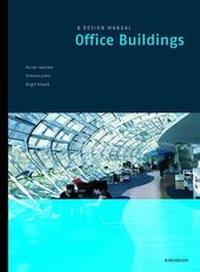
Office Buildings
A Design Manual
Published on 26. September 2002
Book
Hardback
264 pages
978-3-7643-6650-6 (ISBN)
Description
Offices, as a category of building, have undergone dramatic changes in the last few years. Increasing economic globalization, new information and communication technologies, and ecological considerations are all making demands on a branch of architecture which for nearly a century had been marked by the construction norms and standards, and the requirements of office organisation. These old solutions are, however, no longer viable for many modern companies, where flexibility and mobility determine the working day of the new office nomads. With some 70 international examples (including projects from Norman Foster, Frank O. Gehry, Thomas Herzog, Morphosis MVRDV, Renzo Piano, SOM), the authors and editors show how the new issues facing architects can be resolved. Thematic contributions by experts in various disciplines discuss topics such as models of work organisation, façade technology, climatic regulation, lighting etc. This volume is a crucial standard work in the design of offices.
More details
Language
English
Place of publication
Basel/Berlin/Boston
Switzerland
Publishing group
Birkhäuser Verlag GmbH
Target group
Professional and scholarly
US School Grade: College Graduate Student
Illustrations
207 farbige Abbildungen, 629 s/w Abbildungen
264 p. 836 illus., 207 in color.
Dimensions
Height: 33 cm
Width: 24 cm
Weight
1680 gr
ISBN-13
978-3-7643-6650-6 (9783764366506)
Schweitzer Classification
Persons
Rainer Hascher, born in 1950, has had his own office for architecture and product design since 1979. He is also Professor for Design, Construction and Building Studies at the Technical University, Berlin. Simone Jeska, born in 1965, is an architect in Berlin. Birgit Klauck, born in 1963, is an architect and full-time lecturer at the Technical University, Berlin.
Content
Offices, as a category of building, have probably faced more challenges and undergone more dramatic changes in the last few years than most other kinds of buildings. Increasing economic globalization, new information and communication technologies and ecological considerations are all making demands on a branch of architecture which for nearly a century had been marked by the construction norms and standards and the requirements of office organisation. These old solutions are, however, no longer viable for many modern companies, where flexibility and mobility determine the working day of a new generation of office nomads and architecture is having to adapt. With some 70 significant international examples taken from the last five years (including examples from Norman Foster, Frank O. Gehry, Thomas Herzog, Morphosis MVRCV, Renzo Piano, SOM) the authors and editors show how the new issues facing architects can be resolved. In addition to introductory texts there are also thematic contributions by experts in various disciplines on related topics including the new models of work organisation, facade technology, climatic regulation, lighting and more.