

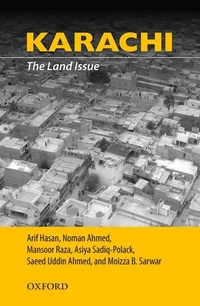
Karachi
The Land Issue
Published on 23. April 2015
Book
Hardback
380 pages
978-0-19-940208-3 (ISBN)
Description
Karachi is one of the fastest growing cities in the world. It is Pakistan's only port and the major contributor to the country's economy. In addition, it is also a diverse city, with its population politically divided along ethnic lines. These three factors make urban land and that on the city fringe, a highly contested commodity around which federal, provincial, and local landowning agencies; corporate sector interests; formal and informal developers; international
capital and military cantonments, compete for control and for extracting maximum value from it. The victims of this battle for turf and profits are the city's social and physical environment and its low and lower middle-income groups.
This book deals with the history, evolution, and present day realities around who owns land; its legal and illegal acquisition, land-use conversions and development; the actors involved and their relationship with each other and with the public at large; the often violent conflicts that take place in this process and the measures that can be taken to regulate the land market for the creation of a better urban environment and for providing homes to its less privileged.
capital and military cantonments, compete for control and for extracting maximum value from it. The victims of this battle for turf and profits are the city's social and physical environment and its low and lower middle-income groups.
This book deals with the history, evolution, and present day realities around who owns land; its legal and illegal acquisition, land-use conversions and development; the actors involved and their relationship with each other and with the public at large; the often violent conflicts that take place in this process and the measures that can be taken to regulate the land market for the creation of a better urban environment and for providing homes to its less privileged.
More details
Language
English
Place of publication
Oxford
Pakistan
Target group
Professional and scholarly
Illustrations
11 folded maps
Dimensions
Height: 242 mm
Width: 162 mm
Thickness: 29 mm
Weight
658 gr
ISBN-13
978-0-19-940208-3 (9780199402083)
Copyright in bibliographic data and cover images is held by Nielsen Book Services Limited or by the publishers or by their respective licensors: all rights reserved.
Schweitzer Classification
Persons
Arif Hasan is an architect/planner dealing with urban planning and development issues, particularly those concerning Asia and Pakistan.
Noman Ahmed has a PhD in Civil and Building Engineering from Loughborough University and is Professor and Chairman, Department of Architecture and Planning at the NED University of Engineering and Technology, Karachi.
Mansoor Raza is a freelance researcher with various action researches to his credit.
Asiya Sadiq-Polack is Associate Professor at the Department of Architecture and Planning at the NED University of Engineering and Technology, Karachi.
Moizza B. Sarwar is a DPhil student at the Department of Social Policy, Sommerville College, Oxford. Her current research builds on her Masters work on informal settlements in Cape Town, South Africa and Karachi, Pakistan.
Noman Ahmed has a PhD in Civil and Building Engineering from Loughborough University and is Professor and Chairman, Department of Architecture and Planning at the NED University of Engineering and Technology, Karachi.
Mansoor Raza is a freelance researcher with various action researches to his credit.
Asiya Sadiq-Polack is Associate Professor at the Department of Architecture and Planning at the NED University of Engineering and Technology, Karachi.
Moizza B. Sarwar is a DPhil student at the Department of Social Policy, Sommerville College, Oxford. Her current research builds on her Masters work on informal settlements in Cape Town, South Africa and Karachi, Pakistan.
Content
1. KARACHI: THE CONTEXT; 2. LAND; 3. REVIEW OF THE LAWS, STATUTES, AND REGULATIONS RELATING TO LAND MANAGEMENT IN KARACHI; 4. CREDIT FOR PURCHASE OF LAND AND HOUSING; 5. ACTORS AND FACTORS IN LAND RELATED CONFLICTS: FINDINGS FROM SECONDARY SOURCES; 6. ACTORS AND FACTORS IN LAND RELATED CONFLICTS: FINDINGS FROM PRIMARY SOURCES; 7. SUPPORT TO POOR COMMUNITIES; RESIDENT'S VIEWS ON AFFORDABILITY AND LOCATION ISSUES; 8. TOWARDS A MORE EQUITABLE LAND POLICY