

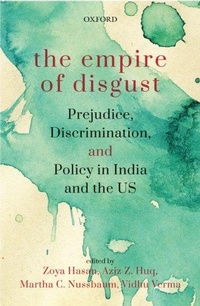
The Empire of Disgust
Prejudice, Discrimination, and Policy in India and the US
Published on 4. October 2018
Book
Hardback
440 pages
978-0-19-948783-7 (ISBN)
Description
All known societies exclude and stigmatize one or more minority groups. Frequently, these exclusions are underwritten with a rhetoric of disgust. People of certain groups, it is alleged, are filthy, hyper-animal, or not fit to share such facilities as drinking water, food, and public swimming pools with the 'clean' and 'fully human' majority. But exclusions vary in their scope and also in the specific disgust-ideologies underlying them. In this volume, interdisciplinary scholars from India and the United States present a detailed comparative study of the varieties of prejudice and stigma that pervade contemporary social and political life. These include prejudice along the axes of caste, race, gender identity, age, sexual orientation, disability, ethnicity, religion, and economic class. In examining these forms of stigma and their intersections, the authors present theoretically pluralistic and empirically sensitive accounts that both explain group-based stigma and suggest ways forward. These forward-looking remedies, including group resistance to subordination as well as institutional and legal change, point the way towards a public culture that is informed by our diverse histories of discrimination and therefore equipped to eliminate stigma in all of its multifaceted forms.
More details
Language
English
Place of publication
New Delhi
India
Target group
Professional and scholarly
Product notice
sewn/stitched
Cloth over boards
Dimensions
Height: 221 mm
Width: 147 mm
Thickness: 30 mm
Weight
567 gr
ISBN-13
978-0-19-948783-7 (9780199487837)
Copyright in bibliographic data and cover images is held by Nielsen Book Services Limited or by the publishers or by their respective licensors: all rights reserved.
Schweitzer Classification
Other editions
Additional editions
Zoya Hasan | Aziz Z. Huq | Martha C. Nussbaum
Empire of Disgust
Prejudice, Discrimination, and Policy in India and the US
E-Book
08/2018
1st Edition
OUP
€58.07
Available for download
Persons
One of India's leading political scientists, Hasan recently retired from her Professorship in the Centre for Political Studies at JNU, where she served for many years, and where she now has Emerita status; she has also served as Dean of the School Social Sciences at JNU and as Chair of the Gender Studies program at JNU. She is a former member of the National Commission for Minorities. Her books include Dominance and Mobilisation: Rural Politics in Western Uttar Pradesh, 1930-80 , Quest for Power: Oppositional Movements and Post-Congress Politics in Uttar Pradesh; Unequal Cigizens: Status of Muslim Women in India (with Ritu Menon); Politics of Inclusion: Castes, Minorities and Affirmative Action , and Congress After Indira: Policy, Power and Political Change 1984-2009.
Huq is Frank and Bernice J. Greenberg Professor of Law at the University of Chicago Law School. His teaching and research interests include criminal procedure, constitutional law, and constitutional design.
As a Senior Consultant analyst for the International Crisis Group, he researched the implementation of constitutional norms in Sri Lanka, Nepal, Pakistan, and Afghanistan. He has also directed the Liberty and National Security Project of the Brennan Center for Justice at NYU Law School, and has clerked for Justice Ruth Bader Ginsburg. With Tom Ginsburg he is co-editor of the 2017 volume Implementing Constitutional Design, forthcoming from Cambridge University Press.
Martha C. Nussbaum is Ernst Freund Distinguished Service Professor of Law and Ethics, appointed in the Law School and the Philosophy Department. She holds Associate appointments in Classics, Divinity, and Political Science, and is a member of the Committee on Southern Asian Studies and a Board Member of the Human Rights Program. Her most recent book is Anger and Forgiveness: Resentment, Generosity, Justice. Her longstanding connection with India can be seen in the books Women and Human Development: The Capabilities
Approach, The Clash Within: Democracy, Religious Violence, and India's Future , India: Implementing Pluralism and Democracy (co-edited with Wendy Doniger), and in many articles. She has worked with UNDP-Delhi and with The Lawyers Collective.
Verma is Professor in the Centre for Political Studies, JNU, Delhi. Her areas of research include Indian political thought, feminist politics, affirmative action, and social justice. She is the author of three books: Non-discrimination and Equality in India: Contesting Boundaries of Social Justice, Malaysia: State and Civil Society in Transition, and Justice, Equality, and Community , as well as numerous articles. She is currently a Principal Investigator in a project on Changing Conceptions of Legal Justice in India.
Huq is Frank and Bernice J. Greenberg Professor of Law at the University of Chicago Law School. His teaching and research interests include criminal procedure, constitutional law, and constitutional design.
As a Senior Consultant analyst for the International Crisis Group, he researched the implementation of constitutional norms in Sri Lanka, Nepal, Pakistan, and Afghanistan. He has also directed the Liberty and National Security Project of the Brennan Center for Justice at NYU Law School, and has clerked for Justice Ruth Bader Ginsburg. With Tom Ginsburg he is co-editor of the 2017 volume Implementing Constitutional Design, forthcoming from Cambridge University Press.
Martha C. Nussbaum is Ernst Freund Distinguished Service Professor of Law and Ethics, appointed in the Law School and the Philosophy Department. She holds Associate appointments in Classics, Divinity, and Political Science, and is a member of the Committee on Southern Asian Studies and a Board Member of the Human Rights Program. Her most recent book is Anger and Forgiveness: Resentment, Generosity, Justice. Her longstanding connection with India can be seen in the books Women and Human Development: The Capabilities
Approach, The Clash Within: Democracy, Religious Violence, and India's Future , India: Implementing Pluralism and Democracy (co-edited with Wendy Doniger), and in many articles. She has worked with UNDP-Delhi and with The Lawyers Collective.
Verma is Professor in the Centre for Political Studies, JNU, Delhi. Her areas of research include Indian political thought, feminist politics, affirmative action, and social justice. She is the author of three books: Non-discrimination and Equality in India: Contesting Boundaries of Social Justice, Malaysia: State and Civil Society in Transition, and Justice, Equality, and Community , as well as numerous articles. She is currently a Principal Investigator in a project on Changing Conceptions of Legal Justice in India.
Editor
National FellowNational Fellow, Indian Council of Social Science Research, New Delhi
Frank and Bernice J. Greenberg Professor of LawFrank and Bernice J. Greenberg Professor of Law, University of Chicago Law School
Ernst Freund Distinguished Service Professor of Law and EthicsErnst Freund Distinguished Service Professor of Law and Ethics, University of Chicago Law School
ProfessorProfessor, Centre for Political Studies, School of Social Science, Jawaharlal Nehru University
Content
Acknowledgements
Introduction
1. The Dalit Body: A Reading for the Anthropocene
Dipesh Chakrabarty
2. Stigma or Red Tape? Roadblocks in the Use of Affirmative Action
Ashwini Deshpande
3. Of Big Black Bucks and Golden-Haired Little Girls: How Fear of Miscegenation Informed Brown v. Board of Education and Its Resistance
Justin Driver
4. Four Types of Racism
Emilio Comay del Junco
5. A Social Location Theory of Gender: How Gender Borders Create the Category 'Woman'
Emily Dupree
6. Gender and Anti-Discrimination Laws in India: Modesty, Honour and Defiled Bodies
Vidhu Verma
7. Regulating Retirement and Wrinkles in an Age of Prejudice
Saul Levmore
8. Aging, Stigma, and Disgust
Martha C. Nussbaum
9. Disgust or Equality? Sexual Orientation and Indian Law
Martha C. Nussbaum
10. The Rule of Disgust? Contemporary Transgender Rights Discourse in India
Jeffrey A. Redding
11. Combatting Exclusions Through Law: Rights of Transgender People in India
H.R. Vasujith Ram
12. Disability, Exclusions and Resistance: An Indian Context
Anita Ghai
13. Processes of Shaming: The Limits of Disability Policy in India
Nandini Ghosh
14. What is the Case Against Muslims?
Aziz Z. Huq
15. Muslims and the Politics of Discrimination in India
Zoya Hasan
16. Class and Classification: The Role of Disgust in Regulating Social Status
Laura Weinrib
17. The Point of Discrimination Law: Securing the Freedom to Flourish
Tarunabh Khaitan
18. Economic Theories of Discrimination: The Positive and the Normative
Richard H. McAdams
Author the editors and contributors
Index
Introduction
1. The Dalit Body: A Reading for the Anthropocene
Dipesh Chakrabarty
2. Stigma or Red Tape? Roadblocks in the Use of Affirmative Action
Ashwini Deshpande
3. Of Big Black Bucks and Golden-Haired Little Girls: How Fear of Miscegenation Informed Brown v. Board of Education and Its Resistance
Justin Driver
4. Four Types of Racism
Emilio Comay del Junco
5. A Social Location Theory of Gender: How Gender Borders Create the Category 'Woman'
Emily Dupree
6. Gender and Anti-Discrimination Laws in India: Modesty, Honour and Defiled Bodies
Vidhu Verma
7. Regulating Retirement and Wrinkles in an Age of Prejudice
Saul Levmore
8. Aging, Stigma, and Disgust
Martha C. Nussbaum
9. Disgust or Equality? Sexual Orientation and Indian Law
Martha C. Nussbaum
10. The Rule of Disgust? Contemporary Transgender Rights Discourse in India
Jeffrey A. Redding
11. Combatting Exclusions Through Law: Rights of Transgender People in India
H.R. Vasujith Ram
12. Disability, Exclusions and Resistance: An Indian Context
Anita Ghai
13. Processes of Shaming: The Limits of Disability Policy in India
Nandini Ghosh
14. What is the Case Against Muslims?
Aziz Z. Huq
15. Muslims and the Politics of Discrimination in India
Zoya Hasan
16. Class and Classification: The Role of Disgust in Regulating Social Status
Laura Weinrib
17. The Point of Discrimination Law: Securing the Freedom to Flourish
Tarunabh Khaitan
18. Economic Theories of Discrimination: The Positive and the Normative
Richard H. McAdams
Author the editors and contributors
Index