

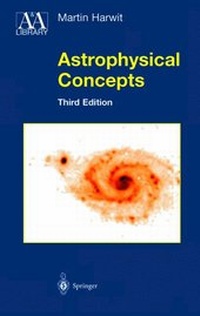
Astrophysical Concepts
3rd Edition
Published on 20. April 2000
Book
Hardback
XIV, 653 pages
978-0-387-94943-7 (ISBN)
Description
This classic text - aimed at senior undergraduates and beginning graduate students in physics and astronomy - presents a wide range of concepts in sufficient depth to give the reader a quantitative understanding of the subject. Emphasising physical concepts, it provides the student with a series of astrophysical sketches, concluding with a synthesis of all the subjects discussed in the book, sketching the history of the universe from its beginning to the formation of the Sun and the planets.
More details
Series
Edition
3rd ed. 1998. Corr. 2nd printing
Language
English
Place of publication
NY
United States
Target group
College/higher education
Professional and scholarly
Edition type
Revised edition
Illustrations
76
18 s/w Tabellen, 76 s/w Abbildungen
168 illus.
Dimensions
Height: 230 mm
Weight
1040 gr
ISBN-13
978-0-387-94943-7 (9780387949437)
DOI
10.1007/978-1-4757-2928-3
Schweitzer Classification
Other editions
New editions
Previous edition

Martin Harwitt
Astrophysical Concepts
Book
06/1988
2nd Edition
Springer
€68.83
Article exhausted; check for reprint
Content
1 An Approach to Astrophysics.- 1:1 Channels for Astronomical Information.- 1:2 X-Ray Astronomy: Development of a New Field.- 1:3 The Appropriate Set of Physical Laws.- 1:4 The Formation of Stars.- 1:5 Evolution of Stars.- 1:6 Abundance of the Chemical Elements in Stars and the Solar System.- 1:7 Origin of the Solar System.- 1:8 The Local Group of Galaxies.- 1:9 Galaxy Formation.- 1:10 Black Holes.- 1:11 Turbulence.- 1:12 Problems of Life.- 1:13 Unobserved Astronomical Objects.- 2 The Cosmic Distance Scale.- 2:1 Size of the Solar System.- 2:2 Trigonometric Parallax.- 2:3 Spectroscopic Parallax.- 2:4 The Moving Cluster Method.- 2:5 Method of Wilson and Bappu.- 2:6 Superposition of Main Sequences.- 2:7 RR Lyrae Variables.- 2:8 Cepheid Variables.- 2:9 Novae and Hu Regions.- 2:10 Supernovae.- 2:11 The Tully-Fisher Relation.- 2:12 Distance-Red-Shift Relation.- 2:13 Distances and Velocities.- 2:14 Seeliger's Theorem and Number Counts in Cosmology.- Problems Dealing with the Size of Astronomical Objects.- Answers to Selected Problems.- 3 Dynamics and Masses of Astronomical Bodies.- 3:1 Universal Gravitational Attraction.- 3:2 Ellipses and Conic Sections.- 3:3 Central Force.- 3:4 Two-Body Problem with Attractive Force.- 3:5 Kepler's Laws.- 3:6 Determination of the Gravitational Constant.- 3:7 The Concept of Mass.- 3:8 Inertial Frames of Reference - The Equivalence Principle.- 3:9 Gravitational Red Shift and Time Dilation.- 3:10 Measures of Time.- 3:11 Uses of Pulsar Time.- 3:12 Galactic Rotation.- 3:13 Scattering in an Inverse Square Law Field.- 3:14 Stellar Drag.- 3:15 Virial Theorem.- 3:16 Stability Against Tidal Disruption.- Additional Problems.- Answers to Selected Problems.- 4 Random Processes.- 4:1 Random Events.- 4:2 Random Walk.- 4:3 Distribution Functions, Probabilities, and Mean Values.- 4:4 Projected Length of Randomly Oriented Rods.- 4:5 The Motion of Molecules.- 4:6 Ideal Gas Law.- 4:7 Radiation Kinetics.- 4:8 Isothermal Distributions.- 4:9 Atmospheric Density.- 4:10 Particle Energy Distribution in an Atmosphere.- 4:11 Phase Space.- 4:12 Angular Diameters of Stars.- 4:13 The Spectrum of Light Inside and Outside a Hot Body.- 4:14 Boltzmann Equation and Liouville's Theorem.- 4:15 Fermi-Dirac Statistics.- 4:16 The Saha Equation.- 4:17 Mean Values.- 4:18 Fluctuations.- 4:19 The First Law of Thermodynamics.- 4:20 Isothermal and Adiabatic Processes.- 4:21 Formation of Condensations and the Stability of the Interstellar Medium.- 4:22 Ionized Gases and Assemblies of Stars.- Answers to Selected Problems.- 5 Photons and Fast Particles.- 5:1 The Relativity Principle.- 5:2 Relativistic Terminology.- 5:3 Relative Motion.- 5:4 Four-Vectors.- 5:5 Aberration of Light.- 5:6 Momentum, Mass, and Energy.- 5:7 The Doppler Effect.- 5:8 Poynting-Robertson Drag on a Grain.- 5:9 Motion Through the Cosmic Microwave Background Radiation.- 5:10 Particles at High Energies.- 5:11 High-Energy Collisions.- 5:12 Faster-Than-Light Particles.- 5:13 Strong Gravitational Fields.- 5:14 Gravitational Time Delay; Deflection of Light.- 5:15 Gravitational Lenses.- 5:16 An Independent Measure of the Hubble Constant.- Answers to Selected Problems.- 6 Electromagnetic Processes in Space.- 6:1 Coulomb's Law and Dielectric Displacement.- 6:2 Cosmic Magnetic Fields.- 6:3 Ohm's Law and Dissipation.- 6:4 Magnetic Acceleration of Particles.- 6:5 Ampère's Law and the Relation Between Cosmic Currents and Magnetic Fields.- 6:6 Magnetic Mirrors, Magnetic Bottles, and Cosmic Ray Particles.- 6:7 Maxwell's Equations.- 6:8 The Wave Equation.- 6:9 Phase and Group Velocity.- 6:10 Energy Density, Pressure, and the Poynting Vector.- 6:11 Propagation of Waves Through a Tenuous Ionized Medium.- 6:12 Faraday Rotation.- 6:13 Light Emission by Slowly Moving Charges.- 6:14 Gravitational Radiation.- 6:15 Light Scattering by Unbound Charges.- 6:16 Scattering by Bound Charges.- 6:17 Extinction by Interstellar Grains.- 6:18 Absorption and Emission of Radiation by a Plasma.- 6:19 Radiation from Thermal Radio Sources.- 6:20 Synchrotron Radiation.- 6:21 The Synchrotron Radiation Spectrum.- 6:22 The Compton Effect and Inverse Compton Effect.- 6:23 The Sunyaev-Zel'dovich Effect.- 6:24 Synchrotron Emission and the Inverse Compton Effect on a Cosmic Scale.- 6:25 The Cherenkov Effect.- Answers to Selected Problems.- 7 Quantum Processes in Astrophysics.- 7:1 Absorption and Emission of Radiation by Atomic Systems.- 7:2 Quantization of Atomic Systems.- 7:3 Atomic Hydrogen and Hydrogenlike Spectra.- 7:4 Spectra of Ionized Hydrogen.- 7:5 Hydrogen Molecules.- 7:6 The Information Contained in Spectral Lines.- 7:7 Selection Rules.- 7:8 Absorption and Emission Line Profile.- 7:9 Quantum Mechanical Transition Probabilities.- 7:10 Stimulated Emission, Coherent Processes, and Blackbody Radiation.- 7:11 Stimulated Emission and Cosmic Masers.- 7:12 Stellar Opacity.- 7:13 Chemical Composition of Stellar Atmospheres - The Radiative Transfer Problem.- Answers to Selected Problems.- 8 Stars.- 8:1 Observations.- 8:2 Sources of Stellar Energy.- 8:3 Requirements Imposed on Stellar Models.- 8:4 Mathematical Formulation of the Theory.- 8:5 Relaxation Times.- 8:6 Equation of State.- 8:7 Luminosity.- 8:8 Opacity Inside a Star.- 8:9 Convective Transfer.- 8:10 Nuclear Reaction Rates.- 8:11 Particles and Basic Particle Interactions.- 8:12 Energy-Generating Processes in Stars.- 8:13 The Hertzsprung-Russell Diagram and Stellar Evolution.- 8:14 Evidence for Stellar Evolution, as Seen from the Surface Composition of Some Stars.- 8:15 The Possibility of Direct Observations of Nuclear Processes in Stars.- 8:16 Population III Stars.- 8:17 Compact Stars.- 8:18 White Dwarf Stars.- 8:19 Supernovae, Neutron Stars, and Black Holes.- 8:20 Vibration and Rotation of Stars.- Additional Problems.- Answers to Problems.- 9 Cosmic Gas and Dust.- 9:1 Observations.- 9:2 Strömgren Spheres.- 9:3 Pressure Propagation and the Speed of Sound.- 9:4 Shock Fronts and Ionization Fronts.- 9:5 Origin of Cosmic Magnetic Fields.- 9:6 Dynamo Amplification of Magnetic Fields.- 9:7 Cosmic Ray Particles in the Interstellar Medium.- 9:8 Formation of Molecules and Grains.- 9:9 Infrared Emission from Galactic Sources.- 9:10 Polycyclic Aromatic Hydrocarbons.- 9:11 Heating and Cooling by Grains.- 9:12 Orientation of Interstellar Grains.- 9:13 Dark Matter.- Additional Problems.- Answers to Selected Problems.- 10 Formation of Stars and Planetary Systems.- 10:1 Star Formation.- 10:2 Gravitational Condensation of Matter.- 10:3 Jeans Criterion.- 10:4 Hydrostatics of Gaseous Clouds.- 10:5 Ambipolar Diffusion.- 10:6 Triggered Collapse.- 10:7 Energy Dissipation.- 10:8 Cooling of Dense Clouds by Grain Radiation.- 10:9 Condensation in the Early Solar Nebula.- 10:10 The Evidence Provided by Meteorites.- 10:11 Formation of Primitive Condensates in the Early Solar Nebula.- 10:12 Formation of Planetesimals.- 10:13 Condensation in the Primeval Solar Nebula.- Answers to Selected Problems.- 11 The Universe We Inhabit.- 11:1 Questions About the Universe.- 11:2 Isotropy and Homogeneity of the Universe.- 11:3 Cosmological Principle.- 11:4 Homogeneous Isotropic Models of the Universe.- 11:5 Measuring the Geometric Properties of the Universe.- 11:6 Topology of the Universe.- 11:7 Dynamics on a Cosmic Scale.- 11:8 Some Simple Models of the Universe.- 11:9 The Einstein Equations.- 11:10 Self-Regenerating Universes.- 11:11 Olbers's Paradox.- 11:12 Horizon of a Universe.- 11:13 Bulging.- 11:14 Cosmological Models with Matter and Antimatter.- 11:15 Do the Constants of Nature Change with Time?.- 11:16 The Flow of Time.- Answers to Selected Problems.- 12 The Early Universe.- 12:1 Background Radiation.- 12:2 Background Contributions of Discrete Sources.- 12:3 Cool Expanding Universe.- 12:4 Extrapolating Back to Early Epochs.- 12:5 The Isotropy Problem.- 12:6 The Density Parameter ?.- 12:7 Hot Exploding Universe.- 12:8 The Flatness Problem.- 12:9 The Planck Era.- 12:10 Inflationary Cosmological Models.- 12:11 The Matter-Antimatter Asymmetry.- 12:12 The Post-Inflationary Stage.- 12:13 The Entropy of the Universe.- 12:14 Early Element Formation.- 12:15 How Hot Was the Early Universe?.- 12:16 Galaxy Formation.- Answers to Problems.- 13 Origins of Structure.- 13:1 The Inhomogeneous Universe.- 13:2 A Swiss-Cheese Model.- 13:3 Birkhoff's Theorem.- 13:4 Embeddings.- 13:5 Estimates of the Density Parameter ?o.- 13:6 Looking Back in Time.- 13:7 Inhomogeneities in the Microwave Background Radiation.- 13:8 The Inflationary Era.- 13:8.1 The Very Earliest Times.- 13:8.2 The Post-Inflationary Phase Transition.- 13:9 Inflationary Origins of Structure.- 13:10 The Nature of Dark Matter.- 13:11 Primordial Black Holes.- 13:12 Physical Conditions at Galaxy Formation.- 13:13 The Decoupling Era.- 13:14 Photon Drag.- 13:15 Oscillations Before Decoupling.- 13:16 Condensation on Superhorizon Scales.- 13:17 Condensation on Subhorizon Scales.- 13:18 Formation of Sheets of Galaxies.- 13:19 Localized Coupling and Condensation.- 13:20 Accretion onto Galaxy-Forming Seeds.- 13:21 Inflationary-Lemaître Universes.- 13:22 Last Impact and Decoupling of Matter from Radiation.- 13:23 Heating of Gas After Decoupling.- 13:24 Protogalactic Cooling.- 13:25 Formation of Our Own Galaxy.- 13:26 Growth Through Merging.- 13:27 Final Thoughts.- Answers to Selected Problems.- 14 Life in the Universe.- 14:1 Introduction.- 14:2 Thermodynamics of Biological Systems.- 14:3 Organic Molecules in Nature and in the Laboratory.- 14:4 Origins of Life on Earth.- 14:5 The Chemical Basis of Terrestrial Life.- 14:6 Laboratory Syntheses.- 14:7 Panspermia.- 14:8 Higher Organisms and Intelligence.- 14:9 Communication and Space Travel.- Problem 14-2 Answer.- Epilogue.- Appendix A: Astronomical Terminology.- A:1 Introduction.- A:2 The Sun.- A:3 The Solar System.- A:4 Stellar Systems and Galaxies.- A:5 Brightness of Stars.- A:6 Classification of Stars.- A:7 The Distribution of Stars in Space and Velocity.- A:8 Pulsars, Radio Stars, and X-Ray Sources.- A:9 Quasars and Active Galactic Nuclei, AGNs.- A:10 Gamma-Ray Bursts.- A:11 Photons and Cosmic Ray Particles.- Appendix B: Astrophysical Constants.- B:1 Physical Constants.- B:2 Astronomical Constants.- B:3 Units.- List of References.