

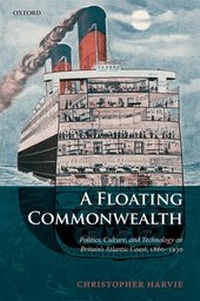
A Floating Commonwealth
Politics, Culture, and Technology on Britain's Atlantic Coast, 1860-1930
Published on 10. May 2012
Book
Paperback/Softback
336 pages
978-0-19-965518-2 (ISBN)
Description
Christopher Harvie offers a new portrait of society and identity in high industrial Britain by focusing on the sea as connector, not barrier. Atlantic and 'inland sea' together, Harvie argues, created a 'floating commonwealth' of port cities and their hinterlands whose interaction, both with one another and with nationalist and imperial politics, created an intense political and cultural synergy.
At a technical level, this produced the freight steamer and the efficient types of railways which opened up the developing world, as well as the institutions of international finance and communications in the age of 'telegrams and anger'. And ultimately, the resources of the Atlantic cities, their shipyards and works, enabled Britain to win withstand the test of the First World War.
Meanwhile, as Harvie shows, the continuous attempt to make sense of an ever-changing material reality also stimulated the discourses on which social criticism and literary modernism were based, from Carlyle to James Joyce - although the ultimate outcome, of slump and emigration, would leave enduring problems in the years to come.
At a technical level, this produced the freight steamer and the efficient types of railways which opened up the developing world, as well as the institutions of international finance and communications in the age of 'telegrams and anger'. And ultimately, the resources of the Atlantic cities, their shipyards and works, enabled Britain to win withstand the test of the First World War.
Meanwhile, as Harvie shows, the continuous attempt to make sense of an ever-changing material reality also stimulated the discourses on which social criticism and literary modernism were based, from Carlyle to James Joyce - although the ultimate outcome, of slump and emigration, would leave enduring problems in the years to come.
Reviews / Votes
Review from previous edition Harvie is especially good at selecting an economic or artistic personality, and using his furiously allusive scholarship to place them at the heart of historical change. * Pat Kane, The Independent * the tremendous wit and humour of Harvie's writing.... Then there is Harvie's scholarship and his seemingly limitless knowledge of all sorts of areas of historical inquiry * Bill Knox, Times Literary Supplement * Harvie has provided a new mental and historical map for these islands, which could have more than scholarly consequences. * Pat Kane, Times Higher Education Supplement * He examines the concept of Celticism in its various aspects with more accuracy and fewer histrionics than we often encounter in other works. Look at his index, and marvel at the number of creative talents identified, testimony to the painstaking and devoted energy which he brought to his researches. Then go back to the text and appreciate what fruitful use he has made of his discoveries. * James Halliday, Scots Independent * The book is a celebration of the Scottish technological intellect and the inland sea that linked the west coast of Britain. It was a hugely successful collaboration between English capital and Scottish brains and really made Britain great. It is intoxicating stuff. * Iain Macwhirter, Sunday Herald * There is at all levels, a kind of elegiac poignancy to the book which only adds to its authority and its power. I recommend you read it twice, once at speed and without pause for the footnotes or to jot down the flurries of reference, and once with pencil and notebook at hand. Impossible to fault... its an intellectual masterwork and one of the most important books of the present decade. * Brian Morton, The Scottish Review of Books * this is an engaging and lively book, often bold and witty. * Robert McLain, Enterprise & Society * intellectually ambitious, interesting ... It is the consistent demonstration of the links and synergies between parallel histories of politics, business and culture that consitutes the real strength of this book. Tjis weaving together of different worlds brings Harvies Floating Commonwealth to life * Gordon pentland, History Scotland *More details
Language
English
Place of publication
Oxford
United Kingdom
Target group
College/higher education
Illustrations
10 black and white images
Dimensions
Height: 234 mm
Width: 155 mm
Thickness: 19 mm
Weight
524 gr
ISBN-13
978-0-19-965518-2 (9780199655182)
Copyright in bibliographic data and cover images is held by Nielsen Book Services Limited or by the publishers or by their respective licensors: all rights reserved.
Schweitzer Classification
Other editions
Additional editions
Christopher Harvie
A Floating Commonwealth
Politics, Culture, and Technology on Britain's Atlantic Coast, 1860-1930
Book
03/2008
Oxford University Press
€140.40
Shipment within 15-20 days
Person
Christopher Harvie was born in Motherwell, Scotland. He was Senior Lecturer in History at the Open University and is currently Professor of British Studies in the English Seminar of Tuebingen University, Germany. He has been several times Director of Seminar and visiting fellow or guest professor at Merton and Nuffield Colleges, Oxford, Edinburgh and Strathclyde Universities, and St David's University College, Lampeter. He is Honorary Professor of Politics at the University of Wales, Aberystwyth, and also at Strathclyde University, Glasgow. Harvie has also lectured for the British Council in France, Finland, Hungary and Germany, and for the Anglo-German Society, besides other lecture tours in Russia, Italy, the United States and Canada.
Content
PRELUDE: BEHOLD THE SEA!; I PLACES AND VOICES; II OURSELVES TOGETHER; III IN TIME OF THE BREAKING OF NATIONS; IV AFTERMATH; PRELUDE: BEHOLD THE SEA!; I PLACES AND VOICES; II OURSELVES TOGETHER; III IN TIME OF THE BREAKING OF NATIONS; IV AFTERMATH