

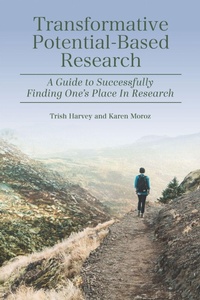
Transformative Potential-Based Research
A Guide to Successfully Finding One's Place in Research
Published on 4. November 2024
Book
Paperback/Softback
175 pages
978-1-9755-0701-5 (ISBN)
Description
Researchers working to clearly identify a research topic and theme have difficulty deciding how to focus their work. Using a potential-based learning focus, detailed in this text, readers are challenged to consider their role as researcher, scholar, and leader to guide their reflective work. Transformative Potential Based Research: A Guide to Successfully Finding One's Place in Research provides both the theoretical support and the guiding activities to help readers decide on an area of potential-based research. The result will prove to be transformational.
To guide this work, Karen Moroz and Trish Harvey have developed a suitable framework. They invite readers to review the mountain metaphor shared within the framework and to keep the visual present at all times as they progress through the book. It is addressed often and readers will be invited to use, extend, and discuss it numerous times throughout their journey.
Transformative Potential Based Research supports instructors and students through all stages of research, including:
identifying and embracing relevant and essential topics,
crafting research questions that accurately and concisely convey the purpose(s),
exploring one's own connection to the issue,
developing and employing individual processes that lead to success, and
determining a potential-based frame that motivates the writer and frames the work
Perfect for courses such as: Dissertation; Research Methods; Educational Methods; Intro to Research Design; Academic Writing; Capstone Practicum; Educational Research; Understanding Research
To guide this work, Karen Moroz and Trish Harvey have developed a suitable framework. They invite readers to review the mountain metaphor shared within the framework and to keep the visual present at all times as they progress through the book. It is addressed often and readers will be invited to use, extend, and discuss it numerous times throughout their journey.
Transformative Potential Based Research supports instructors and students through all stages of research, including:
identifying and embracing relevant and essential topics,
crafting research questions that accurately and concisely convey the purpose(s),
exploring one's own connection to the issue,
developing and employing individual processes that lead to success, and
determining a potential-based frame that motivates the writer and frames the work
Perfect for courses such as: Dissertation; Research Methods; Educational Methods; Intro to Research Design; Academic Writing; Capstone Practicum; Educational Research; Understanding Research
More details
Series
Language
English
Place of publication
United States
Target group
Professional and scholarly
Product notice
Paperback (trade)
Unsewn / adhesive bound
Dimensions
Height: 224 mm
Width: 150 mm
Thickness: 10 mm
Weight
277 gr
ISBN-13
978-1-9755-0701-5 (9781975507015)
Copyright in bibliographic data and cover images is held by Nielsen Book Services Limited or by the publishers or by their respective licensors: all rights reserved.
Schweitzer Classification
Persons
Trish Harvey is an associate professor in Hamline University's School of Education with an emphasis in Advanced Learning Technologies at Hamline University. Trish's background includes over 21 years of K-16 experience, including teaching social studies, facilitating graduate students in their pursuit of advanced degrees and serving as a district digital learning administrator. Her technology-related experiences include a 1-1 iPad implementation roll-out; the development of online and hybrid courses; district-wide professional development around technology goals; and a Bring-Your-Own-Device district initiative. Focus areas of scholarship and research include the use of digital tools for learning and assessment; fostering quality online learning experiences and relationships between students and instructors; and educational transformation via policy and technology. In her higher education experience, she has advised over 300 capstone students and dissertation students to completion. Additionally, Dr. Harvey serves as the Program Director for the EdD and MAEd programs where she teaches all research courses.
Karen Moroz taught seventh grade for 15 years and then served as a secondary-level literacy coach. She is now an Associate Professor in and the Program Director for Hamline University's Masters in the Arts of Literacy Education and Reading License programs. She also teaches within the doctoral program. Dr. Moroz's key areas of scholarship include effective online teaching; engaged learning; formative assessment; technology enhanced instruction; and facilitating relevant and authentic dialogue with learners. In her role as an instructor within a graduate school, Karen has advised over 200 capstone and dissertation students, providing her with a wealth of understanding of the processes and nuances researchers experience throughout their journey.
Karen Moroz taught seventh grade for 15 years and then served as a secondary-level literacy coach. She is now an Associate Professor in and the Program Director for Hamline University's Masters in the Arts of Literacy Education and Reading License programs. She also teaches within the doctoral program. Dr. Moroz's key areas of scholarship include effective online teaching; engaged learning; formative assessment; technology enhanced instruction; and facilitating relevant and authentic dialogue with learners. In her role as an instructor within a graduate school, Karen has advised over 200 capstone and dissertation students, providing her with a wealth of understanding of the processes and nuances researchers experience throughout their journey.
Content
List of Figures and Tables
Introduction
Chapter One - Introduction: The Journey
Karen's Journey
Trish's Journey
Framework
Conclusion
Chapter Two - What Do You Care About? Why? Where is the Potential?
What Do You Care About and Where is the Potential?: Argument and Explanation
Literature: Identifying a Research Focus
From a Research Topic to a Research Question
? Chapter Two Reflective Activities
Chapter Three - Who Are You?
Researcher Positionality: Argument and Explanation
Literature on a Reflexive Approach in Research
? Chapter Three Reflective Activities
Chapter Four - Embracing a Mindset of Inquiry
Embracing a Mindset of Inquiry: Argument and Explanation
Literature on the Mindset of a Researcher
Transitioning from a Problem-Based to a Potential-Based Mindset
Accepting and Conquering the Impostor Phenomenon
? Chapter Four Reflective Activities
Chapter Five - Your Community and Your Support
Professional Community: Argument and Explanation
Literature on Your Community and Your Support
Who is Your Community of Support?
? Chapter Five Reflective Activities
Chapter Six - Framing Your Potential-Based Area of Inquiry: Why Is This Important to Other People? What Are Other Points of View OnYour Problem?
Framing Your Audience: Argument and Explanation
Literature in Support of Identifying Conflicting Points of View
Potential-Based vs. "Problem of Practice"
Framing the Argument...Toward the Potential
? Chapter Six Reflective Activities
Chapter Seven - Standing on the Shoulders of Those Who Came Before
Those That Came Before Us-Argument and Explanation
Literature in Support of...Literature!
?Chapter Seven Reflective Activities
Chapter Eight - Nuts and Bolts & Conclusion
Nuts and Bolts: Argument and Explanation
? Chapter Eight Reflective Activities
About the Authors
Index
Introduction
Chapter One - Introduction: The Journey
Karen's Journey
Trish's Journey
Framework
Conclusion
Chapter Two - What Do You Care About? Why? Where is the Potential?
What Do You Care About and Where is the Potential?: Argument and Explanation
Literature: Identifying a Research Focus
From a Research Topic to a Research Question
? Chapter Two Reflective Activities
Chapter Three - Who Are You?
Researcher Positionality: Argument and Explanation
Literature on a Reflexive Approach in Research
? Chapter Three Reflective Activities
Chapter Four - Embracing a Mindset of Inquiry
Embracing a Mindset of Inquiry: Argument and Explanation
Literature on the Mindset of a Researcher
Transitioning from a Problem-Based to a Potential-Based Mindset
Accepting and Conquering the Impostor Phenomenon
? Chapter Four Reflective Activities
Chapter Five - Your Community and Your Support
Professional Community: Argument and Explanation
Literature on Your Community and Your Support
Who is Your Community of Support?
? Chapter Five Reflective Activities
Chapter Six - Framing Your Potential-Based Area of Inquiry: Why Is This Important to Other People? What Are Other Points of View OnYour Problem?
Framing Your Audience: Argument and Explanation
Literature in Support of Identifying Conflicting Points of View
Potential-Based vs. "Problem of Practice"
Framing the Argument...Toward the Potential
? Chapter Six Reflective Activities
Chapter Seven - Standing on the Shoulders of Those Who Came Before
Those That Came Before Us-Argument and Explanation
Literature in Support of...Literature!
?Chapter Seven Reflective Activities
Chapter Eight - Nuts and Bolts & Conclusion
Nuts and Bolts: Argument and Explanation
? Chapter Eight Reflective Activities
About the Authors
Index