

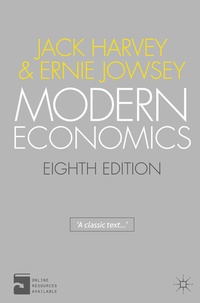
Modern Economics
An Introduction
8th Edition
Published on 4. May 2007
Book
Paperback/Softback
584 pages
978-0-230-55129-9 (ISBN)
Description
Jack Harvey's Modern Economics is a classic in the world of economics teaching and learning and is an ideal entry to the subject for introductory students in business and economics. This edition has been thoroughly revised and updated to reflect developments in a number of important and emerging areas of economics.
More details
Edition
8th ed. 2007
Language
English
Place of publication
London
United Kingdom
Publishing group
Bloomsbury Publishing PLC
Target group
College/higher education
Professional and scholarly
Dimensions
Height: 234 mm
Width: 156 mm
Thickness: 31 mm
Weight
881 gr
ISBN-13
978-0-230-55129-9 (9780230551299)
DOI
10.1007/978-1-137-08602-0
Schweitzer Classification
Other editions
Additional editions
E-Book
05/2007
8th Edition
Bloomsbury Academic
€140.99
Available for download
E-Book
05/2007
8th Edition
Bloomsbury Academic
€77.99
Available for download
Previous edition

Book
05/1998
7th Edition
Palgrave Macmillan
€37.19
Article exhausted; check for reprint
Persons
JACK HARVEY is a pioneer in teaching and writing textbooks about economics. He has taught economics at all levels and is the author of several successful and influential textbooks that have become modern classics.
ERNIE JOWSEY is Principal Lecturer in Economics in the School of Environment and Development at Sheffield Hallam University, UK.
ERNIE JOWSEY is Principal Lecturer in Economics in the School of Environment and Development at Sheffield Hallam University, UK.
Content
Preface.- PART 1: INTRODUCTION.- What Economics is About.- Methods of Allocating Resources.- PART 2: WHAT TO PRODUCE.- How Price is Formed in the Free Market.- Applications of Demand and Supply Analysis.- A Further Look at Demand.- PART 3: HOW TO PRODUCE THE THEORY OF PRODUCTION.- The Firm.- The Organisation and Scale of Production.- The Distribution of Goods to the Consumer.- The Location of Production.- Combining the Factors of Production.- Deciding on the Most Profitable Output.- The Supply Curve of the Industry under Perfect Competition.- Rewarding the Factors of Production: The Marginal Productivity Theory of Distribution.- PART 4: THE GOVERNMENT AND THE ALLOCATION OF RESOURCES.- Market Failure and the Role of Government.- Monopoly.- Imperfect Competition: Other Forms.- Externalities and Cost-Benefit Analysis.- The Environment: Conservation and Pollution.- The Provision of Goods and Services by the Public Sector.- PART 5: REWARDS TO THE DIFFERENT FACTORS OF PRODUCTION.- Labour and Wages.- Capital and Interest.- Land and Rent.- Entrepreneurship and Profit.- PART 6: MONEY AND FINANCIAL INSTITUTIONS.- Money and the Rate of Interest.- Financial Markets.- Clearing Banks.- The Bank of England.- PART 7: THE GOVERNMENT AND STABILISATION POLICY.- Measuring the Level of Activity: National Income Calculations.- Unemployment.- The Level of Output and Aggregate Demand: The Keynesian Explanation.- Employment and the Price Level.- Inflation: Its Effects.- Policies to Achieve Price Stability.- Economic Growth.- Balanced Regional Development.- Public Finance.- PART 8: INTERNATIONAL TRADE.- The Nature of International Trade.- The Balance-of-Payments.- Foreign Exchange Rates.- The Correction of a Balance-of-Payments Disequilibrium.- The European Union.- PART 9: LOOKING INTO THE FUTURE.- The Population of the UK.- Current Problems and Policies in the UK and Europe.