

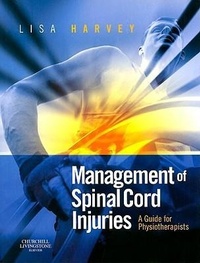
Management of Spinal Cord Injuries
A Guide for Physiotherapists
Published on 10. January 2008
Book
Paperback/Softback
316 pages
978-0-443-06858-4 (ISBN)
Description
Combining 25 years of clinical, research and teaching experience, Dr Lisa Harvey provides an innovative 5-step approach to the physiotherapy management of people with spinal cord injury. Based on the International Classification of Functioning, this approach emphasises the importance of setting goals which are purposeful and meaningful to the patient. These goals are related to performance of motor tasks analysed in terms of 6 key impairments. The assessment and treatment performance of each of these impairments for people with spinal cord injury is described in the following chapters:
training motor tasks
strength training
contracture management
pain management
respiratory management
cardiovascular fitness training
Dr Harvey develops readers' problem-solving skills equipping them to manage all types of spinal cord injuries. Central to these skills is an understanding of how people with different patterns of paralysis perform motor tasks and the importance of differentmuscles for motor tasks such as:
transfers and bed mobility of people
wheelchair mobility
hand function for people with tetraplegia
standing and walking with lower limb paralysis
This book is for students and junior physiotherapists with little or no experience in the area of spinal cord injury but with a general understanding of the principles of physiotherapy. It is also a useful tool for experienced clinicians, including those keen to explore the evidence base that supports different physiotherapy interventions.
training motor tasks
strength training
contracture management
pain management
respiratory management
cardiovascular fitness training
Dr Harvey develops readers' problem-solving skills equipping them to manage all types of spinal cord injuries. Central to these skills is an understanding of how people with different patterns of paralysis perform motor tasks and the importance of differentmuscles for motor tasks such as:
transfers and bed mobility of people
wheelchair mobility
hand function for people with tetraplegia
standing and walking with lower limb paralysis
This book is for students and junior physiotherapists with little or no experience in the area of spinal cord injury but with a general understanding of the principles of physiotherapy. It is also a useful tool for experienced clinicians, including those keen to explore the evidence base that supports different physiotherapy interventions.
Reviews / Votes
"This book fills a need and should become a motivation for physiotherapists in their clinical practice and reasoning and development...The book is extremely well referenced throughout with up-to-date material and so provides current supporting background to the clinical reasoning of practice.I would recommend this book."Dot Tussler MSc MCSP, 27.4.08"It will not just be valuable for students and junior therapists but also for academics in higher education to help deliver the core knowledge in this field. This book can also serve as a reference guide in a specialty unit owing to its wide coverage of the various aspects of this complex topic...In summary, with its excellent referencing back to literature, pointers on prioritizing therapy in such a task-intensive condition, and acknowledgment of limitations in the evidence base, this is an honest and very helpful book."International Journal of Therapy and Rehabilitation, March 2009, Vol 16, No 3"The book provides the student, and physiotherapists of all experience levels, with a wealth of information. As anexperienced clinician there was much in this text which I found stimulating and informative. The breadth of the content is extensive."Australian Journal of Physiotherapy 2009 Vol. 55More details
Language
English
Place of publication
London
United Kingdom
Publishing group
Elsevier Health Sciences
Target group
College/higher education
Physiotherapy undergraduates, on clinical placement and newly qualified physiotherapists.
Product notice
Paperback (trade)
sewn/stitched
Illustrations
Approx. 190 illustrations
Dimensions
Height: 248 mm
Width: 189 mm
Thickness: 19 mm
Weight
686 gr
ISBN-13
978-0-443-06858-4 (9780443068584)
Copyright in bibliographic data and cover images is held by Nielsen Book Services Limited or by the publishers or by their respective licensors: all rights reserved.
Schweitzer Classification
Other editions
Additional editions
E-Book
01/2008
Elsevier
€43.99
Available for download
Person
Lisa Harvey is a physiotherapist from the Royal Rehabilitation Centre in Sydney, and was awarded the Australian ACHS 2005 Gold Medal. This medal is awarded each year to one person that has made a significant contribution to the development of healthcare services. She lead the development of a website (www.physiotherapyexercises.com) which provides images of exercises appropriate for people with spinal cord injuries and other neurological conditions. Dr Harvey also teaches at the School of Physiotherapy at the University of Sydney and has taught large numbers of undergraduate and postgraduate students as well as running workshops worldwide.
Content
Section 1: The Bare EssentialsChapter 1: Background informationChapter 2: A framework for physiotherapy managementSection 2: Understanding how people with paralysis perform motor tasksChapter 3: Transfers and bed mobility for people with lower limb paralysisChapter 4: Wheelchair mobilityChapter 5: Hand function of people with tetraplegiaChapter 6: Standing and walking with lower limb paralysisChapter 7: Training Motor tasksChapter 8: Strength trainingChapter 9: Contracture managementChapter 10: Pain managementChapter 11: Respiratory managementChapter 12: Cardiovascular fitness trainingSection 3: Environmental factorsChapter 13: Wheelchair seatingSection 4: The way forwardChapter 14: Evidence-based physiotherapyAppendix: Innervation of muscles