

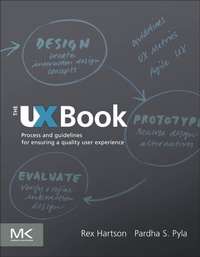
The UX Book
Process and Guidelines for Ensuring a Quality User Experience
Published on 27. February 2012
Book
Hardback
976 pages
978-0-12-385241-0 (ISBN)
Description
The UX Book: Process and Guidelines for Ensuring a Quality User Experience aims to help readers learn how to create and refine interaction designs that ensure a quality user experience (UX). The book seeks to expand the concept of traditional usability to a broader notion of user experience; to provide a hands-on, practical guide to best practices and established principles in a UX lifecycle; and to describe a pragmatic process for managing the overall development effort. The book provides an iterative and evaluation-centered UX lifecycle template, called the Wheel, for interaction design. Key concepts discussed include contextual inquiry and analysis; extracting interaction design requirements; constructing design-informing models; design production; UX goals, metrics, and targets; prototyping; UX evaluation; the interaction cycle and the user action framework; and UX design guidelines. This book will be useful to anyone interested in learning more about creating interaction designs to ensure a quality user experience. These include interaction designers, graphic designers, usability analysts, software engineers, programmers, systems analysts, software quality-assurance specialists, human factors engineers, cognitive psychologists, cosmic psychics, trainers, technical writers, documentation specialists, marketing personnel, and project managers.
Reviews / Votes
"The book is brimming with advanced knowledge for perfecting written communication in our mobile digital age... If you write anything at all (you send emails, don't you?), you need to grab a copy of Letting Go of the Words and keep it close at hand...This book has joined my writer's bookshelf as a valued aid I refer to every day." --TechWhirl.com, January 21, 2014More details
Language
English
Place of publication
San Francisco
United States
Publishing group
Elsevier Science & Technology
Target group
Professional and scholarly
UX practitioners, software engineers, programmers, and software testers. Graduate and Undergraduate students in user experience and UX design courses
Dimensions
Height: 235 mm
Width: 191 mm
Weight
1650 gr
ISBN-13
978-0-12-385241-0 (9780123852410)
Copyright in bibliographic data and cover images is held by Nielsen Book Services Limited or by the publishers or by their respective licensors: all rights reserved.
Schweitzer Classification
Other editions
New editions

Book
01/2019
2nd Edition
Morgan Kaufmann
€86.65
Article exhausted; check for reprint

Book
11/2018
2nd Edition
Morgan Kaufmann
€75.51
The article will not be published
Additional editions

Rex Hartson | Pardha S. Pyla
The UX Book
Process and Guidelines for Ensuring a Quality User Experience
E-Book
01/2012
Morgan Kaufmann
€63.95
Available for download
Persons
Rex Hartson is a pioneer researcher, teacher, and practitioner-consultant in HCI and UX. He is the founding faculty member of HCI (in 1979) in the Department of Computer Science at Virginia Tech. With Deborah Hix, he was co-author of one of the first books to emphasize the usability engineering process, Developing user interfaces: Ensuring usability through product & process. Hartson has been principle investigator or co-PI at Virginia Tech on a large number of research grants and has published many journal articles, conference papers, and book chapters. He has presented many tutorials, invited lectures, workshops, seminars, and international talks. He was editor or co-editor for Advances in Human-Computer Interaction, Volumes 1-4, Ablex Publishing Co., Norwood, NJ. His HCI practice is grounded in over 30 years of consulting and user experience engineering training for dozens of clients in business, industry, government, and the military. Pardha Pyla is an award-winning designer and product strategist with deep expertise in envisioning and delivering industry-leading products. He is the founding member of multiple thriving product and design (UX) practices that were responsible for producing successful enterprise software solutions in use across many industries. He is a pioneering researcher in the area of coordinating software engineering and UX lifecycle processes and the author of several peer-reviewed research publications in human-computer interaction and software engineering. He has received numerous awards in recognition of his work in design thinking, research, teaching, leadership, and service.
Content
Chapter 1: IntroductionPart I: ProcessChapter 2: The Wheel: A Lifecycle TemplateChapter 3: Contextual Inquiry: Eliciting Work Activity DataChapter 4: Contextual Analysis: Consolidating and Interpreting Work Activity DataChapter 5: Extracting Interaction Design RequirementsChapter 6: Constructing Design-Informing ModelsChapter 7: Design Thinking, Ideation and SketchingChapter 8: Mental Models and Conceptual DesignChapter 9: Design ProductionChapter 10: UX Goals, Metrics and TargetsChapter 11: PrototypingChapter 12: UX Evaulation IntroductionChapter 13: Rapid Evaluation MethodsChapter 14: Rigorous Empirical Evaluation: PreparationChapter 15: Rigorous Empirical Evaluation: Running the SessionChapter 16: Rigorous Empirical Evaluation: AnalysisChapter 17: Evaluation ReportingChapter 18: Wrapping up Rigorous UX EvaluationChapter 19: UX Methods for Agile DevelopmentPart II: Design Infrastructure GuidelinesChapter 20: Affordances DemystifiedChapter 21: The Interaction Cycle and the User Action FrameworkChapter 22: UX Design GuidelinesPart III: Advanced TopicsChapter 23: Connections with Software EngineeringChapter 24: Making it Work in the Real WorldReferencesExercisesIndex