

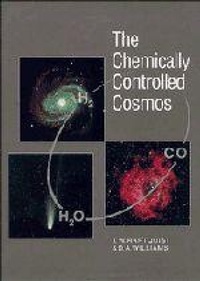
The Chemically Controlled Cosmos
Astronomical Molecules from the Big Bang to Exploding Stars
Published on 7. December 1995
Book
Hardback
186 pages
978-0-521-41983-3 (ISBN)
Description
Molecules in the early Universe acted as natural temperature regulators, keeping the primordial gas cool and, in turn, allowing galaxies and stars to be born. Even now, such similarly simple chemistry continues to control a wide variety of the exotic objects that populate our cosmos. What are the tools of the trade for the cosmic chemist? What can they teach us about the Universe we live in? These are the questions answered in this engaging and informative guide, The Chemically Controlled Cosmos. In clear, non-technical terms, and without formal mathematics, we learn how to study and understand the behaviour of molecules in a host of astronomical situations. We study the secretive formation of stars deep within interstellar clouds, the origin of our own Solar System, the cataclysmic deaths of many massive stars that explode as supernovae, and the hearts of active galactic nuclei, the most powerful objects in the Universe. We are given an accessible introduction to a wealth of astrophysics, and an understanding of how cosmic chemistry facilitates the investigation of many of the most exciting questions concerning astronomy today.
Reviews / Votes
'There is no doubt that in The Chemically Controlled Cosmos Hartquist and Williams have produced an extremely valuable synthesis of our present knowledge of the important chemical processes in space.' New Scientist 'In this excellent and remarkable book, compressing a dozen learned textbooks into 160 ebullient pages, Hartquist and Williams endeavour to tell how the chemistry and physics of space are intimately entwined, one dictating the other. To achieve this, some fundamental chemistry and physics is outlined in chapters one to three, without using any mathematics. Readers who are unversed in physical science may fail to understand a great deal of this, but persevere, for you may still acquire insight into the way in which chemistry controls the cosmos.' Chemistry in Britain ' ... a welcome addition to the bookshelves ... You will need patience and concentration because there is so much detail packed into its 160 pages. But if you really want to understand what is out there and why, it's worth it.' Astronomy Now ' ... a clear nonmathematical description of how the chemisty of simple molecules acts to regulate a number of important astro-environmental variables ... if astrochemistry has been the Cinderella of astronomy in recent years, this book is the ticket to the ball.' Nick Petford, THES ' ... students of chemistry and cosmochemistry might enjoy this pleasantly produced, introductory book.' Irish Astronomical Journal ' The text is singularly easy to read, and ample use is made of helpful analogies that facilitate the understanding of difficult concepts ... This is an excellent book, and, at just under GBP20 in hardback, it is good value for money.' David Flower, Webb Society ReviewsMore details
Language
English
Place of publication
Cambridge
United Kingdom
Illustrations
5 Tables, unspecified; 21 Halftones, unspecified; 43 Line drawings, unspecified
Dimensions
Height: 250 mm
Width: 175 mm
Thickness: 15 mm
Weight
510 gr
ISBN-13
978-0-521-41983-3 (9780521419833)
Copyright in bibliographic data and cover images is held by Nielsen Book Services Limited or by the publishers or by their respective licensors: all rights reserved.
Schweitzer Classification
Persons
Content
Preface; 1. A brief history; 2. Setting the astronomical scene; 3. The tools of the trade; 4. Chemistry after the Big Bang; 5. Interstellar clouds - the birth places of stars; 6. Star formation; 7. The solar system at birth; 8. Stellar winds and outflows; 9. Astronomical masers near bright stars; 10. Supernovae: fairly big bang; 11. Active galaxies; 12. Epilogue; Index.