

Geometry and the Silversmith
The Domcha Collection
Published on 30. October 2008
Book
Hardback
128 pages
978-0-9524322-8-9 (ISBN)
Description
From the earliest times, learning how to construct simple and complex geometric shapes has been part of the training of a silversmith. Moreover, the educated patron of 300 years ago was also likely to be well versed in geometry and able to appreciate the subtleties of design of a seemingly simple cream jug or sugar bowl. Many functional objects in what became known as the 'Queen Anne' style rely for effect on polygons, multifoils, ellipses, and truncated pyramids and cones. Curiously, however, books on the history of European silver have been silent on the subject of geometry and the process by which design is transmitted via the workbench to a finished silver object has scarcely been explored. In his introductory essay, Christopher Hartop suggests that many of the geometric forms that became popular in the early eighteenth century were in fact modelled on imported Asian ceramics and lacquer, some of which in turn were copying much earlier Chinese metal wares. Yet a silversmith still needed a knowledge of geometrical constructions, whether he was copying an imported object, following a design on paper, or utilizing a template.
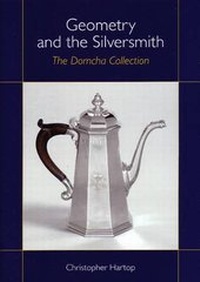
Using the Domcha Collection of predominantly English seventeenth- to nineteenth-century silver as examples, this important new study examines the role of geometry in the design and manufacture of silverware. The coffee pot illustrated on the front cover is a truncated octagonal pyramid and the octofoil salver achieves its pleasing effect through the intersection of four ellipses with common centre. The Domcha Collection, formed during the last 25 years, shows the timeless beauty of plain silver forms, where the emphasis is on line rather than ornament. The collection includes works by such important masters as Paul de Lamerie, Paul Crespin, Frederick Kandler, and the Hennell family. Silver made in Ireland and Scotland is also featured, as is provincial English silver made in York, Sheffield and Newcastle.
Using the Domcha Collection of predominantly English seventeenth- to nineteenth-century silver as examples, this important new study examines the role of geometry in the design and manufacture of silverware. The coffee pot illustrated on the front cover is a truncated octagonal pyramid and the octofoil salver achieves its pleasing effect through the intersection of four ellipses with common centre. The Domcha Collection, formed during the last 25 years, shows the timeless beauty of plain silver forms, where the emphasis is on line rather than ornament. The collection includes works by such important masters as Paul de Lamerie, Paul Crespin, Frederick Kandler, and the Hennell family. Silver made in Ireland and Scotland is also featured, as is provincial English silver made in York, Sheffield and Newcastle.
More details
Language
English
Place of publication
Cambridge
United Kingdom
Publishing group
John Adamson Publishing Consultants
Illustrations
128 illustrations
Dimensions
Height: 296 mm
Width: 220 mm
ISBN-13
978-0-9524322-8-9 (9780952432289)
Copyright in bibliographic data and cover images is held by Nielsen Book Services Limited or by the publishers or by their respective licensors: all rights reserved.
Schweitzer Classification
Persons
Christopher Hartop's books include: East Anglian Silver (2004); Royal Goldsmiths: The Art of Rundell & Bridge (2005); A Noble Feast (2008); The Classical Ideal (2010); A Noble Pursuit (2010); and Norfolk Summer: Making The Go-Between (2011).
Content
Foreword; Acknowledgements; Geometry and the silversmith: The importance of geometry; The attraction of simplicity; The triumph of the polygon; Proportion and harmony; The influence of Asia; The timelessness of the plain and the geometric The catalogue About the catalogue Glossary Bibliography Picture credits Index