

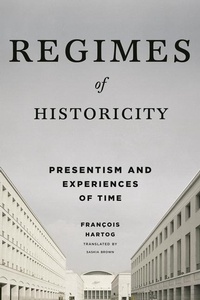
Regimes of Historicity
Presentism and Experiences of Time
Published on 6. December 2016
Book
Paperback/Softback
288 pages
978-0-231-16377-4 (ISBN)
Description
Francois Hartog explores crucial moments of change in society's "regimes of historicity," or its ways of relating to the past, present, and future. Inspired by Hannah Arendt, Reinhart Koselleck, and Paul Ricoeur, Hartog analyzes a broad range of texts, positioning The Odyssey as a work on the threshold of historical consciousness and contrasting it with an investigation of the anthropologist Marshall Sahlins's concept of "heroic history." He tracks changing perspectives on time in Chateaubriand's Historical Essay and Travels in America and sets them alongside other writings from the French Revolution. He revisits the insights of the French Annales School and situates Pierre Nora's Realms of Memory within a history of heritage and today's presentism, from which he addresses Jonas's notion of our responsibility for the future. Our presentist present is by no means uniform or clear-cut, and it is experienced very differently depending on the position we occupy in society.
We are caught up in global movement and accelerated flows, or else condemned to the life of casual workers, living from hand to mouth in a stagnant present, with no recognized past, and no real future either (since the temporality of plans and projects is inaccessible). The present is therefore experienced as emancipation or enclosure, and the perspective of the future is no longer reassuring, since it is perceived not as a promise, but as a threat. Hartog's resonant readings show us how the motor of history(-writing) has stalled and help us understand the contradictory qualities of our contemporary presentist relation to time.
We are caught up in global movement and accelerated flows, or else condemned to the life of casual workers, living from hand to mouth in a stagnant present, with no recognized past, and no real future either (since the temporality of plans and projects is inaccessible). The present is therefore experienced as emancipation or enclosure, and the perspective of the future is no longer reassuring, since it is perceived not as a promise, but as a threat. Hartog's resonant readings show us how the motor of history(-writing) has stalled and help us understand the contradictory qualities of our contemporary presentist relation to time.
Reviews / Votes
Since his classic Mirror of Herodotus, Francois Hartog has emerged as the most significant theorist of history and chronicler of our changing relationship to our own past that France has produced. In this series of meditative chapters, he takes us from the Greeks to the present once more, emphasizing how the theory of history must move from diagnosing the modern gap between expectation and experience to confronting the exigency of historical crisis today. Hartog's reflections are valuable for all humanists. -- Samuel Moyn, Columbia University In a book that should be required reading for anyone interested in history's role in contemporary society, Francois Hartog shows how unexamined assumptions about the past shape our understandings of ourselves and our place in history. -- Lynn Hunt, University of California, Los Angeles Francois Hartog's pioneering work on the concept of 'regimes of historicity' makes this book a must for scholars in both the social sciences and the humanities. A distinguished classical historian, Hartog uses specific, well-chosen examples to explain how understanding regimes of historicity will allow us to better understand the conditions of possibility for producing histories and, more generally, our own relationship to time. -- Robert Morrissey, University of Chicago Francois Hartog is perhaps the most important historian of historiography today... Regimes of Historicity should be required reading for anyone interested in the past, present, and future writing of history. American Historical Review Regimes of Historicity should be required reading for anyone interested in the past, present, and future writing of history. Time's BooksMore details
Series
Language
English
Place of publication
New York
United States
Target group
Professional and scholarly
Product notice
Paperback (trade)
Dimensions
Height: 228 mm
Width: 154 mm
Thickness: 17 mm
Weight
401 gr
ISBN-13
978-0-231-16377-4 (9780231163774)
Copyright in bibliographic data and cover images is held by Nielsen Book Services Limited or by the publishers or by their respective licensors: all rights reserved.
Schweitzer Classification
Other editions
Additional editions
Book
02/2015
Columbia University Press
€37.17
Shipment within 10-20 days
Persons
Francois Hartog is a professor at the Ecole des hautes etudes en sciences sociales and holds the Chair of Ancient and Modern Historiography. He is the author of many works, including The Mirror of Herodotus: The Representation of the Other in the Writing of History and Croire en l'histoire. Saskia Brown is an experienced translator of French works in intellectual history, philosophy, legal theory, and art.
Content
Presentism: Stopgap or New State? Introduction: Orders of Time and Regimes of Historicity Orders of Time 1 1. Making History: Sahlins's Islands 2. From Odysseus's Tears to Augustine's Meditations 3. Chateaubriand, Between Old and New Regimes of Historicity Orders of Time 2 4. Memory, History, and the Present 5. Heritage and the Present Our Doubly Indebted Present: The Reign of Presentism Notes Index