

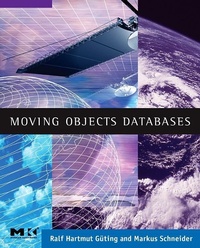
Moving Objects Databases
Published on 6. September 2005
Book
Hardback
416 pages
978-0-12-088799-6 (ISBN)
Description
Moving Objects Databases is the first uniform treatment of moving objects databases, the technology that supports GPS and RFID. It focuses on the modeling and design of data from moving objects - such as people, animals, vehicles, hurricanes, forest fires, oil spills, armies, or other objects - as well as the storage, retrieval, and querying of that very voluminous data.
It includes homework assignments at the end of each chapter, exercises throughout the text that students can complete as they read, and a solutions manual in the back of the book.
This book is intended for graduate or advanced undergraduate students. It is also recommended for computer scientists and database systems engineers and programmers in government, industry and academia; professionals from other disciplines, e.g., geography, geology, soil science, hydrology, urban and regional planning, mobile computing, bioterrorism and homeland security, etc.
It includes homework assignments at the end of each chapter, exercises throughout the text that students can complete as they read, and a solutions manual in the back of the book.
This book is intended for graduate or advanced undergraduate students. It is also recommended for computer scientists and database systems engineers and programmers in government, industry and academia; professionals from other disciplines, e.g., geography, geology, soil science, hydrology, urban and regional planning, mobile computing, bioterrorism and homeland security, etc.
Reviews / Votes
"This book represents a milestone in the synthesis of temporal and spatial database concepts and techniques. It unifies and organizes the existing research into a coherent whole and presents substantial new results and approaches in many areas. In each case it begins with what is known, then it introduces the new concepts in an abstract and general model, and then it translates the ideas into a pragmatic representation of data structures or SQL-like query language extensions. As such, the book makes both an excellent text and an excellent reference. It also takes you to the frontiers of our understanding, so it is a great point of departure for a new researcher who wants to advance this field." --from the foreword by Jim Gray, Microsoft ResearchMore details
Series
Language
English
Place of publication
San Francisco
United States
Publishing group
Elsevier Science & Technology
Target group
Professional and scholarly
Researchers, computer scientists and database systems engineers and programmers in government, industry and academia; professionals from other disciplines, e.g., geography, geology, soil science, hydrology, urban and regional planning, mobile computing, bioterrorism and homeland security, etc.
Product notice
sewn/stitched
Cloth over boards
Dimensions
Height: 244 mm
Width: 198 mm
Thickness: 32 mm
Weight
1133 gr
ISBN-13
978-0-12-088799-6 (9780120887996)
Copyright in bibliographic data and cover images is held by Nielsen Book Services Limited or by the publishers or by their respective licensors: all rights reserved.
Schweitzer Classification
Other editions
Additional editions
Ralf Hartmut Güting | Markus Schneider
Moving Objects Databases
E-Book
09/2005
Morgan Kaufmann
€64.95
Available for download
Ralf Hartmut Guting | Markus Schneider
Moving Objects Databases
Book
08/2005
Morgan Kaufmann
€82.50
Shipment within 15-20 days
Persons
Ralf Hartmut Gueting is Professor of computer science at the University of Hagen, Germany. After a one-year visit to the IBM Almaden Research Center in 1985, extensible and spatial database systems became his major research interests. He is the author of two German textbooks on data structures/algorithms and on compilers and has published about 50 articles on computational geometry and database systems. He is an associate editor of ACM Transactions on Database Systems. Markus Schneider is an Assistant Professor in the Computer Science Department of the University of Florida and holds a doctoral degree in Computer Science from the University of Hagen, Germany. He is author of a monograph in the area of spatial databases and of a German textbook on implementation concepts for database systems, and has published about 40 articles on database systems. He is on the editorial board of GeoInformatica.
Content
IntroductionSpatio-Temporal Databases in the PastModeling and Querying Current MovementModeling and Querying History of MovementData Structures and Algorithms for Moving Objects TypesThe Constraint Database ApproachSpatio-Temporal Indexing.