

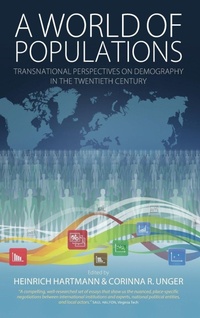
A World of Populations
Transnational Perspectives on Demography in the Twentieth Century
1st Edition
Published on 1. September 2014
Book
Hardback
264 pages
978-1-78238-427-4 (ISBN)
Description
Demographic study and the idea of a "population" was developed and modified over the course of the twentieth century, mirroring the political, social, and cultural situations and aspirations of different societies. This growing field adapted itself to specific policy concerns and was therefore never apolitical, despite the protestations of practitioners that demography was "natural." Demographics were transformed into public policies that shaped family planning, population growth, medical practice, and environmental conservation. While covering a variety of regions and time periods, the essays in this book share an interest in the transnational dynamics of emerging demographic discourses and practices. Together, they present a global picture of the history of demographic knowledge.
Reviews / Votes
"...an important step in writing global or transnational histories of demographic ideas and discourses... The volume offers insights into global and local interactions, covers major aspects of global family planning programmes and "overpopulation" debates, as well as contains case studies on the United States, Poland, Chile, South Korea, Turkey, Kenya, and Melanesia." ? H-Soz-Kult"I learned something new on almost every page of A World of Populations, despite having worked very closely in this field. The case studies herein are surprising and fascinating, offering new geographies and perspectives. This book has made me intrigued and curious about demography and world population all over again." ? Alison Bashford, University of Cambridge, author of Global Population
"Overall, this is a compelling, well-researched set of essays..[that] show us the nuanced, place-specific negotiations between international institutions and experts, national political entities, and local actors... Both the overall picture and the specific stories provided in this text are important contributions to the emerging literature on the history and social studies of demography and population policy." ? Saul Halfon, Virginia Tech
More details
Language
English
Place of publication
Oxford
United Kingdom
Target group
College/higher education
Product notice
Library binding
Illustrations
5 Illustrations
Dimensions
Height: 235 mm
Width: 157 mm
Thickness: 19 mm
Weight
532 gr
ISBN-13
978-1-78238-427-4 (9781782384274)
DOI
10.3167/9781782384274
Copyright in bibliographic data and cover images is held by Nielsen Book Services Limited or by the publishers or by their respective licensors: all rights reserved.
Schweitzer Classification
Other editions
Additional editions
Heinrich Hartmann | Corinna R. Unger
A World of Populations
Transnational Perspectives on Demography in the Twentieth Century
E-Book
09/2014
1st Edition
Berghahn Books
€35.49
Available for download
Persons
Heinrich Hartmann is Assistant Professor of History at the University of Basel, Switzerland. His book, Der Volkskoerper bei der Musterung. Militaerstatistik und Demographie in Europa vor dem Ersten Weltkrieg (Wallstein 2011) received the Henry E. Sigerist Award in 2012. His research focuses on the history of nineteenth and twentieth century demography in Europe and on the history of Turkish modernization in a transnational perspective.
Content
List of Figures
Notes on Contributors
Introduction: Counting, Constructing, and Controlling Populations: The History of Demography, Population Studies, and Family Planning in the Twentieth Century
Corinna R. Unger and Heinrich Hartmann
Part I: Producing Demographic Subjects: Transnational Discourses
Chapter 1. The View From Below and the View From Above: What U.S. Census-taking Reveals about Social Representations in the Era of Jim Crow and Immigration Restriction
Paul Schor
Chapter 2. "Reproduction" as a New Demographic Issue in Interwar Poland
Morgane Labbe
Chapter 3. Family Planning: A Rational Choice? The Influence of Systems Approaches, Behavioralism, and Rational Choice Thinking on Mid-Twentieth Century Family Planning Programs
Corinna R. Unger
Chapter 4. "Overpopulation" and the Politics of Family Planning in Chile and Peru: Negotiating National Interests and Global Paradigms in a Cold War World
Jadwiga E. Pieper Mooney
Chapter 5. Revisiting the Early 1970s Commoner-Ehrlich Debate about Population and Environment: Dueling Critiques of Production and Consumption in a Global Age
Thomas Robertson
Part II: Demographic Knowledge in Practice: Transfers and Transformations
Chapter 6. "Counting People": The Emerging Field of Demography and the Mobilization of the Social Sciences in the Formation of Policy, South Korea since 1948
John Paul DiMoia
Chapter 7. Laparoscopy as a Technology of Population Control: A Use-Centered History of Surgical Sterilization
Jesse Olszynko-Gryn
Chapter 8. A Twofold Discovery of Population: Assessing the Turkish Population by its "Knowledge, Attitudes and Practices", 1962-1980
Heinrich Hartmann
Chapter 9. Seeing Population as a Problem: Influences of the Construction of Population Knowledge on Kenyan Politics (1940s to 1980s)
Maria Doernemann
Chapter 10. Filtering Demography and Biomedical Technologies: Melanesian Nurses and Global Population Concerns
Alexandra Widmer
Index
Notes on Contributors
Introduction: Counting, Constructing, and Controlling Populations: The History of Demography, Population Studies, and Family Planning in the Twentieth Century
Corinna R. Unger and Heinrich Hartmann
Part I: Producing Demographic Subjects: Transnational Discourses
Chapter 1. The View From Below and the View From Above: What U.S. Census-taking Reveals about Social Representations in the Era of Jim Crow and Immigration Restriction
Paul Schor
Chapter 2. "Reproduction" as a New Demographic Issue in Interwar Poland
Morgane Labbe
Chapter 3. Family Planning: A Rational Choice? The Influence of Systems Approaches, Behavioralism, and Rational Choice Thinking on Mid-Twentieth Century Family Planning Programs
Corinna R. Unger
Chapter 4. "Overpopulation" and the Politics of Family Planning in Chile and Peru: Negotiating National Interests and Global Paradigms in a Cold War World
Jadwiga E. Pieper Mooney
Chapter 5. Revisiting the Early 1970s Commoner-Ehrlich Debate about Population and Environment: Dueling Critiques of Production and Consumption in a Global Age
Thomas Robertson
Part II: Demographic Knowledge in Practice: Transfers and Transformations
Chapter 6. "Counting People": The Emerging Field of Demography and the Mobilization of the Social Sciences in the Formation of Policy, South Korea since 1948
John Paul DiMoia
Chapter 7. Laparoscopy as a Technology of Population Control: A Use-Centered History of Surgical Sterilization
Jesse Olszynko-Gryn
Chapter 8. A Twofold Discovery of Population: Assessing the Turkish Population by its "Knowledge, Attitudes and Practices", 1962-1980
Heinrich Hartmann
Chapter 9. Seeing Population as a Problem: Influences of the Construction of Population Knowledge on Kenyan Politics (1940s to 1980s)
Maria Doernemann
Chapter 10. Filtering Demography and Biomedical Technologies: Melanesian Nurses and Global Population Concerns
Alexandra Widmer
Index