

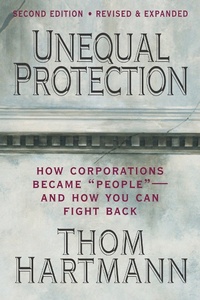
Unequal Protection: The Rise of Corporate Dominance and the Theft of Human Rights
Description
Thom Hartmann takes on these most difficult questions and tells a startling story that will forever change your understanding of American history. Amongst a deep historical context, Hartmann describes the history of the Fourteenth Amendment created at the end of the Civil War to grant basic rights to freed slaves and how it has been used by lawyers representing corporate interests to extend additional rights to businesses far more frequently than to freed slaves. Prior to 1886, corporations were referred to in U.S. law as "artificial persons." But in 1886, after a series of cases brought by lawyers representing the expanding railroad interests, the Supreme Court ruled that corporations were "persons" and entitled to the same rights granted to people under the Bill of Rights. Since this ruling, America has lost the legal structures that allowed for people to control corporate behavior.
In this revised and expanded second edition, Hartmann incorporates specific examples from today's headlines and proposes specific legal remedies that could truly save the world from political, economic and ecological disaster.
More details
Other editions
Additional editions
Person
Content
PART I – Corporations Take Over
Chapter 1: The Deciding Moment
Chapter 2: The Corporate Conquest of America
PART II – From the Birth of American Democracy through the Birth of Corporate Personhood
Chapter 3: Banding Together for the Good of “the Commons”
Chapter 4: The Boston Tea Party Revealed
Chapter 5: Jefferson Versus the Corporate Aristocracy
Chapter 6: The Early Role of Corporations in America
Chapter 7: The People’s Masters
Chapter 8: Corporations Go Global
Chapter 9: SCOTUS Takes the Presidency
Chapter 10: Protecting Corporate Liars
Chapter 11: Corporate Control of Politics
PART III – Unequal Consequences
Chapter 12: Unequal Uses for the Bill of Rights
Chapter 13: Unequal Regulation
Chapter 14: Unequal Protection from Risk
Chapter 15: Unequal Taxes
Chapter 16: Unequal Responsibility for Crime
Chapter 17: Unequal Privacy
Chapter 18: Unequal Citizenship and Access to Commons
Chapter 19: Unequal Wealth
Chapter 20: Unequal Trade
Chapter 21: Unequal Media
Chapter 22: Unequal Influence
PART IV – Restoring Personhood to People
Chapter 23: Capitalists and Americans Speak Out for Community
Chapter 24: End Corporate Personhood
Chapter 25: A New Entrepreneurial Boom
Chapter 26: A Democratic Marketplace
Chapter 27: Restoring Government of, by, and for the People
Acknowledgments
Notes
Index
About the Author