

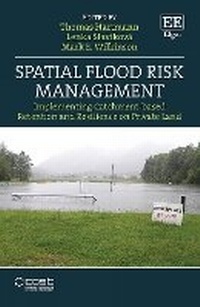
Spatial Flood Risk Management
Implementing Catchment-based Retention and Resilience on Private Land
Published on 22. April 2022
Book
Hardback
192 pages
978-1-80037-952-7 (ISBN)
Description
This is an open access title available under the terms of a CC BY-NC-ND 4.0 License. It is free to read, download and share at Elgaronline.
Centralizing the role of land and landowners, Spatial Flood Risk Management brings together knowledge from socio-economy, public policy, hydrology, geomorphology, and engineering to establish an interdisciplinary knowledge base on spatial approaches to managing flood risks.
Discussing key barriers and sharing evidence-based best practices to flood risk management, international contributors involved in the LAND4FLOOD EU COST Action initiative (CA16209) seek transferrable solutions to the implementation challenges of nature-based solutions. Introducing the concept of spatial flood risk management, the multi-national teams of authors consider the notion of land through three analytical lenses: as a biophysical system, a socio-economic resource, and a solution to flood-risk management. Advocating for a more comprehensive approach, the book explores options of where and how to store water within catchments, including decentralized water retention in the hinterland, flood storage along rivers, and planned flooding in resilient cities.
Bringing together the existing knowledge on the relation between flood risk management and land with an international and interdisciplinary scope, this book will prove invaluable to academics, policy makers and public authorities involved in flood risk management, urban planners, and governing environmental bodies.
Centralizing the role of land and landowners, Spatial Flood Risk Management brings together knowledge from socio-economy, public policy, hydrology, geomorphology, and engineering to establish an interdisciplinary knowledge base on spatial approaches to managing flood risks.
Discussing key barriers and sharing evidence-based best practices to flood risk management, international contributors involved in the LAND4FLOOD EU COST Action initiative (CA16209) seek transferrable solutions to the implementation challenges of nature-based solutions. Introducing the concept of spatial flood risk management, the multi-national teams of authors consider the notion of land through three analytical lenses: as a biophysical system, a socio-economic resource, and a solution to flood-risk management. Advocating for a more comprehensive approach, the book explores options of where and how to store water within catchments, including decentralized water retention in the hinterland, flood storage along rivers, and planned flooding in resilient cities.
Bringing together the existing knowledge on the relation between flood risk management and land with an international and interdisciplinary scope, this book will prove invaluable to academics, policy makers and public authorities involved in flood risk management, urban planners, and governing environmental bodies.
Reviews / Votes
'In a world where climatic variability is expected to deluge various regions of the world, the link between land use and water management will become even more evident. Hence, this book is a very timely and welcomed compilation of articles exploring nature-based solutions for flood risk management on privately-owned lands. It fills a large gap in the literature and is certainly a major contribution to the field.' -- Gabriel Eckstein, Texas A&M University and Immediate past-President of The International Water Resources Association, US 'Global climate change will cause more flood damage. The implementation of nature-based water retardation and absorption measures on both private and public land is an essential damage mitigation strategy. This book by leading European flood experts provides a roadmap to the hydrological, economic, geographic, legal and social challenges that the adoption and implementation of effective strategies poses.' -- A. Dan Tarlock, Chicago-Kent College of Law, Illinois Tech, USMore details
Language
English
Place of publication
Cheltenham
United Kingdom
Target group
Professional and scholarly
Dimensions
Height: 234 mm
Width: 156 mm
ISBN-13
978-1-80037-952-7 (9781800379527)
Copyright in bibliographic data and cover images is held by Nielsen Book Services Limited or by the publishers or by their respective licensors: all rights reserved.
Schweitzer Classification
Persons
Edited by Thomas Hartmann, School of Spatial Planning, TU Dortmund University, Germany, Lenka Slavikova, Faculty of Social and Economic Studies and Institute for Economic and Environmental Policy (IEEP), Jan Evangelista Purkyne University, Czech Republic and Mark E. Wilkinson, Department of Environmental and Biochemical Sciences, James Hutton Institute, UK
Content
Contents:
Foreword xii
Sally Priest
Acknowledgement xiv
1 Introduction to Spatial Flood Risk Management:
Implementing Catchment-based Retention and Resilience
on Private Land 1
Thomas Hartmann, Lenka Slavikova and Mark E. Wilkinson
PART I WATER RETENTION IN THE HINTERLAND
2 Nature-based solutions for flow reduction in catchment
headwaters 13
Mary Bourke, Mark E. Wilkinson and Zorica Srdjevic
3 Legal challenges of restricting land use for natural flood
protection in the hinterland 33
Juliane Albrecht and Sofija Nikolic Popadic
4 Implementation of measures in the hinterland: transaction
costs and economic instruments 52
Gabor Ungvari and Dennis Collentine
PART II FLOOD STORAGE ALONG RIVERS
5 Technical and hydrological effects across scales and
thresholds of polders, dams and levees 68
Reinhard Pohl and Nejc Bezak
6 Financial compensation and legal restrictions for using
land for flood retention 89
Andras Kis, Arthur Schindelegger and Vesna Zupanc
7 Upstream-downstream schemes and their instruments 106
Thomas Hartmann, Lukas Loeschner and Jan Machac
PART III RESILIENT CITIES
8 Individual measures for adaptive cities 120
Christin Rinnert, Thomas Thaler and Robert Ju?pner
9 Institutionalizing the resilient city: constraints and opportunities 134
Rares Halbac-Cotoara-Zamfir and Barbara Tempels
10 The role of risk transfer and spatial planning for enhancing
the flood resilience of cities 148
Paul Hudson and Lenka Slavikova
PART IV CONCLUSION
11 Challenges of spatial flood risk management 164
Thomas Hartmann, Lenka Slavikova and Mark E.
Wilkinson
Index
Foreword xii
Sally Priest
Acknowledgement xiv
1 Introduction to Spatial Flood Risk Management:
Implementing Catchment-based Retention and Resilience
on Private Land 1
Thomas Hartmann, Lenka Slavikova and Mark E. Wilkinson
PART I WATER RETENTION IN THE HINTERLAND
2 Nature-based solutions for flow reduction in catchment
headwaters 13
Mary Bourke, Mark E. Wilkinson and Zorica Srdjevic
3 Legal challenges of restricting land use for natural flood
protection in the hinterland 33
Juliane Albrecht and Sofija Nikolic Popadic
4 Implementation of measures in the hinterland: transaction
costs and economic instruments 52
Gabor Ungvari and Dennis Collentine
PART II FLOOD STORAGE ALONG RIVERS
5 Technical and hydrological effects across scales and
thresholds of polders, dams and levees 68
Reinhard Pohl and Nejc Bezak
6 Financial compensation and legal restrictions for using
land for flood retention 89
Andras Kis, Arthur Schindelegger and Vesna Zupanc
7 Upstream-downstream schemes and their instruments 106
Thomas Hartmann, Lukas Loeschner and Jan Machac
PART III RESILIENT CITIES
8 Individual measures for adaptive cities 120
Christin Rinnert, Thomas Thaler and Robert Ju?pner
9 Institutionalizing the resilient city: constraints and opportunities 134
Rares Halbac-Cotoara-Zamfir and Barbara Tempels
10 The role of risk transfer and spatial planning for enhancing
the flood resilience of cities 148
Paul Hudson and Lenka Slavikova
PART IV CONCLUSION
11 Challenges of spatial flood risk management 164
Thomas Hartmann, Lenka Slavikova and Mark E.
Wilkinson
Index