

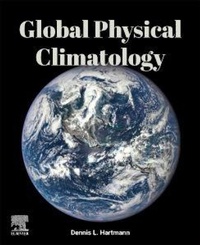
Global Physical Climatology
3rd Edition
Published on 16. April 2026
Book
Paperback/Softback
568 pages
978-0-443-27331-5 (ISBN)
Description
Global Physical Climatology, Third Edition delineates the science of climate and climate change that spans the atmosphere, oceans, and land surfaces. The book begins with a detailed introduction of the climate system and then introduces its physics, including the principles and processes that determine the structure and climate of the atmosphere, oceans, and land surfaces. More advanced sections apply the basic knowledge introduced earlier in the text in understanding natural variability of the climate in both the present and past, the sensitivity of climate to external forces, explanations for the ice ages, and the science of human-induced climate change.
The physical principles and computer models necessary for understanding past climate and predicting future climate are also discussed. This book is recommended for upper division undergraduates and graduates in meteorology, atmospheric science, oceanography, and other environmental fields. It is also suitable for students with a background of at least one year of college physics and calculus as well as researchers in academia, government (military, NOAA, NWS), and policymakers.
The physical principles and computer models necessary for understanding past climate and predicting future climate are also discussed. This book is recommended for upper division undergraduates and graduates in meteorology, atmospheric science, oceanography, and other environmental fields. It is also suitable for students with a background of at least one year of college physics and calculus as well as researchers in academia, government (military, NOAA, NWS), and policymakers.
More details
Edition
3rd edition
Language
English
Place of publication
Philadelphia
United States
Target group
College/higher education
Product notice
Paperback (trade)
Unsewn / adhesive bound
Dimensions
Height: 229 mm
Width: 153 mm
Thickness: 26 mm
Weight
816 gr
ISBN-13
978-0-443-27331-5 (9780443273315)
Copyright in bibliographic data and cover images is held by Nielsen Book Services Limited or by the publishers or by their respective licensors: all rights reserved.
Schweitzer Classification
Other editions
Additional editions
Dennis L. Hartmann
Global Physical Climatology
E-Book
02/2026
3rd Edition
Elsevier
€95.99
Available for download
Previous edition
Dennis L. Hartmann
Global Physical Climatology
Book
12/2015
2nd Edition
Elsevier
€126.27
Shipment within 15-20 days
Person
Professor Dennis L. Hartmann received his BS degree in Mechanical Engineering from the University of Portland, and his PhD in Geophysical Fluid Dynamics from Princeton University. After postdoctoral appointments at McGill University and the National Center for Atmospheric Research, he joined the faculty of the University of Washington, where he is currently an emeritus professor in the Department of Atmospheric and Climate Sciences. He is a member of the U.S. National Academy of Sciences. Professor Hartmann's research interests include dynamics of the atmosphere, atmosphere-ocean interaction, climate feedback processes and climate change. His primary areas of expertise are atmospheric dynamics, radiation and remote sensing, and mathematical and statistical techniques for data analysis.
Content
1. Introduction to the Climate System
2. The Global Energy Balance
3. Atmospheric Radiative Transfer and Climate
4. The Energy Balance of the Surface
5. The Hydrologic Cycle
6. Atmospheric General Circulation and Climate
7. The Ocean General Circulation and Climate
8. Natural Intraseasonal and Interannual Variability
9. History and Evolution of Earth's Climate
10. Climate Sensitivity and Feedback Mechanisms
11. Global Climate Models
12. Natural Climate Change
13. Anthropogenic Climate Change
2. The Global Energy Balance
3. Atmospheric Radiative Transfer and Climate
4. The Energy Balance of the Surface
5. The Hydrologic Cycle
6. Atmospheric General Circulation and Climate
7. The Ocean General Circulation and Climate
8. Natural Intraseasonal and Interannual Variability
9. History and Evolution of Earth's Climate
10. Climate Sensitivity and Feedback Mechanisms
11. Global Climate Models
12. Natural Climate Change
13. Anthropogenic Climate Change