

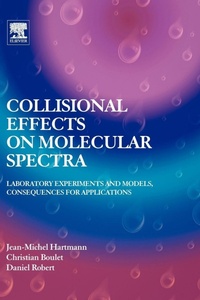
Collisional Effects on Molecular Spectra
Laboratory Experiments and Models, Consequences for Applications
Published on 11. August 2008
Book
Hardback
432 pages
978-0-444-52017-3 (ISBN)
Description
Gas phase molecular spectroscopy is a powerful tool for obtaining information on the geometry and internal structure of isolated molecules as well as on the interactions that they undergo. It enables the study of fundamental parameters and processes and is also used for the sounding of gas media through optical techniques. It has been facing always renewed challenges, due to the considerable improvement of experimental techniques and the increasing demand for accuracy and scope of remote sensing applications.
In practice, the radiating molecule is usually not isolated but diluted in a mixture at significant total pressure. The collisions among the molecules composing the gas can have a large influence on the spectral shape, affecting all wavelength regions through various mechanisms. These must be taken into account for the correct analysis and prediction of the resulting spectra.
This book reviews our current experimental and theoretical knowledge and the practical consequences of collisional effects on molecular spectral shapes in neutral gases. General expressions are first given. They are formal of difficult use for practical calculations often but enable discussion of the approximations leading to simplified situations. The first case examined is that of isolated transitions, with the usual pressure broadening and shifting but also refined effects due to speed dependence and collision-induced velocity changes. Collisional line-mixing, which invalidates the notion of isolated transitions and has spectral consequences when lines are closely spaced, is then discussed within the impact approximation. Regions where the contributions of many distant lines overlap, such as troughs between transitions and band wings, are considered next. For a description of these far wings the finite duration of collisions and concomitant breakdown of the impact approximation must be taken into account. Finally, for long paths or elevated pressures, the dipole or polarizability induced by intermolecular interactions can make significant contributions. Specific models for the description of these collision induced absorption and light scattering processes are presented.
The above mentioned topics are reviewed and discussed from a threefold point of view: the various models, the available data, and the consequences for applications including heat transfer, remote sensing and optical sounding. The extensive bibliography and discussion of some remaining problems complete the text.
In practice, the radiating molecule is usually not isolated but diluted in a mixture at significant total pressure. The collisions among the molecules composing the gas can have a large influence on the spectral shape, affecting all wavelength regions through various mechanisms. These must be taken into account for the correct analysis and prediction of the resulting spectra.
This book reviews our current experimental and theoretical knowledge and the practical consequences of collisional effects on molecular spectral shapes in neutral gases. General expressions are first given. They are formal of difficult use for practical calculations often but enable discussion of the approximations leading to simplified situations. The first case examined is that of isolated transitions, with the usual pressure broadening and shifting but also refined effects due to speed dependence and collision-induced velocity changes. Collisional line-mixing, which invalidates the notion of isolated transitions and has spectral consequences when lines are closely spaced, is then discussed within the impact approximation. Regions where the contributions of many distant lines overlap, such as troughs between transitions and band wings, are considered next. For a description of these far wings the finite duration of collisions and concomitant breakdown of the impact approximation must be taken into account. Finally, for long paths or elevated pressures, the dipole or polarizability induced by intermolecular interactions can make significant contributions. Specific models for the description of these collision induced absorption and light scattering processes are presented.
The above mentioned topics are reviewed and discussed from a threefold point of view: the various models, the available data, and the consequences for applications including heat transfer, remote sensing and optical sounding. The extensive bibliography and discussion of some remaining problems complete the text.
More details
Language
English
Place of publication
Oxford
United Kingdom
Publishing group
Elsevier Science & Technology
Target group
College/higher education
Research workers in the fields of spectroscopy, remote sensing, optical sounding and radiative heat transfer in gas media
University libraries (PhD students)
Product notice
Laminated cover
Dimensions
Height: 239 mm
Width: 163 mm
Thickness: 25 mm
Weight
930 gr
ISBN-13
978-0-444-52017-3 (9780444520173)
Copyright in bibliographic data and cover images is held by Nielsen Book Services Limited or by the publishers or by their respective licensors: all rights reserved.
Schweitzer Classification
Other editions
New editions
Jean-Michel Hartmann | Christian Boulet | Daniel Robert
Collisional Effects on Molecular Spectra
Laboratory Experiments and Models, Consequences for Applications
Book
01/2021
2nd Edition
Elsevier
€253.50
Shipment within 15-20 days
Additional editions
Jean-Michel Hartmann | Christian Boulet | Daniel Robert
Collisional Effects on Molecular Spectra
Laboratory Experiments and Models, Consequences for Applications
E-Book
08/2008
Elsevier
€155.00
Available for download
Persons
Jean-Michel HARTMANN: born in 1961, << Directeur de Recherche >> for the French CNRS (Centre National de la Recherche Scientifique has been carrying research and advising PhD students in the field of the book for about twenty years. He is the director of the French Molecular Spectroscopy Network and the author of more than 100 publications in international journals. Christian BOULET: born in 1947, Professor at Universite Paris XI (Orsay) has been carrying theoretical researches in the field for more than 30 years and is the author of about 130 publications in international journals. He has been the director of the Laboratoire d'Infrarouge and of the Laboratoire de Physique Moleculaire et Applications. Daniel Robert: born in 1940, "Emerite professor? at Franche Comte University (besancon) is also a theoretician of line-shapes who has been working in the field for more than 30 years and who is the author of about 120 publications in international journals. He has been the director of the Laboratoire de Physique Moleculaire (Besancon
Content
I. IntroductionII. General EquationsIII. Isolated LinesIV. Collisional Line-Mixing (within clusters of lines)V. The Far Wings (beyond the impact approximations)VI. Collision Induced Absorption and Light ScatteringVII. Consequences for ApplicationsVIII. Towards Future Researches