

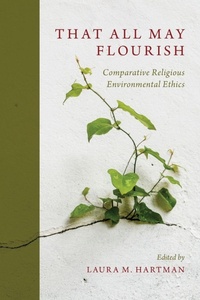
That All May Flourish
Comparative Religious Environmental Ethics
Published on 12. July 2018
Book
Paperback/Softback
328 pages
978-0-19-045603-0 (ISBN)
Description
Can humans flourish without destroying the earth? In this book, experts on many of the world's major and minor religious traditions address the question of human and earth flourishing. Each chapter considers specific religious ideas and specific environmental harms. Chapters are paired and the authors work in dialogue with one another. Taken together, the chapters reveal that the question of flourishing is deceptively simple. Most would agree that humans should flourish without destroying the earth. But not all humans have equal opportunities to flourish. Additionally, on a basic physical level any human flourishing must, of necessity, cause some harm. These considerations of the price and distribution of flourishing raise unique questions about the status of humans and nature. This book represents a step toward reconciliation: that people and their ecosystems may live in peace, that people from different religious worldviews may engage in productive dialogue; in short, that all may flourish.
Reviews / Votes
[That All May Flourish] provides much to advancing interreligious, cross-cultural inquiry into better understanding the ways that human flourishing and ecological well-being are enmeshed. * Michael VanZandt Collins, Boston College, Religious Studies Reviews * This is a great text that challenges the dominant language of stewardship and the Anthropocene and offers the metaphor of flourishing instead. It will be a great supplemental text for courses on comparative religion, environmental ethics, and religion and nature. I appreciate that it includes both comparative approaches, but also a topic-centered approach. Furthermore, the case studies that many of the authors use to anchor their work will be valuable in the classroom! * Whitney A. Bauman, Journal for the Study of Religion, Nature and Culture * With accessible chapters covering a range of academic disciplines and religious traditions, this book should be studied by scholars and educated lay readers of environmental ethics. Theologians and philosophers will find wisdom from the "flourishing" approach to environmental ethics, not only in their own traditions but in other religious traditions as well. Students will find the brief dialogue chapters an easy entry into key questions. * Harold Coward, Theological Studies * Overall, though, this book is challenging and impressive in scope, and it is far more successful than most edited volumes at creating insight and interest across its different discussions. The editor and the contributors are to be commended on their collective work on this project. * Anne Mocko, Concordia College, Reading Religion * Written from a process of learned exchange across traditions, this book hosts a focused dialogue on something that matters for every living thing: what it means to flourish. Curated with originality and carefully written, this volume will be especially useful for teaching in courses on religion, on environmental studies, and on cultural dialogue. * Willis Jenkins, Professor of Religious Studies and Co-Director of the Institute for Practical Ethics at the University of Virginia * Laura Hartman has done something extraordinary: she produced a volume on comparative religious ethics whose organization replicates the type of productive dialogue at the core of this enterprise. When you add that the chapters are written in an accessible and engaging style, and this is the first comparative religious ethics collection that focuses on the non-human world, it is a must read for all ethicists. * Elizabeth Bucar, author of Pious Fashion: How Muslim Women Dress * In this fascinating, timely, and suggestive collection, the contributors extend the concept of 'flourishing' beyond human-centered virtue ethics to the wider world of ecology and environmental ethics. As a work of comparative religious ethics, it exemplifies a novel and welcome approach to cross-cultural analysis: the chapters each combine specialist attention to particular cases in context, with ongoing constructive dialogue around important aspects of human, animal, and environmental flourishing. * Aaron Stalnaker, Associate Professor of Religious Studies, Indiana University *More details
Language
English
Place of publication
New York
United States
Target group
Professional and scholarly
Dimensions
Height: 234 mm
Width: 156 mm
Thickness: 19 mm
Weight
557 gr
ISBN-13
978-0-19-045603-0 (9780190456030)
Copyright in bibliographic data and cover images is held by Nielsen Book Services Limited or by the publishers or by their respective licensors: all rights reserved.
Schweitzer Classification
Other editions
Additional editions
Book
08/2018
Oxford University Press Inc
€175.60
Shipment within 15-20 days
E-Book
05/2018
1st Edition
OUP eBook
€14.49
Available for download
E-Book
05/2018
1st Edition
OUP eBook
€16.49
Available for download
Person
Laura M. Hartman blends her passions for religion and the environment in her work on consumption, climate engineering, ecological restoration, feminism, virtue, and other topics. She is author of The Christian Consumer: Living Faithfully in a Fragile World.
Content
Table of Contents
Acknowledgements
List of Contributors
Introduction by Laura M. Hartman
Part 1: Flourishing and Its Costs
Chapter 1: Buddha, Aristotle, and Science: Rediscovering Purpose and the Value of Flourishing in Nature by Colette Sciberras
Chapter 2: Eating: Glimpsing God's Infinite Goodness by Nelson Reveley
Chapter 3: Dialogue: Sciberras and Reveley
Part 2: Animals and Care
Chapter 4: Daoism, Natural Life, and Human Flourishing by David E. Cooper
Chapter 5: All God's Creatures are Communities Like You (Qur'an 6:38): Precedents for Eco-halal Meat in Muslim Traditions by Sarah E. Robinson-Bertoni
Chapter 6: Dialogue: Cooper and Robinson-Bertoni
Part 3: Climate and Culture
Chapter 7: Yoga Bodies and Bodies of Water: Solutions for Climate Change in India? By Christopher Miller
Chapter 8: Understanding a 'Broken World': Islam, Ritual, and Climate Change in Mali, West Africa by Dianna Bell
Chapter 9: Dialogue: Miller and Bell
Part 4: Texts and Traditions
Chapter 10: Intertextually Modified Organisms: Genetic Engineering, Jewish Ethics, and Rabbinic Text by Rebecca J. Epstein-Levi
Chapter 11: Flourishing in Crisis: Environmental Issues in the Catholic Social Teachings by Jennifer Phillips
Chapter 12: Dialogue: Epstein-Levi and Phillips
Part 5: Communities and Human Agency
Chapter 13: Flourishing in Nature Religion by Chris Klassen
Chapter 14: Interfaith Environmentalism and Uneven Opportunities to Flourish by Amanda Baugh
Chapter 15: Dialogue: Klassen and Baugh
Part 6: Respect and Relationality
Chapter 16: Developing a Mengzian Environmental Ethic by Cheryl Cottine
Chapter 17: Relationality, Reciprocity and Flourishing in an African Landscape by Michael Hannis and Sian Sullivan
Chapter 18: Dialogue: Cottine, Hannis, and Sullivan
Conclusion by Laura M. Hartman
Acknowledgements
List of Contributors
Introduction by Laura M. Hartman
Part 1: Flourishing and Its Costs
Chapter 1: Buddha, Aristotle, and Science: Rediscovering Purpose and the Value of Flourishing in Nature by Colette Sciberras
Chapter 2: Eating: Glimpsing God's Infinite Goodness by Nelson Reveley
Chapter 3: Dialogue: Sciberras and Reveley
Part 2: Animals and Care
Chapter 4: Daoism, Natural Life, and Human Flourishing by David E. Cooper
Chapter 5: All God's Creatures are Communities Like You (Qur'an 6:38): Precedents for Eco-halal Meat in Muslim Traditions by Sarah E. Robinson-Bertoni
Chapter 6: Dialogue: Cooper and Robinson-Bertoni
Part 3: Climate and Culture
Chapter 7: Yoga Bodies and Bodies of Water: Solutions for Climate Change in India? By Christopher Miller
Chapter 8: Understanding a 'Broken World': Islam, Ritual, and Climate Change in Mali, West Africa by Dianna Bell
Chapter 9: Dialogue: Miller and Bell
Part 4: Texts and Traditions
Chapter 10: Intertextually Modified Organisms: Genetic Engineering, Jewish Ethics, and Rabbinic Text by Rebecca J. Epstein-Levi
Chapter 11: Flourishing in Crisis: Environmental Issues in the Catholic Social Teachings by Jennifer Phillips
Chapter 12: Dialogue: Epstein-Levi and Phillips
Part 5: Communities and Human Agency
Chapter 13: Flourishing in Nature Religion by Chris Klassen
Chapter 14: Interfaith Environmentalism and Uneven Opportunities to Flourish by Amanda Baugh
Chapter 15: Dialogue: Klassen and Baugh
Part 6: Respect and Relationality
Chapter 16: Developing a Mengzian Environmental Ethic by Cheryl Cottine
Chapter 17: Relationality, Reciprocity and Flourishing in an African Landscape by Michael Hannis and Sian Sullivan
Chapter 18: Dialogue: Cottine, Hannis, and Sullivan
Conclusion by Laura M. Hartman