

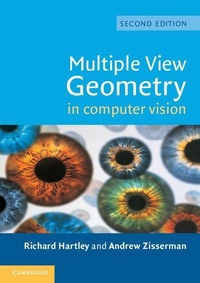
Multiple View Geometry in Computer Vision
2nd Edition
Published on 25. March 2004
Book
Paperback/Softback
670 pages
978-0-521-54051-3 (ISBN)
Description
A basic problem in computer vision is to understand the structure of a real world scene given several images of it. Techniques for solving this problem are taken from projective geometry and photogrammetry. Here, the authors cover the geometric principles and their algebraic representation in terms of camera projection matrices, the fundamental matrix and the trifocal tensor. The theory and methods of computation of these entities are discussed with real examples, as is their use in the reconstruction of scenes from multiple images. The new edition features an extended introduction covering the key ideas in the book (which itself has been updated with additional examples and appendices) and significant new results which have appeared since the first edition. Comprehensive background material is provided, so readers familiar with linear algebra and basic numerical methods can understand the projective geometry and estimation algorithms presented, and implement the algorithms directly from the book.
Reviews / Votes
'I am very positive about this book. The authors have succeeded very well in describing the main techniques in mainstream multiple view geometry, both classical and modern, in a clear and consistent way.' Computing Reviews '... a book which is timely, extremely thorough and commendably clear ... Overall, the approach is masterly ... The authors have managed to present the very essence of the subject in a way which the most subtle ideas seem natural and straightforward. I have never seen such a clear exploration of the geometry of vision. I would wholeheartedly recommend this book. It deserves to be in the library of every serious researcher in the field of computer vision.' Journal of Robotica 'The new edition features an extended introduction covering the key ideas in the book (which itself have been updated with additional examples and appendices) and significant new results which have appeared since the first edition. Comprehensive background material is provided, so readers familiar with linear algebra and basic numerical methods can understand the projective geometry and estimation algorithms presented, and implement the algorithms directly from the book.' Zentralblatt MATHMore details
Edition
2nd Revised edition
Language
English
Place of publication
Cambridge
United Kingdom
Target group
Professional and scholarly
Edition type
Revised edition
Product notice
Paperback (trade)
Illustrations
Worked examples or Exercises; 35 Tables, unspecified; 36 Line drawings, color
Dimensions
Height: 244 mm
Width: 170 mm
Thickness: 36 mm
Weight
1140 gr
ISBN-13
978-0-521-54051-3 (9780521540513)
Copyright in bibliographic data and cover images is held by Nielsen Book Services Limited or by the publishers or by their respective licensors: all rights reserved.
Schweitzer Classification
Other editions
Additional editions
Richard Hartley | Andrew Zisserman
Multiple View Geometry in Computer Vision
E-Book
05/2006
2nd Edition
Cambridge University Press
€85.99
Available for download
Richard Hartley
Multiple View Geometry in Computer Vision
E-Book
03/2004
Cambridge University Press
€72.99
Available for download
Previous edition
Richard Hartley | Andrew Zisserman
Multiple View Geometry in Computer Vision
Book
07/2000
Cambridge University Press
€86.66
Article exhausted; check for reprint
Persons
fm.author_biographical_note1 fm.author_biographical_note2
Content
1. Introduction - a tour of multiple view geometry; Part 0. The Background: Projective Geometry, Transformations and Estimation: 2. Projective geometry and transformations of 2D; 3. Projective geometry and transformations of 3D; 4. Estimation - 2D projective transforms; 5. Algorithm evaluation and error analysis; Part I. Camera Geometry and Single View Geometry: 6. Camera models; 7. Computation of the camera matrix; 8. More single view geometry; Part II. Two-View Geometry: 9. Epipolar geometry and the fundamental matrix; 10. 3D reconstruction of cameras and structure; 11. Computation of the fundamental matrix F; 12. Structure computation; 13. Scene planes and homographies; 14. Affine epipolar geometry; Part III. Three-View Geometry: 15. The trifocal tensor; 16. Computation of the trifocal tensor T; Part IV. N -View Geometry: 17. N-linearities and multiple view tensors; 18. N-view computational methods; 19. Auto-calibration; 20. Duality; 21. Chirality; 22. Degenerate configurations; Part V. Appendices: Appendix 1. Tensor notation; Appendix 2. Gaussian (normal) and chi-squared distributions; Appendix 3. Parameter estimation. Appendix 4. Matrix properties and decompositions; Appendix 5. Least-squares minimization; Appendix 6. Iterative Estimation Methods; Appendix 7. Some special plane projective transformations; Bibliography; Index.