

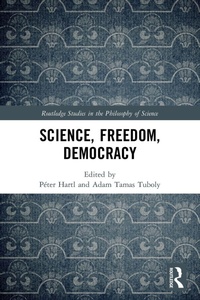
Science, Freedom, Democracy
1st Edition
Published on 25. September 2023
Book
Paperback/Softback
230 pages
978-0-367-70400-1 (ISBN)
Description
This book addresses the complex relationship between the values of liberal democracy and the values associated with scientific research. The chapters explore how these values mutually reinforce or conflict with one another, in both historical and contemporary contexts.
The contributors utilize various approaches to address this timely subject, including historical studies, philosophical analysis, and sociological case studies. The chapters cover a range of topics including academic freedom and autonomy, public control of science, the relationship between scientific pluralism and deliberative democracy, lay-expert relations in a democracy, and the threat of populism and autocracy to scientific inquiry. Taken together the essays demonstrate how democratic values and the epistemic and non-epistemic values associated with science are interconnected.
Science, Freedom, Democracy will be of interest to scholars and graduate students working in philosophy of science, history of philosophy, sociology of science, political philosophy, and epistemology.
The contributors utilize various approaches to address this timely subject, including historical studies, philosophical analysis, and sociological case studies. The chapters cover a range of topics including academic freedom and autonomy, public control of science, the relationship between scientific pluralism and deliberative democracy, lay-expert relations in a democracy, and the threat of populism and autocracy to scientific inquiry. Taken together the essays demonstrate how democratic values and the epistemic and non-epistemic values associated with science are interconnected.
Science, Freedom, Democracy will be of interest to scholars and graduate students working in philosophy of science, history of philosophy, sociology of science, political philosophy, and epistemology.
Reviews / Votes
"Hartl and Tuboly edited this timely collection of ten essays examining the tangled connections between the principles of liberal democracy and those of scientific research. This text is an important compilation of current scholarship on how the values of liberal democracy and the values of scientific research can either support each other or be in conflict. Summing up: Recommended."CHOICE
More details
Series
Language
English
Place of publication
London
United Kingdom
Publishing group
Taylor & Francis Ltd
Target group
College/higher education
Postgraduate and Undergraduate
Dimensions
Height: 229 mm
Width: 152 mm
Thickness: 13 mm
Weight
354 gr
ISBN-13
978-0-367-70400-1 (9780367704001)
Copyright in bibliographic data and cover images is held by Nielsen Book Services Limited or by the publishers or by their respective licensors: all rights reserved.
Schweitzer Classification
Other editions
Additional editions
Peter Hartl | Adam Tamas Tuboly
Science, Freedom, Democracy
Book
03/2021
1st Edition
Routledge
€230.80
Shipment within 15-20 days
Peter Hartl | Adam Tamas Tuboly
Science, Freedom, Democracy
E-Book
03/2021
1st Edition
Routledge
€59.49
Available for download
Peter Hartl | Adam Tamas Tuboly
Science, Freedom, Democracy
E-Book
03/2021
1st Edition
Routledge
€59.49
Available for download
Persons
Peter Hartl is a research fellow at the Institute of Philosophy, Research Centre for the Humanities, Budapest, MTA BTK Lenduelet Morals and Science Research Group. His research focuses on epistemology and the history of philosophy (Hume, Michael Polanyi). He published papers on Polanyi, Hume, and modal epistemology. He co-edited "The Value of Truth" special issue for Synthese. His monograph on Hume is under contract.
Adam Tamas Tuboly is a postdoctoral researcher at the Institute of Philosophy, Research Centre for the Humanities, Budapest, MTA BTK Lenduelet Morals and Science Research Group, and a research fellow at the Institute of Transdisciplinary Discoveries, Medical School, University of Pecs. He works on the history of logical empiricism and has edited numerous volumes on it.
Adam Tamas Tuboly is a postdoctoral researcher at the Institute of Philosophy, Research Centre for the Humanities, Budapest, MTA BTK Lenduelet Morals and Science Research Group, and a research fellow at the Institute of Transdisciplinary Discoveries, Medical School, University of Pecs. He works on the history of logical empiricism and has edited numerous volumes on it.
Content
1. Science, Freedom, Democracy: Introduction
Peter Hartl and Adam Tamas Tuboly
Part I. Academic Freedom and Other Values in Science and Society
2. Michael Polanyi's Post-Critical Vision of Science and Society
Phil Mullins
3. The Ethos of Science and Central Planning: Merton and Michael Polanyi on the Autonomy of Science
Peter Hartl
4. Scientific Freedom and Social Responsibility
Heather Douglas
5. Bacon's Promise
Janet Kourany
Part II: Democracy and Citizen Participation in Science
6. Which Science, Which Democracy, and Which Freedom?
Hans Radder
7. Participatory Democracy and Multi-Strategic Research
Hugh Lacey
8. Public Opinion, Democratic Legitimacy, and Epistemic Compromise
Dustin Olson
Part III: Freedom and Pluralism in Scientific Methodology and Values
9. Are Transparency and Representativeness of Values Hampering Scientific Pluralism?
Jeroen Van Bouwel
10. Max Weber's Value-Judgment and the Problem of Science Policy-making
Lidia Godek
Peter Hartl and Adam Tamas Tuboly
Part I. Academic Freedom and Other Values in Science and Society
2. Michael Polanyi's Post-Critical Vision of Science and Society
Phil Mullins
3. The Ethos of Science and Central Planning: Merton and Michael Polanyi on the Autonomy of Science
Peter Hartl
4. Scientific Freedom and Social Responsibility
Heather Douglas
5. Bacon's Promise
Janet Kourany
Part II: Democracy and Citizen Participation in Science
6. Which Science, Which Democracy, and Which Freedom?
Hans Radder
7. Participatory Democracy and Multi-Strategic Research
Hugh Lacey
8. Public Opinion, Democratic Legitimacy, and Epistemic Compromise
Dustin Olson
Part III: Freedom and Pluralism in Scientific Methodology and Values
9. Are Transparency and Representativeness of Values Hampering Scientific Pluralism?
Jeroen Van Bouwel
10. Max Weber's Value-Judgment and the Problem of Science Policy-making
Lidia Godek