

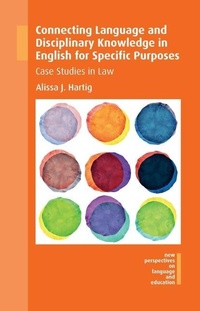
Connecting Language and Disciplinary Knowledge in English for Specific Purposes
Case Studies in Law
Published on 11. August 2017
Book
Hardback
208 pages
978-1-78309-850-7 (ISBN)
Description
How are language and disciplinary knowledge connected in the English for Legal Purposes (ELP) classroom, and how far should ELP practitioners go in supporting students' acquisition of the conceptual frameworks that shape the genres they are learning? This book presents a pedagogical model for incorporating these conceptual frameworks into disciplinary language instruction and follows four focal participants as they learn to read and write new genres in a second language and disciplinary culture. By examining not just students' written texts, but also their reading practices and interactions in class and in tutoring sessions, the book traces the ways in which disciplinary knowledge and language interact as students develop academic literacy in a new disciplinary community. Throughout the book, the discipline of law is used as a lens for examining broader connections between language, culture and disciplinary knowledge, and their relevance for English for Specific Purposes and writing in the disciplines.
Reviews / Votes
An innovative and significant addition to current thinking in English for Legal Communication, proposing a discursive pedagogic model integrating concepts, practice, and culture in legal settings. An excellent resource for ESP researchers and practitioners. * Vijay K. Bhatia, Chinese University of Hong Kong, Hong Kong * This innovative book examines the development of disciplinary discourse and knowledge in the field of law using concept-based instruction. Alissa Hartig presents a compelling, well-theorized multiple-case study of the academic and linguistic socialization of international graduate students into legal reading, writing, and reasoning in their new textual communities and cultures. * Patricia A. Duff, University of British Columbia, Canada * The novelty of this book lies in its interweaving of theoretical insight, analyticalperspective and practical implications, which can not only support the work of
scholars and practitioners, but also benefit students, especially those receiving
discipline-specific language instruction. -- Le Cheng and Jiamin Pei, Zhejiang University, China * International Journal of Speech Language and the Law, November 2018 * A major strength of the book is that it analyses the performance of individuals with different professional experience and linguistic proficiency, from countries with different cultures and legal systems. Hartig identifies factors that promote or impede their development in legal reading and writing, which will enlighten the legal education community about what aspects to focus on in instruction. -- Jianhong Wu, Zhejiang University of Finance and Economics, China * Discourse Studies 20 (5), 2018 * The book makes for fascinating reading as it represents an extreme in the intertwining of language and subject-matter knowledge. -- Anne-Marie Barrault-Methy, Universite de Bordeaux, France * ASp la revue du GERAS, 73 (2018) *
More details
Series
Language
English
Place of publication
Bristol
United Kingdom
Publishing group
Channel View Publications Ltd
Target group
College/higher education
Product notice
sewn/stitched
Cloth over boards
Dimensions
Height: 241 mm
Width: 162 mm
Thickness: 20 mm
Weight
459 gr
ISBN-13
978-1-78309-850-7 (9781783098507)
DOI
10.21832/HARTIG8507
Copyright in bibliographic data and cover images is held by Nielsen Book Services Limited or by the publishers or by their respective licensors: all rights reserved.
Schweitzer Classification
Other editions
Additional editions
Alissa J. Hartig
Connecting Language and Disciplinary Knowledge in English for Specific Purposes
Case Studies in Law
E-Book
08/2017
Multilingual Matters
€24.49
Available for download
Complete work / Part of the work
Viv Edwards | Phan Le Ha
New Perspectives on Language and Education (Vols 51-60)
Book
Multilingual Matters
€1,032.48
The article will not be published
Person
Alissa J. Hartig is Assistant Professor of Applied Linguistics at Portland State University, USA. Her research interests include English for Specific Purposes and second language writing.
Content
Acknowledgements
Transcription Conventions
1. Introduction
Part 1: Language, Literacy, and Disciplinary Knowledge
2. Second Language Legal Literacy
3. Linking Language and Concepts through Pedagogy
Part 2: Case Studies
4. Hong: Legal Concepts Mediating Language Use
5. Weixin: Understanding Precedent but Struggling with Language
6. Bader: Negotiating Genre to Express a Common Law Argument
7. Alima: Distinguishing Discourse Proficiency from 'Professional Vision'
Part 3: Addressing Connections between Language and Disciplinary Knowledge
8. Implications for Research and Teaching
Conclusion
Epilogue
References
Index
Transcription Conventions
1. Introduction
Part 1: Language, Literacy, and Disciplinary Knowledge
2. Second Language Legal Literacy
3. Linking Language and Concepts through Pedagogy
Part 2: Case Studies
4. Hong: Legal Concepts Mediating Language Use
5. Weixin: Understanding Precedent but Struggling with Language
6. Bader: Negotiating Genre to Express a Common Law Argument
7. Alima: Distinguishing Discourse Proficiency from 'Professional Vision'
Part 3: Addressing Connections between Language and Disciplinary Knowledge
8. Implications for Research and Teaching
Conclusion
Epilogue
References
Index