

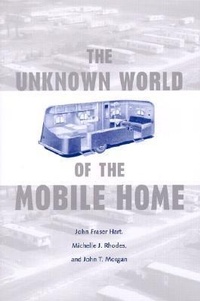
The Unknown World of the Mobile Home
Published on 15. October 2002
Book
Hardback
160 pages
978-0-8018-6899-3 (ISBN)
Description
In American popular imagination, the mobile home evokes images of cramped interiors, cheap materials, and occupants too poor or unsavory to live anywhere else. Since the 1940s and '50s, however, mobile home manufacturers have improved standards of construction and now present them as an affordable alternative to conventional site-built homes. Today one of every fourteen Americans lives in a mobile home. In The Unknown World of the Mobile Home authors John Fraser Hart, Michelle J. Rhodes, and John T. Morgan illuminate the history and culture of these often misunderstood domiciles. They describe early mobile homes, which were trailers designed to be pulled behind automobiles and which were more often than not poorly constructed and unequal to the needs of those who used them. During the 1970s, however, Congress enacted federal standards for the quality and safety of mobile homes, which led to innovation in design and the production of much more attractive and durable models. These models now comply with local building codes and many are designed to look like conventional houses.
As a result, one out every five new single-family housing units purchased in the United States is a mobile home, sited everywhere from the conventional trailer park to custom-designed "estates" aimed at young couples and retirees. Despite all these changes in manufacture and design, even the most immobile mobile homes are still sold, financed, regulated, and taxed as vehicles. With a wealth of detail and illustrations, The Unknown World of the Mobile Home provides readers with an in-depth look into this variation on the American dream.
As a result, one out every five new single-family housing units purchased in the United States is a mobile home, sited everywhere from the conventional trailer park to custom-designed "estates" aimed at young couples and retirees. Despite all these changes in manufacture and design, even the most immobile mobile homes are still sold, financed, regulated, and taxed as vehicles. With a wealth of detail and illustrations, The Unknown World of the Mobile Home provides readers with an in-depth look into this variation on the American dream.
Reviews / Votes
An insightful meditation on American notions of mobility and class. Doubletake This clear, to-the-point study directs attention to the proliferation of this type of housing and the social stigma attached to it and its occupants... This is a thought-provoking, readable examination of modern US life, far broader in scope than one might first imagine. Choice 2003 Provides the reader with a complex, nuanced, and sympathetic look at the world of the mobile home dweller. There are no trailer trash in this book, just decent, hard-working middle- and working-class men and women looking for affordable housing options. -- Jan Davidson Enterprise and SocietyMore details
Series
Language
English
Place of publication
Baltimore, MD
United States
Target group
College/higher education
Professional and scholarly
Product notice
sewn/stitched
Cloth over boards
With dust jacket
Illustrations
50 s/w Photographien bzw. Rasterbilder, 23 s/w Zeichnungen
23 Line drawings, black and white; 50 Halftones, black and white
Dimensions
Height: 233 mm
Width: 158 mm
Thickness: 16 mm
Weight
390 gr
ISBN-13
978-0-8018-6899-3 (9780801868993)
DOI
10.1353/book.20629
Copyright in bibliographic data and cover images is held by Nielsen Book Services Limited or by the publishers or by their respective licensors: all rights reserved.
Schweitzer Classification
Other editions
Additional editions
John Fraser Hart | Michelle J. Rhodes | John T. Morgan
The Unknown World of the Mobile Home
E-Book
06/2003
Johns Hopkins University Press
€37.49
Available for download
Persons
John Fraser Hart is a professor of geography at the University of Minnesota. He is author and editor of ten books, most recently The Rural Landscape, also available from Johns Hopkins. Michelle J. Rhodes is a Ph.D. candidate in the department of geography at Simon Fraser University and an instructor of political science and geography at the University of Montana-Western. John T. Morgan is a professor of geography at Emory and Henry College.
Content
Acknowledgments
Part I: Background
Prologue
Chapter 1. Trailers
Chapter 2. Trailer Parks
Chapter 3. The War Years
Chapter 4. Mobile Homes
Chapter 5. The HUD Code
Chapter 6. New Models
Chapter 7. Sitting Mobile Homes
Part II: Single-Siteds
Chapter 8. Where Are They?
Chapter 9. The Lexington Hexagon
Chapter 10. Northern New Mexico
Chapter 11. Mercer County, North Dakota
Chapter 12. Upstate New York
Chapter 13. Adams County, Wisconsin
Chapter 14. Spersopolis
Chapter 15. The Coal Field
Part III: Side by Side
Chapter 16. The Mountain West
Chapter 17. Filling in the Flathead
Chapter 18. A Snapshot of Evergreen
Chapter 19. Boom and Bust in Western Montana
Chapter 20. The Changing "Small"-Town West
Part IV: Parks
Chapter 21. Mobile Home Parks, Utilitarian to Upscale
Chapter 22. The Twin Cities Metropolitan Area
Chapter 23. Southwestern Kansas
Chapter 24. Long Neck
Chapter 25. Florida
Chapter 26. Southern California
Part V: Conclusion & Epilogue
Conclusion
Epilogue
Bibliography
Index
Part I: Background
Prologue
Chapter 1. Trailers
Chapter 2. Trailer Parks
Chapter 3. The War Years
Chapter 4. Mobile Homes
Chapter 5. The HUD Code
Chapter 6. New Models
Chapter 7. Sitting Mobile Homes
Part II: Single-Siteds
Chapter 8. Where Are They?
Chapter 9. The Lexington Hexagon
Chapter 10. Northern New Mexico
Chapter 11. Mercer County, North Dakota
Chapter 12. Upstate New York
Chapter 13. Adams County, Wisconsin
Chapter 14. Spersopolis
Chapter 15. The Coal Field
Part III: Side by Side
Chapter 16. The Mountain West
Chapter 17. Filling in the Flathead
Chapter 18. A Snapshot of Evergreen
Chapter 19. Boom and Bust in Western Montana
Chapter 20. The Changing "Small"-Town West
Part IV: Parks
Chapter 21. Mobile Home Parks, Utilitarian to Upscale
Chapter 22. The Twin Cities Metropolitan Area
Chapter 23. Southwestern Kansas
Chapter 24. Long Neck
Chapter 25. Florida
Chapter 26. Southern California
Part V: Conclusion & Epilogue
Conclusion
Epilogue
Bibliography
Index