

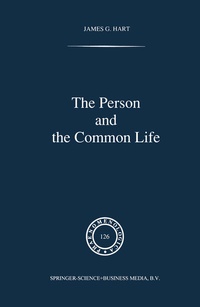
The Person and the Common Life
Studies in a Husserlian Social Ethics
Published on 31. October 1992
Book
Hardback
XIV, 488 pages
978-0-7923-1724-1 (ISBN)
Description
What follows attempts to synthesize Husserl's social ethics and to integrate the themes of this topic into his larger philosophical concerns. Chapter I proceeds with the hypothesis that Husser! believed that all of life could be examined and lived by the transcendental phenomenologist, and therefore action was not something which one did isolated from one's commitment to being philosophical within the noetic-noematic field. Therefore besides attempting to be clear about the meaning of the reduction it relates the reduction to ethical life. Chapter II shows that the agent, properly understood, i. e. , the person, is a moral theme, indeed, reflection on the person involves an ethical reduction which leads into the essentials of moral categoriality, the topic of Chapter IV. Chapter III mediates the transcendental ego, individual person, and the social matrix by showing how the common life comes about and what the constitutive processes and ingredients of this life are. It also shows how the foundations of this life are imbued with themes which adumbrate moral categoriality discussed in Chapter IV. The final Chapters, V and VI, articulate the communitarian ideal, "the godly person of a higher order," emergent in Chapters II, III and IV, in terms of social-political and theological specifications of what this "godly" life looks like.
More details
Series
Edition
1992 ed.
Language
English
Place of publication
Dordrecht
Netherlands
Target group
Professional and scholarly
Research
Illustrations
XIV, 488 p.
Dimensions
Height: 241 mm
Width: 160 mm
Thickness: 33 mm
Weight
922 gr
ISBN-13
978-0-7923-1724-1 (9780792317241)
DOI
10.1007/978-94-015-7991-9
Schweitzer Classification
Other editions
Additional editions
Book
12/2010
Springer
€213.99
Shipment within 15-20 days
Person
James G. Hart (b. 1936) did a Ph.D. at the University of Chicago after research in Munich on Hedwig Conrad Martius. He taught at Indiana University, Bloomington (USA) from 1971-2001 in the Department of Religious Studies. His writings have been primarily in the area of phenomenology; his teaching was primarily in the philosophy of religion and peace studies. Since retirement he has spent his energy on philosophy and on reform of the criminal justice system.
Content
The transcendental reduction and ethics; the adventure of being a person; the common life and the formation of "we"; the absolute ought and the godly person of a higher order; the political life of the godly person of a higher order; the common good of the common life of the godly person of a higher order.