

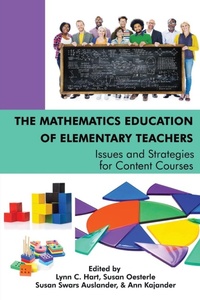
The Mathematics Education of Elementary Teachers
Issues and Strategies for Content Courses
Published on 29. July 2016
Book
Paperback/Softback
146 pages
978-1-68123-572-1 (ISBN)
Description
This book is an edited volume addressing specific issues of significance for individuals involved with the undergraduate mathematics content preparation of prospective elementary teachers (PSTs). Teaching mathematics content courses to this group of students presents unique challenges. While some PSTs enter their teacher preparation with weak mathematical skills and knowledge, many also hold negative attitudes, anxiety, and misguided beliefs about mathematics. This book is designed to support instructors who teach these students in mathematics content for elementary teachers courses.
Elementary teachers need a richly developed understanding of the mathematics they are teaching in order to teach it effectively. Providing them with the needed preparation is difficult, but can be eased with a solid understanding of the mathematical concerns and limitations PSTs bring to the learning of mathematics and a familiarity with the standards and curricula topics PSTs will be expected to teach. Chapter One makes the argument that elementary mathematics is not trivial. This is followed by an analysis of four central issues related to the mathematical preparation of elementary teachers, specifically: (1) selecting/creating/modifying and implementing mathematical tasks (2) noticing/understanding children's ways of thinking as a foundation for learning mathematics, (3) developing mathematical habits of mind in PSTs, and (4) understanding the role affect plays in the mathematical learning of PSTs. The final chapter presents three international examples of programs that currently consider these factors in the implementation of their courses.
Elementary teachers need a richly developed understanding of the mathematics they are teaching in order to teach it effectively. Providing them with the needed preparation is difficult, but can be eased with a solid understanding of the mathematical concerns and limitations PSTs bring to the learning of mathematics and a familiarity with the standards and curricula topics PSTs will be expected to teach. Chapter One makes the argument that elementary mathematics is not trivial. This is followed by an analysis of four central issues related to the mathematical preparation of elementary teachers, specifically: (1) selecting/creating/modifying and implementing mathematical tasks (2) noticing/understanding children's ways of thinking as a foundation for learning mathematics, (3) developing mathematical habits of mind in PSTs, and (4) understanding the role affect plays in the mathematical learning of PSTs. The final chapter presents three international examples of programs that currently consider these factors in the implementation of their courses.
More details
Language
English
Place of publication
Charlotte
United States
Publishing group
Emerald Publishing Inc
Target group
Professional and scholarly
Dimensions
Height: 234 mm
Width: 156 mm
Thickness: 8 mm
Weight
234 gr
ISBN-13
978-1-68123-572-1 (9781681235721)
Copyright in bibliographic data and cover images is held by Nielsen Book Services Limited or by the publishers or by their respective licensors: all rights reserved.
Schweitzer Classification
Other editions
Additional editions
E-Book
01/2016
1st Edition
Information Age Publishing
from
€62.33
Available for download
Persons
Lynn C. Hart, Georgia State University, USA.
Susan Oesterle, Douglas College, Canada.
Susan Swars Auslander, Georgia State University, USA.
Ann Kajander, Lakehead University, Canada.
Susan Oesterle, Douglas College, Canada.
Susan Swars Auslander, Georgia State University, USA.
Ann Kajander, Lakehead University, Canada.