

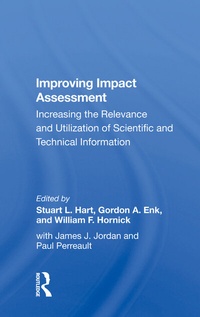
Improving Impact Assessment
Increasing The Relevance And Utilization Of Scientific And Technical Information
1st Edition
Published on 18. April 2019
Book
Hardback
456 pages
978-0-367-01995-2 (ISBN)
Description
As Environmental Impact Statements (EIS) become increasingly important in the policymaking process, it is vital that they be as complete and accurate as possible. The authors of this volume consider ways in which the development and evaluation of scientific and technical information for EIS can be improved. Addressing key legal, social, political,
More details
Language
English
Place of publication
London
United Kingdom
Publishing group
Taylor & Francis Ltd
Target group
College/higher education
Dimensions
Height: 229 mm
Width: 152 mm
Weight
1000 gr
ISBN-13
978-0-367-01995-2 (9780367019952)
Copyright in bibliographic data and cover images is held by Nielsen Book Services Limited or by the publishers or by their respective licensors: all rights reserved.
Schweitzer Classification
Other editions
Additional editions
Stuart L. Hart
Improving Impact Assessment
Increasing The Relevance And Utilization Of Scientific And Technical Information
Book
10/2020
1st Edition
Routledge
€51.98
Shipment within 15-20 days
Stuart L. Hart
Improving Impact Assessment
Increasing The Relevance And Utilization Of Scientific And Technical Information
E-Book
03/2019
1st Edition
Routledge
€59.49
Available for download
Stuart L. Hart
Improving Impact Assessment
Increasing The Relevance And Utilization Of Scientific And Technical Information
E-Book
03/2019
1st Edition
Routledge
€59.49
Available for download
Person
Stuart L. Hart is assistant research scientist and project director at the Institute for Social Research at the University of Michigan and consultant to the Research and Decision Center, Medusa, New York.
Gordon A. Enk is president of the Research and Decision Center, where William F. Hornick is an associate.
Gordon A. Enk is president of the Research and Decision Center, where William F. Hornick is an associate.
Content
Introduction: Problem Statement and Project Context -- Redefining the Scope of Environmental Assessment -- A Process-Oriented Approach to Human Concerns in Environmental Decision Making1 -- Assessing Human Concerns for Environmental Decision Making1 -- EIA Scoping for Aesthetics: Hindsight from the Greene County Nuclear Power Plant EIS1 -- Socioeconomic Impact Assessment and Nuclear Power Plant Licensing: Greene County, New York -- The Role of Human Values, Attitudes, and Beliefs in Environmental Assessment -- Applying Assessment Techniques -- Improving Predictive Performance and Usefulness of Biological Environmental Impact Assessment: Experimental Impact Studies and Adaptive Impact Assessment -- Preliminary Environmental Assessment Techniques for Soils1 -- Land-Capability Analysis As a Planning and Regulatory Tool -- The Application of Image-Based Information Systems for Environmental Assessment1 -- Toward a Participant Value Method for the Presentation of Environmental Impact Data1 -- Comparisons of Methods for Evaluating Multiattributed Alternatives in Environmental Assessments: Results of the BNL-NRC Siting Methods Project1 -- The Scoping Concept and Citizen Involvement: An Opportunity for Rejuvenating NEPA -- Keying Analysis to Decision Makers -- How to Write a Socially Useful EIS -- The EIS and the Decision Maker: Closing the Gap -- The Impact Judgment: A Technical Impasse? -- Organizational Environmental Management: The Los Alamos National Laboratory and Tennessee Valley Authority Experience -- Analysis and Case Study -- The Costs of Environmental Review: Assessment Methods and Trends -- The Fate of EIS Projects: A Retrospective Study -- Improving the EIS Process: A Case Study of Spruce Budworm Control -- The Interface Between Federal and State EIS Requirements: An Overview -- The Uses of Scoping: The Massachusetts Experience -- Changing the Environmental Review Procedure in Minnesota1 -- Recent Changes and Conclusions -- The 1979 CEQ NEPA Regulations -- Concluding Observations and Future Directions