

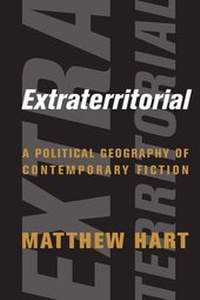
Extraterritorial
A Political Geography of Contemporary Fiction
Published on 25. August 2020
Book
Hardback
328 pages
978-0-231-18838-8 (ISBN)
Description
The future of fiction is neither global nor national. Instead, Matthew Hart argues, it is trending extraterritorial. Extraterritorial spaces fall outside of national borders but enhance state power. They cut across geography and history but do not point the way to a borderless new world. They range from the United Nations headquarters and international waters to CIA black sites and the departure zones at international airports. The political geography of the present, Hart shows, has come to resemble a patchwork of such spaces.
Hart reveals extraterritoriality's centrality to twenty-first-century art and fiction. He shows how extraterritorial fictions expose the way states construct "global" space in their own interests. Extraterritorial novels teach us not to mistake cracks or gradations in political geography for a crisis of the state. Hart demonstrates how the unstable character of many twenty-first-century aesthetic forms can be traced to the increasingly extraterritorial nature of contemporary political geography. Discussing writers such as Margaret Atwood, J. G. Ballard, Amitav Ghosh, Chang-rae Lee, Hilary Mantel, and China Mieville, as well as artists like Hito Steyerl and Mark Wallinger, Hart combines lively critical readings of contemporary novels with historical and theoretical discussions about sovereignty, globalization, cosmopolitanism, and postcolonialism. Extraterritorial presents a new theory of literature that explains what happens when dreams of an open, connected world confront the reality of mobile, elastic, and tenacious borders.
Hart reveals extraterritoriality's centrality to twenty-first-century art and fiction. He shows how extraterritorial fictions expose the way states construct "global" space in their own interests. Extraterritorial novels teach us not to mistake cracks or gradations in political geography for a crisis of the state. Hart demonstrates how the unstable character of many twenty-first-century aesthetic forms can be traced to the increasingly extraterritorial nature of contemporary political geography. Discussing writers such as Margaret Atwood, J. G. Ballard, Amitav Ghosh, Chang-rae Lee, Hilary Mantel, and China Mieville, as well as artists like Hito Steyerl and Mark Wallinger, Hart combines lively critical readings of contemporary novels with historical and theoretical discussions about sovereignty, globalization, cosmopolitanism, and postcolonialism. Extraterritorial presents a new theory of literature that explains what happens when dreams of an open, connected world confront the reality of mobile, elastic, and tenacious borders.
Reviews / Votes
Extraterritorial is a brilliantly original study of the global culture of our times and the extraterritorial space that it occupies, a space at the same time outside nations and states and within them. Hart offers a powerful argument for taking seriously how political geography is not just a topic for literature but also a force that shapes it from within. A provocative and convincing work both of theory and criticism. -- Adam Tooze, author of <i>Crashed: How a Decade of Financial Crises Changed the World</i> A fascinating book about why the idea of being extraterritorial has come to preoccupy writers and artists and a rejoinder to celebrations of the cosmopolitan intellect or the ostensible age of postnational globalization. Hart highlights the aesthetic appeal and confusion arising from extraterritoriality's mixture of loosening and constraint, of being outside but also within, in spaces where political determination is at once constant and violable. -- Sarah Brouillette, author of <i>UNESCO and the Fate of the Literary</i> Matthew Hart remarks that the concept of the extraterritorial has been 'a minor ghost' in the history of literary criticism. Not any more. This is an important study of the contemporary condition where people find themselves in weird enclaves of territory, strange folds of legality, or passing through those transitional pockets of airports, detention camps, freeports, or gated communities that increasingly define existence. Hart makes a compelling argument that this condition is tied to the shifting forms and genres of the contemporary novel. With exhilarating readings of J. G. Ballard, China Mieville, Hilary Mantel, Amitav Ghosh, and others, each chapter opens up hugely productive insights. An essential read. -- Roger Luckhurst, University of London Hart's timely book zeros in on fundamental tensions between sovereignty and territoriality that have only become more urgent in the current moment of crisis. Mining contemporary novels and works of art for insights into political geography, Hart expertly reveals the overlapping jurisdictions and mixed regimes of power that define our world of 'gated communities, mobile border regimes, and insular solidarities.' Extraterritorial offers a lively and engaging mix of theoretical speculation, historical thinking, and sophisticated cultural analysis. -- Michael Rothberg, author of <i>The Implicated Subject: Beyond Victims and Perpetrators</i> [B]rilliantly original . . . this book asks urgent questions about what it means to belong to a territory. * Times Higher Education * A very different ethical commitment emerges in Hart's Extraterritorial to the revolutionary attitude of modernism, not one of escape, but a movement inwards, into the cracks. This is not a hopeless outlook; in fact, Hart's prose is at times surprisingly joyful; his readings retain a kind of enchantment with the aesthetics of the zone. * ASAP/Journal * Recommended. * Choice * Hart reminds us, with a timeliness surely only intensified by a global pandemic, that the power of the state to draw borders, far from waning along with all the other signatures of high modernity, paradoxically intensifies under globalization. * NOVEL: A Forum on Fiction *More details
Language
English
Place of publication
New York
United States
Target group
Professional and scholarly
Product notice
Trade binding
Dimensions
Height: 229 mm
Width: 152 mm
ISBN-13
978-0-231-18838-8 (9780231188388)
Copyright in bibliographic data and cover images is held by Nielsen Book Services Limited or by the publishers or by their respective licensors: all rights reserved.
Schweitzer Classification
Other editions
Additional editions
E-Book
09/2020
1st Edition
Columbia University Press
€33.99
Available for download
Book
08/2020
Columbia University Press
€37.20
Shipment within 10-20 days
Person
Matthew Hart is associate professor of English and comparative literature at Columbia University. He is the author of Nations of Nothing but Poetry: Modernism, Transnationalism, and Synthetic Vernacular Poetry (2010).
Content
Acknowledgments
Introduction: Four Types of Extraterritoriality
1. Zone
2. City-State
3. String Theory
4. A Border That Is Not a Border
5. Settlement
Conclusion: The Extraterritorial Novel
Notes
Index
Introduction: Four Types of Extraterritoriality
1. Zone
2. City-State
3. String Theory
4. A Border That Is Not a Border
5. Settlement
Conclusion: The Extraterritorial Novel
Notes
Index