

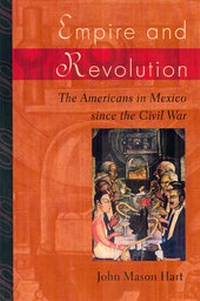
Empire and Revolution
The Americans in Mexico since the Civil War
1st Edition
Will be published approx. on 10. January 2006
Book
Paperback/Softback
690 pages
978-0-520-24671-3 (ISBN)
Description
The deep relationship between the United States and Mexico has had repercussions felt around the world. This sweeping and unprecedented chronicle of the economic and social connections between the two nations opens a new window onto history from the Civil War to today and brilliantly illuminates the course of events that made the United States a global empire. The Mexican Revolution, Manifest Destiny, World War II, and NAFTA are all part of the story, but John Mason Hart's narrative transcends these moments of economic and political drama, resonating with the themes of wealth and power. Combining economic and historical analysis with personal memoirs and vivid descriptions of key episodes and players, "Empire and Revolution" is based on substantial amounts of previously unexplored source material. Hart excavated recently declassified documents in the archives of the United States government and traveled extensively in rural Mexico to uncover the rich sources for this gripping story of 135 years of intervention, cooperation, and corruption.
Beginning just after the American Civil War, Hart traces the activities of an elite group of financiers and industrialists who, sensing opportunities for wealth to the south, began to develop Mexico's infrastructure. He charts their activities through the pivotal regime of Porfirio Diaz, when Americans began to gain ownership of Mexico's natural resources, and through the Mexican Revolution, when Americans lost many of their holdings in Mexico. Hart concentrates less on traditional political history in the twentieth century and more on the hidden interactions between Americans and Mexicans, especially the unfolding story of industrial production in Mexico for export to the United States. Throughout, this masterful narrative illuminates the development and expansion of the American railroad, oil, mining, and banking industries. Hart also shows how the export of the 'American Dream' has shaped such areas as religion and work attitudes in Mexico. "Empire and Revolution" reveals much about the American psyche, especially the compulsion of American elites toward wealth, global power, and contact with other people, often in order to 'save' them.
These characteristics were first expressed internationally in Mexico, and Hart shows that the Mexican experience was and continues to be a prototype for U.S. expansion around the world. His work demonstrates the often inconspicuous yet profoundly damaging impact of American investment in the underdeveloped countries of Latin America, Asia, and Africa. "Empire and Revolution" will be the definitive book on U.S.-Mexico relations and their local and global ramifications.
Beginning just after the American Civil War, Hart traces the activities of an elite group of financiers and industrialists who, sensing opportunities for wealth to the south, began to develop Mexico's infrastructure. He charts their activities through the pivotal regime of Porfirio Diaz, when Americans began to gain ownership of Mexico's natural resources, and through the Mexican Revolution, when Americans lost many of their holdings in Mexico. Hart concentrates less on traditional political history in the twentieth century and more on the hidden interactions between Americans and Mexicans, especially the unfolding story of industrial production in Mexico for export to the United States. Throughout, this masterful narrative illuminates the development and expansion of the American railroad, oil, mining, and banking industries. Hart also shows how the export of the 'American Dream' has shaped such areas as religion and work attitudes in Mexico. "Empire and Revolution" reveals much about the American psyche, especially the compulsion of American elites toward wealth, global power, and contact with other people, often in order to 'save' them.
These characteristics were first expressed internationally in Mexico, and Hart shows that the Mexican experience was and continues to be a prototype for U.S. expansion around the world. His work demonstrates the often inconspicuous yet profoundly damaging impact of American investment in the underdeveloped countries of Latin America, Asia, and Africa. "Empire and Revolution" will be the definitive book on U.S.-Mexico relations and their local and global ramifications.
Reviews / Votes
"[An] important new book. In a sweeping examination of United States economic relations with Mexico from the Civil War forward, Hart explains not only the way these two nations have interacted, but also how this experience has affected American policies with the rest of the world." - San Antonio Express-News "Hart integrates the cultural and demographic shifts that have reshaped life on both sides of a quickly disappearing border...an essential book for understanding not only the past but also the future of North America." - Times, El Paso"More details
Edition
First Edition
Language
English
Place of publication
Berkerley
United States
Product notice
Paperback (trade)
Illustrations
47 b-w photographs, 1 map
Dimensions
Height: 229 mm
Width: 152 mm
Thickness: 51 mm
Weight
1043 gr
ISBN-13
978-0-520-24671-3 (9780520246713)
Copyright in bibliographic data and cover images is held by Nielsen Book Services Limited or by the publishers or by their respective licensors: all rights reserved.
Schweitzer Classification
Other editions
Additional editions
E-Book
04/2002
1st Edition
Naval Institute Press
€33.49
Available for download
Person
John Mason Hart is Professor of History at the University of Houston. His previous books include Revolutionary Mexico: The Coming and Process of the Mexican Revolution, Tenth Anniversary edition (California 1998).
Content
Illustrations Acknowledgments Introduction. Imperial Ambition Part I. The Rise of American Influence, 1865-1876 1. Arms and Capital 2. Rival Concessionaires Part II. The DIaz Regime, 1876-1910 3. Ubiquitous Financiers 4. Building the Railroads 5. Silver, Copper, Gold, and Oil 6. Absentee Landlords 7. Resident American Elite 8. Boomers, Sooners, and Settlers Part III. The Years of Revolution, 1910-1940 9. Mexico for the Mexicans 10. Interventions and Firestorms 11. Crisis in the New Regime 12. Nationalization of Land and Industry Part IV. The Reencounter, 1940-2000 13. Cooperation and Accommodation 14. Return of the American Financiers 15. Mexico in the New World Order Conclusion. Imperial America Appendix 1. Appendix 2. Appendix 3. Notes on Archival Sources Abbreviations Notes Bibliography Index